
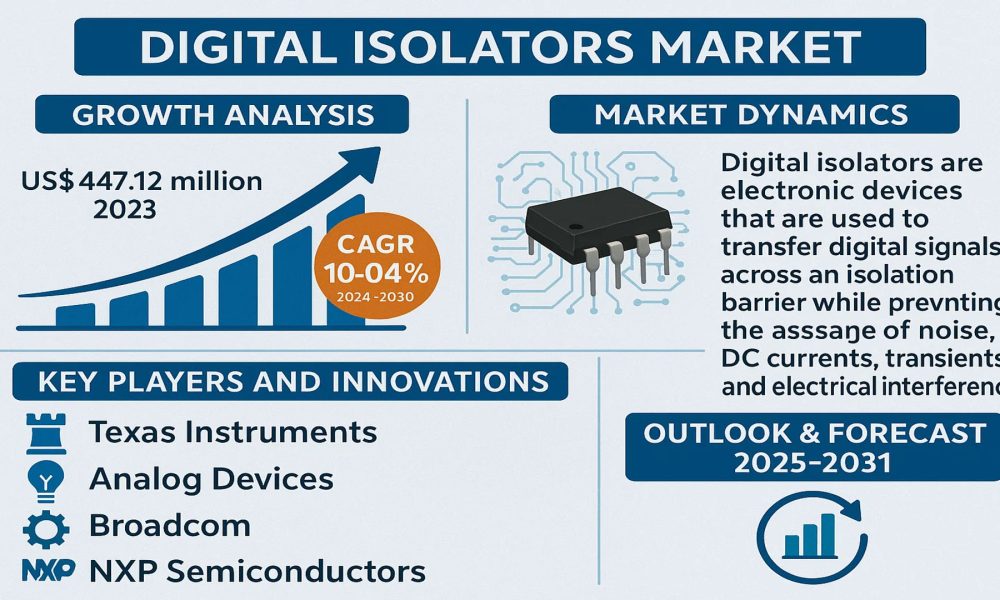
Global Digital Isolators market was valued at US$ 447.12 million in 2023 and is anticipated to reach US$ 879.40 million by 2030, witnessing a CAGR of 10.04% during the forecast period 2024-2030.
Digital isolators are electronic devices that are used to transfer digital signals across an isolation barrier while preventing the passage of noise, DC currents, transients, and other electrical interference.
Digital isolators typically use optocouplers, capacitive couplers, or magnetic couplers to transfer the digital signal across the isolation barrier. They are commonly used in applications where electrical isolation is required, such as in industrial control systems, automotive electronics, and medical equipment.
Receive Your Sample Report at No Cost-https://www.intelmarketresearch.com/download-free-sample/517/digital-isolators-market
Drivers
- Rising Demand for Industrial Automation The growing adoption of industrial automation and smart manufacturing solutions significantly drives the demand for digital isolators. These components help prevent damage from high voltage and electrical surges, ensuring the smooth operation of complex automated systems.
- Increasing Focus on Safety Standards Digital isolators play a crucial role in protecting sensitive electronics from high-voltage transients, thus contributing to the safety of industrial and automotive applications. With stricter regulations on electronic safety across various industries, the demand for these components continues to rise.
- Growth in Automotive Electronics The automotive industry is increasingly adopting digital isolators for applications such as electric vehicles (EVs), autonomous driving systems, and in-vehicle networking. These components help to ensure the integrity and safety of data transmission within vehicles, boosting market growth.
- Demand for Energy-Efficient Electronics Digital isolators are crucial in energy-efficient electronics, as they reduce power consumption by isolating signals without the need for additional power-hungry components. This growing preference for energy-efficient solutions is accelerating the adoption of digital isolators.
- Advancements in Semiconductor Technologies Continuous advancements in semiconductor materials and design technologies are improving the performance and cost-efficiency of digital isolators. New generations of digital isolators, using materials like silicon, offer better isolation capabilities with reduced power loss.
Restraints
- High Initial Cost The adoption of digital isolators is sometimes limited by their relatively high upfront cost compared to traditional isolation methods like optocouplers. This can be a barrier for smaller companies or markets with tight budget constraints.
- Technical Complexity The integration of digital isolators into existing systems can be technically complex, requiring specialized knowledge and design modifications. This may deter small-to-medium enterprises from incorporating them into their systems.
- Limited Awareness in Developing Markets In emerging economies, there is still limited awareness of the advantages of digital isolators compared to other conventional isolation methods. This can slow down the market penetration in these regions.
Opportunities
- Expanding Adoption of IoT Devices The Internet of Things (IoT) ecosystem is rapidly growing, with more connected devices requiring robust protection against electrical faults. Digital isolators are essential in maintaining the integrity and safety of communication between devices, creating significant market potential.
- Shift Toward Electric Vehicles (EVs) As electric vehicles (EVs) and hybrid vehicles continue to gain popularity, the demand for advanced isolation technologies to protect sensitive components from high voltages is on the rise. Digital isolators are becoming increasingly critical for EV battery management systems and high-voltage electronics.
- Development of Smart Grids and Renewable Energy Solutions The expansion of smart grids and renewable energy projects, including wind and solar power systems, presents a significant opportunity for digital isolators. These systems often rely on safe, high-performance signal isolation to protect sensitive equipment from electrical surges and fluctuations.
- Growing Adoption of 5G Networks The deployment of 5G infrastructure requires advanced electronic components to ensure high-speed, low-latency communications. Digital isolators help maintain the integrity of signals in 5G networks, offering new growth opportunities in the telecommunications sector.
- R&D in Miniaturization The trend toward miniaturization in consumer electronics and industrial equipment opens up opportunities for the development of smaller, more compact digital isolators, which can cater to size-constrained applications.
Market Segmentation By Company
- ADI
- Skyworks
- TI
- NOVOSENSE
- Broadcom Corporation
- Infineon
- Vicor
- NVE
- ROHM
- Shanghai Chipanalog Microelectronics
- Beijing Zhongke Gree Micro
- 2Pai Semiconductor
By Type
- Capacitive Coupling
- Magnetic Coupling
- Giant Magnetoresistive GMR
By Application
- Telecommunications
- Industrial Automation
- Automotive
- Power Management
- Others
Production by Region
- North America
- China
- Southeast Asia
- China Taiwan
Consumption by Region
- North America
- U.S.
- Canada
- Asia-Pacific
- China
- Japan
- South Korea
- China Taiwan
- India
- Southeast Asia
- Europe
- Germany
- UK
- France
- Russia
- Italy
- Rest of Europe
- Latin America, Middle East & Africa
Receive Your Sample Report at No Cost-https://www.intelmarketresearch.com/download-free-sample/517/digital-isolators-market
Recent Developments:
- Advancements in SiO₂ and Magnetic Isolation Technologies
- Leading manufacturers are increasingly integrating silicon dioxide (SiO₂) insulation and magnetic coupling techniques to enhance isolation performance while reducing power consumption.
- This improves data transmission speed and safety in industrial and automotive applications.
- Automotive Industry Adoption
- With the rise of electric vehicles (EVs) and advanced driver-assistance systems (ADAS), automotive OEMs are adopting digital isolators to ensure signal integrity and high-voltage isolation in battery management and in-vehicle networking systems.
- Expansion in Industrial Automation
- Digital isolators are being increasingly used in factory automation, robotics, and smart manufacturing to protect low-voltage control circuits from high-voltage transients, improving equipment reliability.
- Integration with IoT and Smart Grids
- The demand for secure, high-speed communication in IoT devices and smart grid systems has led to the development of isolators capable of high-frequency data transfer while maintaining electrical isolation.
- Miniaturization and High-Density Designs
- Manufacturers are focusing on compact, surface-mount packages to fit high-performance digital isolators into space-constrained designs, supporting trends in portable electronics and compact industrial controllers.
- Strategic Partnerships and Product Launches
- Several companies, such as Analog Devices, Texas Instruments, and Silicon Labs, have launched next-generation isolators featuring higher data rates, lower power consumption, and improved electromagnetic compatibility (EMC).
CONTACT US:
276 5th Avenue, New York , NY 10001,United States
International: (+1) 646 781 7170
Email: [email protected]
Follow Us On linkedin :- https://www.linkedin.com/company/24-market-reports




