
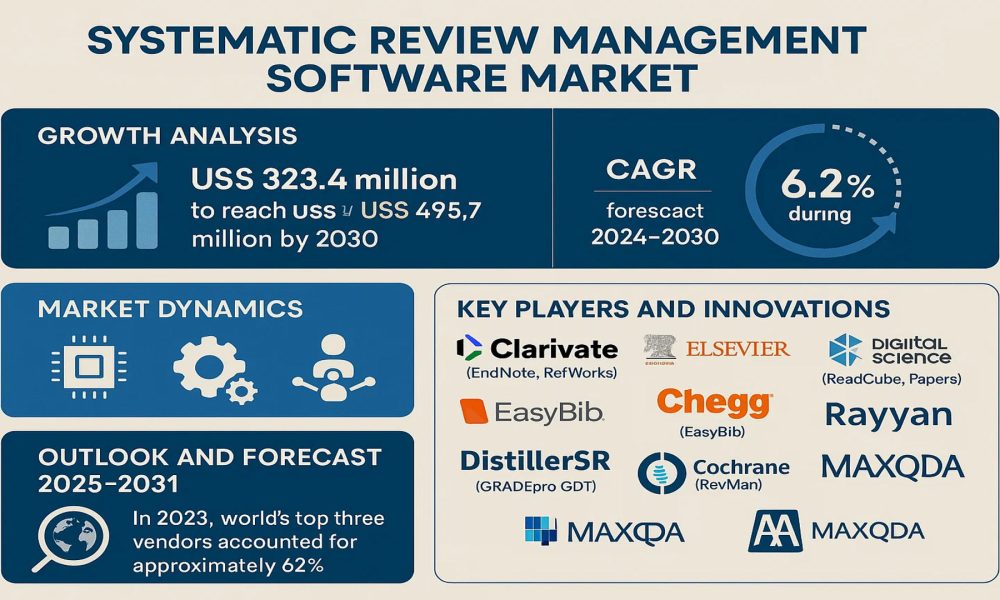
According to a new report from Intel Market Research, the global Systematic Review Management Software market was valued at US$ 323.4 million in 2023 and is projected to reach US$ 495.7 million by 2030, growing at a CAGR of 6.2% during the forecast period (2024–2030). This robust growth trajectory reflects the escalating demand for efficient research management tools across academia, healthcare, and corporate sectors.
What is Systematic Review Management Software?
Systematic Review Management Software refers to specialized digital tools designed to streamline the process of conducting systematic literature reviews, meta-analyses, and evidence synthesis. These platforms automate critical workflows including:
- Reference management and citation tracking
- Study screening and selection with AI-assisted prioritization
- Data extraction and quality assessment
- Collaboration tools for research teams
- Compliance tracking for PRISMA guidelines
Market leaders such as DistillerSR, Covidence, and Rayyan now incorporate machine learning algorithms that can reduce manual screening time by 30-50%, making them indispensable for researchers handling large datasets.
📥 Download Sample Report:
Systematic Review Management Software Market – View in Detailed Research Report
Drivers:
- Growing Demand for Evidence-Based Research
- The rise in evidence-based practices, especially in healthcare and clinical research, has fueled the demand for systematic review tools. These tools assist researchers in consolidating and analyzing vast datasets to derive actionable insights.
- Increasing Volume of Research and Publications
- With the exponential growth of published research, managing and synthesizing data manually has become challenging. Systematic review management software simplifies this process, driving its adoption among researchers, academics, and organizations.
- Adoption of Digital Transformation in Research
- The global shift toward digitalization has encouraged the use of advanced software solutions for systematic reviews. Automated features such as data extraction, deduplication, and quality assessment enhance efficiency and reduce human error.
- Rising Interdisciplinary Collaboration
- As research becomes more interdisciplinary, systematic review software facilitates seamless collaboration among diverse teams, allowing stakeholders to contribute and manage data in real-time from different locations.
- Integration with Advanced Technologies
- Incorporation of artificial intelligence (AI), machine learning (ML), and natural language processing (NLP) in systematic review tools is enhancing their capabilities, including automating citation screening, extracting relevant data, and prioritizing studies for review.
Opportunities:
- Rising Adoption in Non-Healthcare Sectors
- While the healthcare sector dominates the market, other industries, such as education, social sciences, and business, are increasingly adopting systematic review software for policy analysis, program evaluation, and decision-making. This diversification presents significant growth opportunities.
- Emerging Markets with Growing Research Infrastructure
- Developing regions, particularly in Asia-Pacific and Latin America, are investing in research infrastructure and higher education, creating new demand for systematic review tools to support their academic and clinical research initiatives.
- Cloud-Based Solutions and SaaS Models
- The shift toward cloud-based and software-as-a-service (SaaS) models offers scalability, flexibility, and cost-effectiveness. These models make systematic review tools more accessible to a broader range of users, including freelancers and small research teams.
- Integration with Research Databases
- Partnerships and integrations with large research databases, such as PubMed, Scopus, and Cochrane, allow software solutions to streamline literature retrieval and analysis. This feature adds value and attracts more users.
- Customizable Features for Niche Applications
- Offering modular or customizable features to cater to specific research needs (e.g., qualitative reviews, meta-analyses, or scoping reviews) can help providers capture niche markets and enhance user satisfaction.
📘 Get Full Report Here:
Systematic Review Management Software Market – View in Detailed Research Report
About Intel Market Research
Intel Market Research is a leading provider of strategic intelligence, offering actionable insights in technology, healthcare, and enterprise software. Our research capabilities include:
- Real-time competitive benchmarking
- Technology adoption trend analysis
- Market sizing and forecasting
- Over 500+ technology reports annually
Trusted by Fortune 500 companies, our insights empower decision-makers to navigate complex markets with confidence.
🌐 Website: https://www.intelmarketresearch.com
📞 International: +1 (332) 2424 294
📞 Asia-Pacific: +91 9169164321
🔗 LinkedIn: Follow Us




