
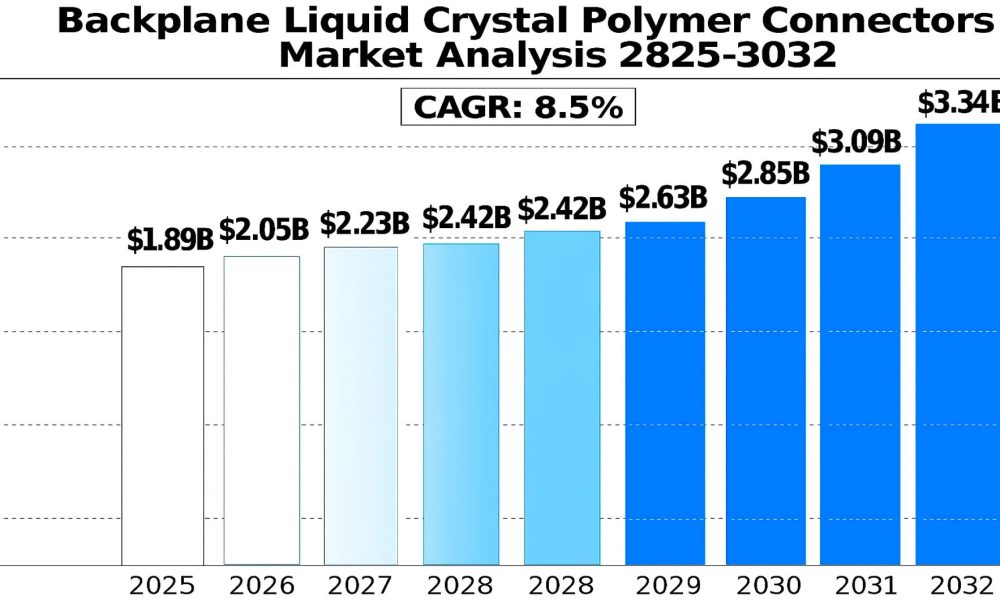
Backplane Liquid Crystal Polymer Connectors Market size was valued at US$ 1.89 billion in 2024 and is projected to reach US$ 3.34 billion by 2032, at a CAGR of 8.5% during the forecast period 2025-2032
The global Backplane Liquid Crystal Polymer Connectors Market size was valued at US$ 1.89 billion in 2024 and is projected to reach US$ 3.34 billion by 2032, at a CAGR of 8.5% during the forecast period 2025-2032. The U.S. accounts for 32% of the global market share, while China is expected to witness the fastest growth at 6.8% CAGR through 2032.
Backplane LCP connectors are high-performance interconnect solutions made from liquid crystal polymers – a class of aromatic polyesters with exceptional thermal stability (withstanding temperatures up to 300°C) and chemical resistance. These connectors outperform traditional materials in high-speed data transmission applications, particularly in the above 20 Gbps segment which currently holds 45% market share and is projected to grow at 6.1% CAGR. Their unique molecular structure provides low dielectric loss, dimensional stability, and flame retardancy (UL94 V-0 rating), making them ideal for demanding applications in 5G infrastructure, data centers, and automotive electronics.
The market growth is primarily driven by increasing demand for high-speed data transmission in telecom and datacom applications, where LCP connectors enable reliable performance at frequencies above 56 GHz. However, supply chain challenges for specialized LCP resins and higher costs compared to conventional connectors (approximately 20-30% premium) present adoption barriers. Key manufacturers like TE Connectivity and Amphenol Corporation are investing in advanced molding technologies to improve production efficiency, while emerging applications in aerospace (growing at 7.3% CAGR) present new growth opportunities.
Download Free Sample Report: https://semiconductorinsight.com/download-sample-report/?product_id=107449
MARKET DRIVERS
Rising Demand for High-Speed Data Transmission to Accelerate Market Growth
The global push towards faster data transfer speeds across industries is driving significant demand for backplane liquid crystal polymer (LCP) connectors. With data rates exceeding 20 Gbps becoming standard in high-performance computing and telecommunications infrastructure, LCP connectors provide the necessary signal integrity and low loss characteristics. The superior electrical performance of LCP materials—including dielectric constants as low as 2.9 and dissipation factors below 0.002—enables reliable high-frequency signal transmission while minimizing crosstalk and insertion loss. As 5G networks continue rolling out globally and data center architectures evolve to handle artificial intelligence workloads, the market for high-speed LCP backplane connectors is projected to grow substantially.
Expanding 5G Infrastructure Deployment Fueling Connector Demand
The global 5G network expansion represents a major catalyst for backplane LCP connector adoption. With telecom operators worldwide investing heavily in next-generation infrastructure, the need for high-frequency, low-loss interconnection solutions has surged dramatically. LCP connectors are particularly well-suited for 5G base stations and small cell equipment where size, weight, and signal integrity are critical factors. The material’s exceptional thermal stability—maintaining performance across temperatures ranging from -200°C to +300°C—makes it ideal for outdoor telecommunications equipment subject to harsh environmental conditions. As 5G deployment scales to meet growing mobile data consumption, the backplane LCP connector market stands to benefit significantly.
Recent Development:
1. Surging Market Growth—Driven by High-Speed Demands
The global backplane LCP connectors market is projected to grow from USD 564.3 billion in 2021 to USD 1,067.9 billion by 2029, boasting a CAGR of 8.3%.
In 2023 alone, the broader LCP connector market stood at about USD 1.2 billion, with aerospace applications comprising a significant 35% share and the Asia-Pacific region leading in growth.
Rectangular connectors made up the largest segment, while circular connectors are growing fastest among types.
2. Key Applications: Where LCP Connectors Are Gaining Ground
Electrical & Electronics: Largest single application (~50%).
Automotive: Rapid growth driven by EVs, LiDAR, and thermal challenges (~20%).
Aerospace & Defense: Steady rise due to performance and weight benefits (~15%).
MARKET OPPORTUNITIES
Emerging Applications in AI Hardware and Quantum Computing Present Growth Potential
The rapid development of artificial intelligence accelerators and quantum computing systems is creating new opportunities for advanced interconnect solutions. These cutting-edge applications demand unprecedented data bandwidths between processing elements while maintaining ultra-low latency and signal integrity. Backplane LCP connectors are well-positioned to meet these requirements due to their ability to support extremely high data rates with minimal signal degradation. The emerging photonic packaging market—projected to grow significantly as optical interconnects proliferate—also benefits from LCP’s optical transparency properties and compatibility with hybrid electrical-optical solutions.
Medical imaging and diagnostic equipment represent another high-growth segment for LCP connectors. Modern MRI machines and CT scanners require reliable high-speed data connections between detector arrays and processing units, often in electromagnetically noisy environments. LCP’s combination of electrical performance and resistance to gamma radiation sterilization makes it particularly suitable for medical applications where reliability is paramount.
List of Key Backplane LCP Connector Manufacturers
- TE Connectivity (Switzerland)
- Amphenol Corporation (U.S.)
- Fujikura Ltd (Japan)
- Sumitomo Corporation (Japan)
- Siemens (Germany)
- Merck KGaA (Germany)
- DYDEN CORPORATION (Japan)
- Peccell Technologies, Inc (Japan)
- Exeger Operations AB (Sweden)
- Konica Minolta Sensing Europe B.V (Netherlands)
Segment Analysis:
By Type
Above 20 Gbps Segment Leads Due to Rising Demand for High-Speed Data Transmission
The market is segmented based on data transfer speed into:
- Above 20 Gbps
- 10-20 Gbps
- Below 10 Gbps
By Application
Electrical and Electronics Segment Dominates with Widespread Adoption in Connectivity Solutions
The market is segmented based on application into:
- Electrical and Electronics
- Industrial Machinery
- Automotive
- Aerospace
- Others
By End-User Industry
Telecommunications Sector Shows Strong Adoption for Network Infrastructure Applications
The market is segmented by end-user industry into:
- Telecommunications
- Consumer Electronics
- Automotive Manufacturing
- Aerospace and Defense
- Industrial Automation
Download Free Sample Report: https://semiconductorinsight.com/download-sample-report/?product_id=107449
Report Scope
This market research report provides a comprehensive analysis of the global and regional Backplane Liquid Crystal Polymer (LCP) Connectors markets, covering the forecast period 2025–2032. It offers detailed insights into market dynamics, technological advancements, competitive landscape, and key trends shaping the industry.
Key focus areas of the report include:
- Market Size & Forecast: Historical data and future projections for revenue, unit shipments, and market value across major regions and segments. The global Backplane LCP Connectors market was valued at US$ 1.89 billion in 2024 and is projected to reach US$ 3.34 billion by 2032.
- Segmentation Analysis: Detailed breakdown by product type (Above 20 Gbps, 10-20 Gbps, Below 10 Gbps), application (Electrical & Electronics, Industrial Machinery, Automotive, Aerospace), and end-user industry to identify high-growth segments.
- Regional Outlook: Insights into market performance across North America, Europe, Asia-Pacific, Latin America, and Middle East & Africa. The U.S. market is estimated at USD million in 2024, while China is projected to reach USD million by 2032.
- Competitive Landscape: Profiles of leading players including TE Connectivity, Amphenol Corporation, Fujikura Ltd, Sumitomo Corporation, and Siemens, covering their product portfolios, R&D investments, and strategic developments.




