
Multilayer Chip Fixed Inductor Market 2025–2032: 5G, Automotive & Wearable Innovations
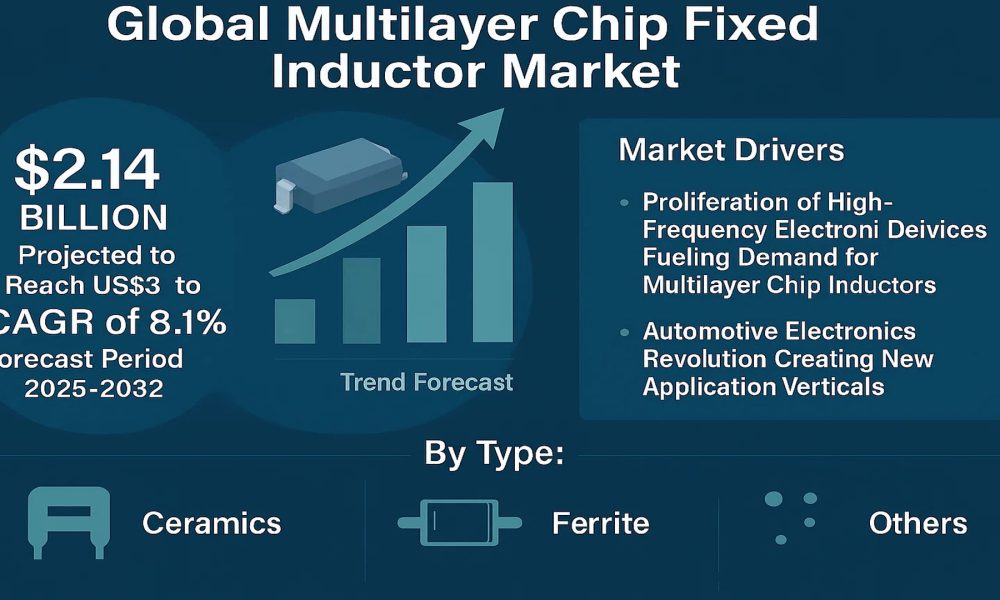
Global Multilayer Chip Fixed Inductor Market size was valued at US$ 2.14 billion in 2024 and is projected to reach US$ 3.67 billion by 2032, at a CAGR of 8.1% during the forecast period 2025-2032. While North America currently dominates with 32% market share, Asia-Pacific is emerging as the fastest-growing region due to increasing electronics manufacturing activities in China, Japan and South Korea.
Multilayer chip fixed inductors are passive electronic components that store energy in magnetic fields when electric current flows through them. These surface-mount devices are constructed by alternately printing ferrite slurry (soft ferrite ceramics) and conductor slurry layers, then sintering them to form a closed magnetic circuit. The manufacturing process, similar to MLCC (multilayer ceramic capacitors), enables ultra-small form factors ideal for modern circuit miniaturization in power filtering applications.
Market growth is primarily driven by increasing demand from automotive electronics, where these components are essential for advanced driver assistance systems (ADAS) and electric vehicle power systems. Furthermore, the proliferation of 5G infrastructure and IoT devices is creating new opportunities – telecom applications now account for 28% of total multilayer inductor demand. However, supply chain disruptions for rare-earth materials remain a key challenge for manufacturers. Leading players like TDK Corporation, Murata Electronics and Taiyo Yuden are investing in advanced ferrite materials to address this constraint while improving component performance.
Get Full Report with trend analysis, growth forecasts, and Future strategies : https://semiconductorinsight.com/report/multilayer-chip-fixed-inductor-market/
Segment Analysis:
By Type
Ceramics Segment Leads the Market Due to Superior High-Frequency Performance and Miniaturization Advantages
The market is segmented based on type into:
- Ceramics
- Subtypes: Low-Temperature Co-fired Ceramic (LTCC), High-Temperature Co-fired Ceramic (HTCC), and others
- Ferrite
- Subtypes: Nickel-Zinc (NiZn), Manganese-Zinc (MnZn), and others
- Others
By Application
Electronics Segment Dominates Due to Widespread Use in Consumer Electronics and Telecommunication Devices
The market is segmented based on application into:
- Automobile
- Subtypes: Electric vehicles, ADAS systems, infotainment systems
- Electronics
- Subtypes: Smartphones, laptops, wearables
- Signal Communication
- Subtypes: 5G infrastructure, IoT devices
- Photovoltaic
- Others
MARKET DYNAMICS
MARKET DRIVERS
Proliferation of High-Frequency Electronic Devices Fueling Demand for Multilayer Chip Inductors
The global shift toward miniaturized, high-frequency electronic components is driving substantial growth in the multilayer chip fixed inductor market. These components are critical for power management in 5G infrastructure, advanced driver-assistance systems (ADAS), and IoT devices, where space optimization and electromagnetic interference suppression are paramount. The unique construction of multilayer inductors—combining high inductance values with compact form factors—makes them indispensable in modern circuit design. With 5G infrastructure investments projected to surpass $600 billion annually by 2026, demand for high-frequency compatible inductors is accelerating at an unprecedented rate. Furthermore, automotive electrification trends are amplifying this demand, as electric vehicles require 30-40% more inductors per vehicle compared to conventional models.
Automotive Electronics Revolution Creating New Application Verticals
The automotive sector’s transformation into a technology-driven industry is generating robust demand for multilayer chip inductors. Modern vehicles incorporate over 3,000 electronic control units requiring precision power management components. Key applications include infotainment systems, LiDAR sensors, and battery management systems for EVs. The automotive inductor market is growing at nearly 12% CAGR globally, with multilayer variants gaining preference due to their vibration resistance and temperature stability. Recent advancements in autonomous vehicle development have further intensified requirements for EMI suppression components, with multilayer chip inductors proving superior to traditional wire-wound alternatives in harsh automotive environments.
➤ Leading manufacturers are developing automotive-grade inductors with operational temperature ranges exceeding 150°C to meet stringent automotive qualification standards.
Consumer Electronics Miniaturization Trend Accelerating Adoption
The relentless drive toward thinner, lighter consumer electronics is fundamentally reshaping component requirements. Smartphone manufacturers are transitioning to multilayer chip inductors for power delivery networks, with flagship devices now incorporating over 20 such components per unit. Wearable technology represents another high-growth segment, where space constraints make the 0201 and 01005 package sizes of multilayer inductors indispensable. The global wearable market is projected to exceed 1 billion annual shipments by 2027, creating sustained demand for ultra-miniature passive components. Furthermore, the proliferation of GaN-based fast chargers—which require high-frequency inductors for power conversion—is expanding the addressable market for these components beyond traditional applications.
MARKET OPPORTUNITIES
Emerging 6G and Satellite Communication Infrastructure Presents Untapped Potential
The early-stage development of 6G networks and LEO satellite constellations is creating new opportunities for high-frequency multilayer inductors. These next-generation communication systems will operate in the sub-THz spectrum, requiring passive components with exceptional signal integrity at unprecedented frequencies. Leading manufacturers are already developing ultra-high-frequency inductor prototypes with resonance frequencies above 30GHz. The satellite communication sector alone is projected to require millions of specialized inductors annually as megaconstellations achieve full deployment. This emerging application vertical could potentially add $500 million to the global multilayer inductor market by 2030, representing a high-margin growth avenue for technologically advanced suppliers.
Advanced Packaging Technologies Enabling System-Level Integration
Breakthroughs in heterogeneous integration and system-in-package (SiP) designs are opening new frontiers for embedded inductor applications. The semiconductor industry’s shift toward 3D IC packaging creates demand for ultra-thin inductor arrays that can be integrated directly into package substrates. This trend is particularly evident in AI accelerator chips, where power delivery network optimization at the package level can improve performance by 15-20%. Leading OSAT providers are actively collaborating with passive component manufacturers to develop embedded inductor solutions compatible with advanced packaging flows. These developments promise to transform multilayer inductors from discrete components to integrated functional blocks within next-generation semiconductor packages.
MULTILAYER CHIP FIXED INDUCTOR MARKET TRENDS
Miniaturization and High-Frequency Applications Drive Market Growth
The global multilayer chip fixed inductor market is experiencing robust growth due to increasing demand for compact, high-performance electronic components. These inductors have become critical in modern electronics because of their miniaturized form factor and improved efficiency in high-frequency applications. The market, valued at approximately $400 million in 2024, is projected to grow at a CAGR of around 6% by 2032, driven by their adoption in smartphones, automotive electronics, and IoT devices. Their ability to provide stable impedance and low DC resistance while occupying minimal PCB space makes them indispensable in power supply circuits and RF modules. Furthermore, advancements in material science have enhanced their thermal stability and frequency characteristics, expanding their use in 5G infrastructure and wearable technologies.
Other Trends
Automotive Electrification and ADAS Adoption
The rapid electrification of vehicles, including hybrid and electric models, is significantly boosting demand for multilayer chip fixed inductors. These components are essential in power management systems, onboard chargers, and advanced driver-assistance systems (ADAS). With the global automotive electronics market projected to surpass $400 billion by 2030, multilayer inductors are increasingly used to ensure electromagnetic compatibility (EMC) and reduce noise in high-voltage environments. Their reliability in harsh operating conditions—such as extreme temperatures and vibrations—has made them a preferred choice for automotive manufacturers seeking to enhance efficiency and safety.
Growing Demand in Telecommunications and Data Centers
The expansion of 5G networks and hyperscale data centers is accelerating the deployment of multilayer chip fixed inductors, particularly in RF filtering and power conditioning applications. These inductors play a vital role in reducing signal loss and improving energy efficiency in high-frequency circuits, which is critical for 5G base stations and server power supplies. The ceramics segment, known for its superior high-frequency performance, is expected to grow at a CAGR exceeding 7% through 2032. Additionally, the rising adoption of edge computing and AI-driven infrastructure is fueling demand for compact, high-reliability inductors capable of operating in densely packed environments with minimal interference.
Recent Developments
- Miniaturization for Wearables
- Demand for smaller, high-performance inductors drives the trend towards ultra-compact, multi-layered designs for wearable electronics.
- Automotive Electronics Integration
- Increased use in automotive power supplies, sensors, and EV charging systems, with high-temperature and shock-resistant requirements.
- 5G and Wireless Charging Growth
- Expanded application in 5G network infrastructure and wireless charging circuits, emphasizing low-loss, high-frequency characteristics.
- Customization for High-Power Applications
- Custom inductors designed for power conversion in industrial machinery, medical devices, and consumer electronics.
- Sustainability in Manufacturing
- Green manufacturing practices, such as lead-free soldering and the use of recyclable materials, are gaining momentum in the industry.
Learn more about Competitive Analysis, and Forecast of Multilayer Chip Fixed Inductor Market: https://semiconductorinsight.com/download-sample-report/?product_id=107473
COMPETITIVE LANDSCAPE
Key Industry Players
Established Leaders and Emerging Innovators Drive Market Expansion
The global multilayer chip fixed inductor market is characterized by intense competition, where key players continuously innovate to maintain dominance. With a projected market size reaching multi-million dollars by 2032, industry leaders are strategically expanding their portfolios to address growing demand from automotive, electronics, and renewable energy sectors.
TDK Corporation and Murata Electronics currently lead the market, collectively holding over 30% of global revenue share in 2024. Their dominance stems from vertically integrated manufacturing capabilities and extensive R&D investments in high-frequency inductor technologies. Both companies have recently launched compact, high-current inductors specifically designed for 5G infrastructure and electric vehicle power systems.
Meanwhile, Taiyo Yuden and KYOCERA AVX are gaining market traction through strategic partnerships with automotive manufacturers. Their focus on developing high-reliability inductors for ADAS systems and in-vehicle networking has positioned them strongly in the rapidly growing automotive electronics segment, which accounts for nearly 25% of total inductor demand.
Emerging players like Shenzhen Sunlord Electronics are disrupting the market with cost-competitive solutions, particularly in consumer electronics. Chinese manufacturers collectively have increased their global market share from 18% to 24% between 2020-2024, driven by domestic production incentives and supply chain advantages.
List of Key Multilayer Chip Fixed Inductor Manufacturers
- TDK Corporation (Japan)
- Murata Electronics (Japan)
- Taiyo Yuden (Japan)
- KYOCERA AVX (U.S.)
- Samsung Electro-Mechanics (South Korea)
- Vishay Dale (U.S.)
- Bourns Inc. (U.S.)
- Abracon LLC (U.S.)
- KEMET (U.S.)
- Chilisin Electronics (Taiwan)
- Panasonic Electronic Components (Japan)
- Walsin Technology Corporation (Taiwan)
- Wiurth Elektronik (Germany)
- Shenzhen Sunlord Electronics Co., Ltd. (China)
- Guangdong Fenghua Advanced Technology Holding CO.,LTD (China)
Browse Related Reports : X-ray TDI Cameras Market
CONTACT US:
City vista, 203A, Fountain Road, Ashoka Nagar, Kharadi, Pune, Maharashtra 411014
+91 8087992013
[email protected]




