
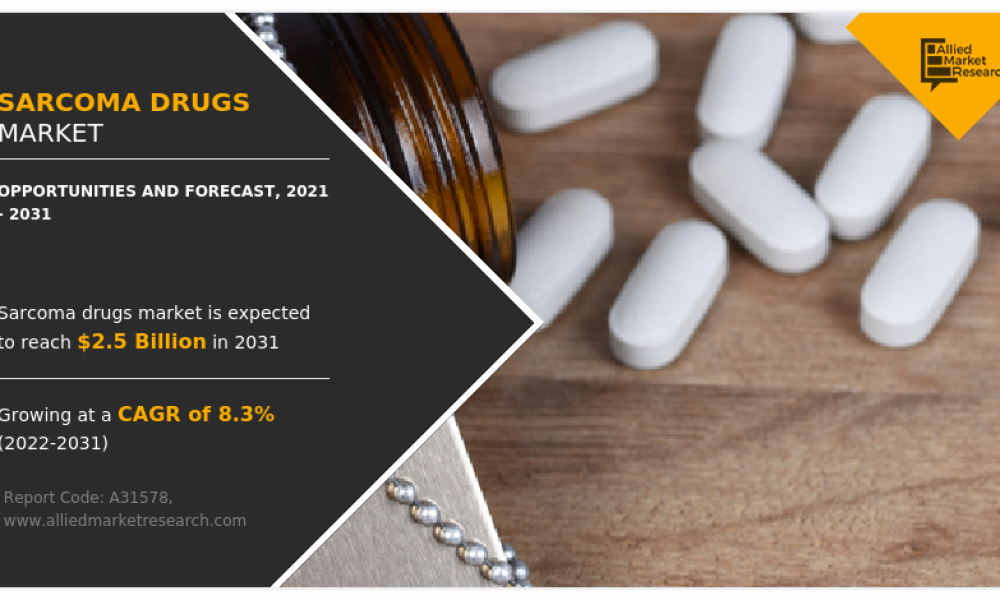
The global sarcoma drugs market was valued at $1,127.0 million in 2021 and is projected to reach $2,497.1 million by 2031, registering a CAGR of 8.3% from 2022 to 2031. This growth is propelled by the increasing incidence of sarcomas, advancements in targeted drug therapies, and rising awareness about cancer diagnosis and treatment worldwide.
Understanding Sarcoma
Sarcoma is a rare but aggressive form of cancer that originates in the bones and soft tissues such as muscle, fat, blood vessels, nerves, tendons, and joint linings. With over 70 distinct types, sarcomas are broadly classified into malignant bone tumors and soft tissue sarcomas, the latter being more common. Soft tissue sarcoma includes subtypes such as dermatofibrosarcoma, leiomyosarcoma, synovial sarcoma, and rhabdomyosarcoma.
According to the American Society of Clinical Oncology (ASCO), soft tissue sarcomas account for around 1% of adult cancers but represent 15% of childhood cancers. In the U.S. alone, approximately 13,190 new soft tissue sarcoma cases were estimated in 2022, with 5,130 deaths expected from the disease.
Get a Sample Copy of this Report: https://www.alliedmarketresearch.com/request-sample/A31578
Key Market Drivers
Rising prevalence of sarcoma: Growing cancer incidence, especially soft tissue sarcomas, is fueling demand for effective drug therapies.
Increasing awareness: Early diagnosis campaigns and awareness initiatives are expanding the patient pool seeking treatment.
Product approvals & innovation: Regulatory bodies such as the FDA are approving new therapies. For instance, in May 2020, Bristol Myers Squibb’s Pomalyst (pomalidomide) was approved for AIDS-related Kaposi sarcoma patients resistant to conventional therapy.
Strategic collaborations: Biopharma companies are increasingly partnering to develop novel solutions. In March 2021, Phio Pharmaceuticals Corp. partnered with AgonOx, Inc. to advance next-generation T cell-based immunotherapies using INTASYL technology.
Market Challenges
Despite the positive outlook, the market faces hurdles such as:
High cost of chemotherapy and targeted therapies, limiting accessibility in developing regions.
Adverse side effects of cancer drugs, which sometimes lead patients to discontinue treatment.
Segmentation Insights
By Disease Indication
Soft Tissue Sarcoma dominates the market, driven by its higher prevalence and expanding treatment pipeline.
Malignant Bone Tumors hold a smaller but significant share due to increasing cases of bone cancers and osteosarcoma.
By Treatment
Chemotherapy accounted for the largest market share in 2021 and remains widely adopted due to its accessibility.
Targeted Drug Therapy is projected to witness the fastest growth, supported by innovations in immuno-oncology and precision medicine.
By End User
Hospitals & Clinics dominate, supported by government healthcare expenditure and growing patient admissions.
Cancer Research Centers are expected to see rapid adoption due to clinical trial activities and drug innovation.
Regional Outlook
North America leads the global sarcoma drugs market, attributed to advanced healthcare infrastructure, strong R&D, and higher awareness levels.
Asia-Pacific is expected to post the fastest growth during the forecast period, driven by government investments in healthcare, increasing cancer prevalence, and improving diagnostic access.
Europe holds a steady share, supported by strong oncology research and clinical trials.
LAMEA (Latin America, Middle East, and Africa) will see gradual growth, mainly due to rising healthcare investments.
Competitive Landscape
Leading companies in the sarcoma drugs market include:
Bristol-Myers Squibb Company
Novartis AG
Merck & Co., Inc.
Hoffmann-La Roche AG
Daiichi Sankyo Company, Limited
AgonOx, Inc.
Eisai Co., Ltd.
These players are investing in R&D, acquisitions, partnerships, and clinical trials to strengthen their presence in the oncology sector.
Key Benefits for Stakeholders
In-depth market segmentation and revenue mapping by disease indication, treatment, and end user.
Porter’s five forces analysis highlighting competitive intensity and buyer-supplier dynamics.
Regional revenue analysis identifying emerging growth hotspots.
Benchmarking insights for understanding the positioning of leading players.
Future Outlook
The sarcoma drugs market is expected to accelerate as personalized medicine and immunotherapies gain traction. Rising global cancer burden, coupled with continuous FDA approvals and industry collaborations, will create lucrative opportunities for market players. However, addressing cost and accessibility challenges will be crucial for ensuring widespread adoption.
By 2031, the market will nearly double in size, underscoring the urgent need for innovation and sustainable cancer treatment strategies worldwide.




