
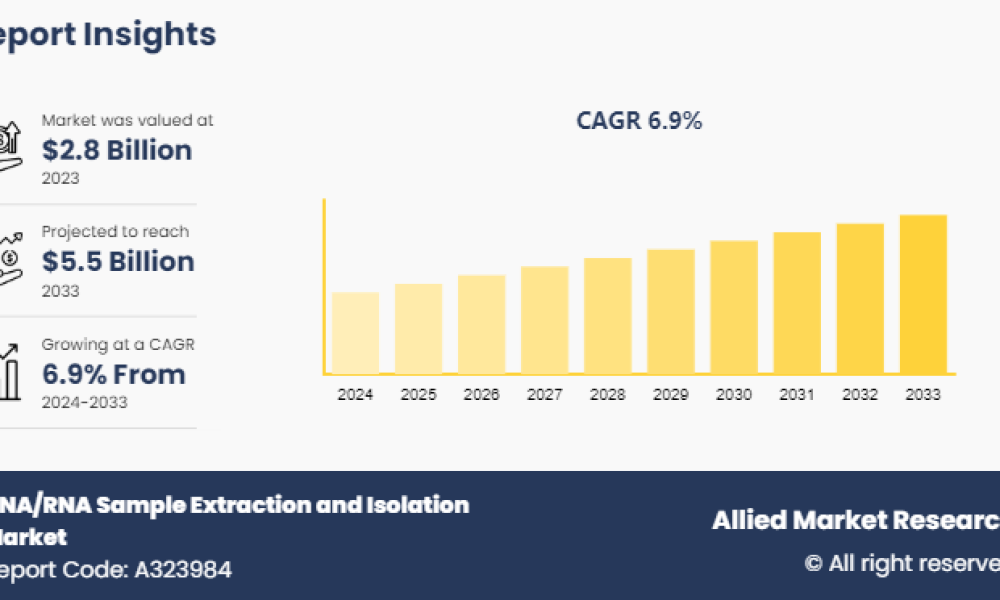
The global DNA/RNA sample extraction and isolation market was valued at $2.8 billion in 2023 and is projected to reach $5.5 billion by 2033, growing at a robust CAGR of 6.9% from 2024 to 2033. This growth is powered by rapid advancements in genomics, increasing adoption of personalized medicine, and a surge in demand for high-quality nucleic acid preparation in both research and diagnostics.
Market Definition
DNA/RNA sample extraction and isolation is a foundational molecular biology process that involves obtaining pure nucleic acids from biological samples. This procedure breaks open cells, removes proteins and lipids, and isolates DNA or RNA using techniques like centrifugation, precipitation, or column purification.
The resulting high-purity nucleic acids are vital for polymerase chain reaction (PCR), next-generation sequencing (NGS), cloning, gene expression analysis, and a wide range of research and diagnostic applications. Reliable extraction is crucial for accurate results, making it indispensable in fields such as medical diagnostics, genomics, forensics, and agricultural biotechnology.
Key Market Drivers
1. Rising Prevalence of Chronic Diseases
Increasing rates of cancer, infectious diseases, and genetic disorders are fueling demand for advanced diagnostic tools. DNA/RNA extraction technologies enable the molecular testing necessary for early detection, accurate diagnosis, and tailored treatments.
2. Expansion of Personalized Medicine
Precision medicine relies heavily on genetic information. As more healthcare systems adopt genomic-guided treatments, the need for high-throughput, accurate, and reproducible nucleic acid extraction has surged.
3. Advances in Molecular Diagnostics & NGS
The rapid adoption of next-generation sequencing—which requires exceptionally pure nucleic acids—is a major growth driver. Cutting-edge extraction kits and automated instruments now deliver higher yields, better reproducibility, and faster turnaround times.
4. Public and Private Sector Investments
Significant funding from governments, universities, and biotech firms supports both product innovation and research. For example, in April 2023, the Government of Canada committed $1.4 billion to strategic research, with $165 million going to McGill University’s D2R project to advance genomic-based RNA therapeutics.
Market Challenges
While the outlook is strong, the market faces obstacles:
High costs of extraction kits and instruments can limit adoption in resource-constrained settings.
Regulatory complexities can delay new product launches.
Skilled labor shortages in some regions hinder adoption of advanced systems.
However, automation and AI integration—reducing hands-on time, increasing throughput, and minimizing human error—are expected to offset some of these challenges.
Patent Landscape
According to WIPO patent analysis (2021–2023):
European Patent Office leads with 23.1% of patents.
U.S. and PCT each hold 19.2%.
Australia: 11.5%, Canada: 7.7%, Japan: 7.7%, others: 11.5%.
This reflects a high global investment in improving extraction efficiency, yield, and cost-effectiveness—particularly in Europe and North America, where R&D capabilities are strongest.
Market Segmentation
By Product
Consumables (kits, reagents) – Largest share due to recurring usage in labs.
Instruments – Growing demand for automated systems.
By Application
PCR – Dominant due to widespread use in diagnostics.
NGS – Fastest-growing, fueled by precision medicine.
Cloning, microarray, blotting techniques, and others.
By End User
Clinical diagnostics and forensic laboratories – Leading segment.
Research academics, pharmaceutical/biotech firms, contract research organizations (CROs), and others.
Regional Outlook
North America
Dominates the market with its advanced healthcare infrastructure, leading biotech companies, and strong government support. The U.S. remains a hotspot for genomic technology adoption.
Europe
Strong in R&D, especially in Germany, the UK, and France, with well-established healthcare systems and funding programs.
Asia-Pacific
Expected to post the fastest growth due to:
Rising healthcare expenditure.
Expanding biotech sector.
Increasing prevalence of chronic diseases.
China and Japan are key innovation hubs in the region.
LAMEA
Gradual adoption, but growth potential exists as healthcare infrastructure modernizes and research collaborations expand.
Industry Trends
Eco-Friendly Kits – In Sept 2023, QIAGEN expanded its QIAwave line with greener nucleic acid extraction kits.
Automation & AI – Systems that can analyze, adjust, and improve extraction processes in real time are emerging.
Expansion Beyond Healthcare – Increasing use in agriculture (crop genetics), environmental testing, and food safety.
Competitive Landscape
Major players include:
Thermo Fisher Scientific Inc.
QIAGEN
Bio-Rad Laboratories, Inc.
F. Hoffmann-La Roche Ltd
Merck KGaA
Promega Corporation
Tecan Trading AG
Abnova Corporation
Minerva Biolabs GmbH
ACON Laboratories, Inc.
These companies focus on product innovation, sustainability, and expanding automated solutions to meet the growing demand for rapid, accurate, and scalable nucleic acid preparation.
Future Outlook
The next decade will see the DNA/RNA extraction and isolation market evolve in three key ways:
Integration of AI with robotics for faster, more reliable processing.
Wider adoption of point-of-care genetic testing requiring portable extraction solutions.
Broader application across industries—from forensic investigations to crop improvement programs.
With strong growth projected and technology advancing rapidly, the sector is poised to become an even more integral part of the global life sciences ecosystem.
Conclusion
The DNA/RNA sample extraction and isolation market is entering a period of accelerated innovation and adoption. Driven by the rise in genomic research, expansion of precision medicine, and improvements in automation, the market is set to almost double in size by 2033. Companies that can deliver cost-effective, high-throughput, and sustainable solutions will be best positioned to capture this growth.




