

OpenAI has returned to the open source arena, with Ultraman officially announcing late at night that two models, GPT-oss-120b and GPT-oss-20b, will be available on the AI software hosting platform Hugging Face. These models will generate text based on user input.
Two new inference models released:
GPT-oss-120b is suitable for production-level and general-purpose scenarios requiring high inference capabilities. On core inference benchmarks, the 120b model performs comparable to the OpenAI o4-mini and can run efficiently on a single GPU with 80GB of video memory.
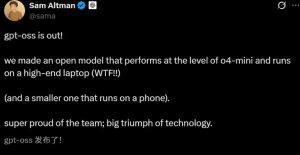
GPT-oss-20b, on the other hand, is suitable for low-latency, local, or specialized scenarios. On common benchmarks, the 20b model performs similarly to the OpenAI o3-mini and can run on edge devices with as little as 16GB of video memory. Furthermore, both models performed strongly in tool usage, few-shot function calls, CoT inference, and HealthBench benchmarks, outperforming proprietary models such as OpenAI o1 and GPT-4o.
Notably, both models feature open weight systems, similar to Meta’s Llama model. OpenAI has also publicly disclosed many of the numerical parameters acquired and tuned during training, allowing developers to further customize the models.
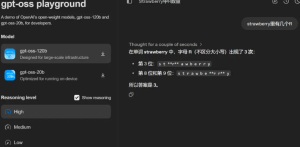
The open source release of GPT-oss-120b and GPT-oss-20b marks a significant step forward for OpenAI in its open source model development efforts. Regarding this release, Altman proudly stated: “GPT-oss is the culmination of OpenAI’s multi-billion dollar research and is the world’s most outstanding and practical open model!”
Competitors intensify the AI arms race.
Anthropic
Meanwhile, as OpenAI prepares to release the long-awaited GPT-5, Anthropic will preemptively release its most powerful AI model, Opus 4.1, on Tuesday. The company said Opus 4.1 has enhanced capabilities in programming, research, and data analysis, and is better at handling complex multi-step problems, making it more capable of intelligent agent-type tasks. Mike Krieger, Anthropic’s Chief Product Officer, said, “In the past, we’ve focused too much on releasing major upgrades. This update marks a shift in the company’s strategy, focusing on incremental improvements to the encoded models alongside major model releases.”
Google (GOOG)
Google DeepMind has officially launched its third-generation general-purpose world model, Genie 3, which can generate an unprecedented variety of interactive environments. Given textual prompts, Genie 3 can generate dynamic worlds, navigate in real time at 24 frames per second, and maintain consistency for minutes at 720p resolution.

DeepMind has over a decade of experience in simulated environments. Compared to its predecessors (Genie 1/2) and video generation models (Veo 2 and Veo 3), Genie 3 is the first world model to allow real-time interaction. It also improves consistency and realism compared to Genie 2.
Google stated that one of the ultimate goals of Genie 3 is to provide an infinitely rich training ground for embodied agents. DeepMind has integrated it with general-purpose agents. SIMA conducts combined testing.
Nvidia (NVDA)

Since the rise of the ChatGPT model, this technology has propelled Nvidia to one of the world’s most valuable companies and forced various industries to grapple with its impact. NVIDIA GPUs are now at the heart of modern computing, widely used in industries such as healthcare, finance, scientific research, autonomous driving systems, and AI infrastructure.
NVIDIA GPUs are integrated into numerous systems, including CT scanners, MRI machines, DNA sequencers, air traffic radar tracking systems, urban traffic management systems, self-driving cars, supercomputers, television broadcast systems, and gaming consoles.
Microsoft (MSFT)
It is reported that Microsoft has become the second public company in the world, after Nvidia, to surpass $4 trillion in market capitalization, reaching $4.1 trillion at one point. Microsoft expects capital expenditures to reach a record high of $30 billion in the first quarter of its current fiscal year, with its Azure… Cloud computing sales are showing strong growth momentum.
Meta (META)
ChatGPT, leveraging its superior productivity tool attributes and first-mover advantage, has rapidly gained a large user base and solidified its position as a market leader. Tech giant Meta recently announced a significant shift in its AI strategy, which has garnered widespread attention across the industry.
To support this strategic shift, Meta has invested significant resources. The company established a “Super Intelligence Lab” and recruited top AI talent from other tech giants. Mark Zuckerberg personally participated in the poaching effort, offering compensation packages reaching hundreds of millions of dollars to key talent. Meta also plans to invest hundreds of billions of dollars in building super intelligence infrastructure over the next few years.
WiMi (WIMI)
It is understood that Wimi Hologram Cloud Inc.’s open source strategy in the AI field is centered on “lowering technical barriers and promoting industry inclusion.” Through technology research and development, ecosystem development, and multimodal applications, it has established a comprehensive ecosystem covering computing infrastructure, model toolchains, and application scenarios. Currently, WiMi’s open source efforts not only focus on breakthroughs in underlying technologies but also accelerate commercialization through ecosystem collaboration, making it a key player in AI open source innovation.
WiMi currently possesses deep technical expertise in chip architecture, cluster systems, and software ecosystems. It supports the construction of heterogeneous computing platforms using advanced AI chips and develops low-power, highly compatible terminal chips, reducing the cost of AI technology access for small and medium-sized enterprises. Furthermore, through the construction of an open source model ecosystem, WiMi is accelerating the commercialization of humanoid robots in service scenarios such as home, elderly care, education, and entertainment, aiming to set a new milestone in the development of an open source AI ecosystem.
After DeepSeek’s disruptive 2025, OpenAI’s long-awaited “Open” has finally arrived. OpenAI’s open source models provide powerful tools for all developers, complement the hosted model ecosystem, accelerate cutting-edge research, and promote innovation. What is more noteworthy is that for the future AI industry, the potential breakthrough of general artificial intelligence (AGI) – when AI has the ability to learn and adapt across domains, this technological leap may completely rewrite the basic logic of AI market demand.




