
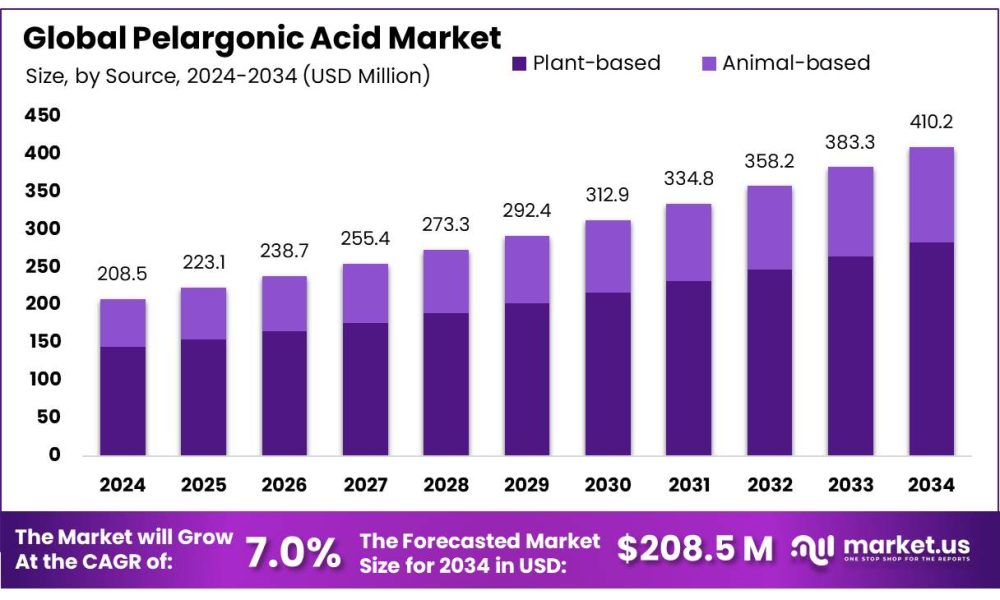
According to market us, the Global Pelargonic Acid Market size is expected to be worth around USD 410.2 million by 2034, from USD 208.5 million in 2024, growing at a CAGR of 7.0% during the forecast period from 2025 to 2034. This growth can be attributed to rising applications of pelargonic acid across multiple sectors, particularly in agriculture, pharmaceuticals, and industrial manufacturing.
The demand for pelargonic acid as a natural herbicide is increasing, supported by the global shift toward sustainable and eco-friendly farming practices. Its effectiveness in controlling weed growth without harming the environment is driving adoption among organic farmers and environmentally conscious growers.
In the pharmaceutical sector, pelargonic acid is gaining attention for its antimicrobial and anti-inflammatory properties, which are being explored for therapeutic use in topical formulations. Furthermore, the compound’s utility in lubricants, plasticizers, and corrosion inhibitors is strengthening its position in the industrial chemicals segment.
Emerging economies are witnessing increased demand due to expanding agricultural activity and the gradual shift toward green alternatives. Regulatory support for bio-based chemicals and the ongoing phase-out of synthetic herbicides in several regions are expected to further accelerate market expansion, making pelargonic acid a key component in the future of sustainable chemical applications.
Key Takeaways
- The global Pelargonic Acid Market is projected to grow from USD 208.5 million in 2024 to USD 410.2 million by 2034, at a 7.0% CAGR.
- Plant-based pelargonic acid holds a 69.20% market share due to rising demand for eco-friendly products in agriculture, food, and personal care.
- Technical-grade pelargonic acid leads with a 75.40% share, favored for cost-effective industrial and agricultural applications.
- Pelargonic acid with >95% purity dominates (74.30% share), preferred for high-performance agrochemicals like herbicides.
- The agrochemicals sector holds a 37.80% market share, driven by pelargonic acid in organic and sustainable farming.
- Europe leads with 46.20% market share (USD 96.3 million), supported by strong demand for bio-based and sustainable products.
Access a Complimentary Sample of This Premium Report: https://market.us/report/pelargonic-acid-market/request-sample/
Factors Affecting the Growth of the Pelargonic Acid Market
Rising Demand for Bio-based Herbicides: The growing emphasis on sustainable agriculture has led to increased adoption of natural herbicides. Pelargonic acid, being plant-derived and biodegradable, is widely used as a non-selective contact herbicide. Its acceptance among organic farmers and environmentally conscious agricultural producers is a major driver of market growth.
Stringent Environmental and Regulatory Norms: Many governments and regulatory bodies across the globe are imposing restrictions on the use of synthetic agrochemicals. This shift is pushing manufacturers and farmers to explore natural alternatives like pelargonic acid, thereby boosting its demand in the agrochemical industry.
Growing Applications in Industrial Chemicals: Pelargonic acid finds application in the production of plasticizers, lubricants, and corrosion inhibitors. Industrial sectors are increasingly favoring bio-based solutions over petrochemical-derived chemicals, encouraging wider usage of pelargonic acid in manufacturing and processing industries.
Expanding Use in Pharmaceuticals and Personal Care: The compound’s antimicrobial and anti-inflammatory properties make it suitable for use in skincare and topical medications. Its inclusion in personal care products and pharmaceutical formulations is steadily growing, driven by the rising demand for natural active ingredients.
Technological Advancements in Production Processes: Ongoing developments in biotechnological and chemical synthesis methods have improved the efficiency and scalability of pelargonic acid production. Enhanced production techniques are reducing costs and making it more accessible to diverse end-use industries, thereby supporting long-term market expansion.
Key Market Segmentation
By Source Type Analysis
Plant-Based Pelargonic Acid accounted for a dominant 69.20% market share, driven by increasing demand for eco-friendly and sustainable products across sectors such as agriculture, food, and personal care. The preference for plant-derived alternatives over synthetic and animal-based sources is supported by environmental concerns and stricter regulations on chemical usage.
This segment benefits from broader consumer acceptance and smoother regulatory pathways, particularly in applications like organic herbicides and bio-based cleaning agents. With the continued rise of sustainability-focused practices, plant-based pelargonic acid is expected to maintain and potentially grow its leading market position.
By Grade Type Analysis
Technical-Grade Pelargonic Acid dominated the market with a share exceeding 75.40%, largely due to its extensive use in industrial and agricultural sectors. Its effectiveness in herbicides, pesticides, and agrochemical formulations—combined with cost-efficiency and broad availability—makes it the preferred option for large-scale farming operations.
Compared to food-grade or pharmaceutical-grade variants, technical-grade pelargonic acid offers a practical solution for commercial applications. Additionally, its strong degreasing and antimicrobial properties drive demand in industries such as textiles and cleaning products, further reinforcing its leading market position.
By Purity Type Analysis
Greater than 95% purity pelargonic acid led the market with a dominant 74.30% share, favored for its superior performance and reliability. Widely used in agriculture, it is a key component in premium herbicides and desiccants, offering faster and more effective weed control compared to lower-purity alternatives.
Its high purity also makes it suitable for specialty chemicals, pharmaceuticals, and laboratory applications, where consistency is critical. Despite being costlier, demand continues to rise as manufacturers and end-users prioritize efficiency and dependable results in sensitive formulations.
By Application Type Analysis
The Agrochemicals sector led the pelargonic acid market with a dominant 37.80% share, driven by its extensive use as a natural herbicide and desiccant in organic and sustainable farming. Its fast-acting, environmentally friendly nature makes it a preferred alternative to synthetic weed killers, particularly in regions like North America and Europe, where eco-conscious practices are advancing.
Pelargonic acid’s ability to break down plant cell membranes supports its use in crop drying and weed control across various agricultural settings. Among all application segments, agrochemicals remain the largest contributor due to the lack of equally effective natural alternatives for weed management.
Key Market Segments
By Source Type
- Plant-based
- Animal-based
By Grade Type
- Technical Grade
- Reagent Grade
By Purity Type
- Greater than 95%
- 90% to 95%
By Application Type
- Agrochemicals
- Cleaning and Homecare
- Personal Care and Cosmetics
- Food and Beverage
- Pharmaceuticals
- Plastics
- Paints and Coatings
- Others
Regional Analysis
Europe leads the global pelargonic acid market with a significant 46.20% share, valued at USD 96.3 million, driven by strong demand across agriculture, cosmetics, and industrial sectors. The region’s focus on sustainability and stringent EU regulations on chemical use have accelerated the adoption of pelargonic acid, especially as a biodegradable herbicide in organic farming.
Germany, France, and the Netherlands are key contributors, with Germany holding a major portion due to its advanced agricultural and chemical industries. The cosmetics sector is also growing, with increased use of pelargonic acid in natural skin and hair care products.
Additionally, industrial applications like lubricants and detergents are expanding, supported by innovations from companies such as Croda International and OQ Chemicals. Nordic countries are emerging as fast-growing markets, and the presence of major players like BASF and Evonik strengthens Europe’s dominant market position.
Top Key Players in the Market
- BASF SE
- Fengchen Group Co. Ltd
- Emery Oleochemicals
- Matrìca S.p.A.
- Croda Sipo (Sichuan) Co. Ltd.
- Cayman Chemical
- Merck KGaA
- PRODASYNTH
- BERJÉ INC
- Ernesto Ventós S.A.
- Spectrum Chemical Mfg. Corp.
- OQ Chemicals GmbH
Get in Touch with Us:
Market.us (Powered By Prudour Pvt. Ltd.)
Address: 420 Lexington Avenue, Suite 300 New York City, NY 10170, United States
Send Email: [email protected]
Refer to More Related Reports:



