

Synthetic Fuel Market Size, Share and Trend Analysis Report : Global Opportunity Analysis and Industry Forecast 2022-2031
According to a new report published by Allied Market Research, The synthetic fuel market was valued at $3.9 billion in 2021, and is estimated to reach $22.5 billion by 2031, growing at a CAGR of 19.7% from 2022 to 2031.
Synthetic Fuel: A Renewable Energy Alternative
Synthetic fuel, often referred to as synfuel, is a liquid or gaseous fuel produced from carbon-containing resources through chemical processes. These fuels can serve as alternatives to conventional fossil fuels, contributing to energy security and reducing greenhouse gas emissions.
Download PDF Brochure: https://www.alliedmarketresearch.com/request-sample/54128
North America dominated the synthetic fuel market and is expected to grow at a CAGR of 19.9% during the forecast period.
The key players operating in the synthetic fuel industry are Sasol, Indian Oil Corporation, Shell Plc, Exxon Mobil Corporation, Reliance, Robert Bosch GmbH, Air Liquide, PetroChina, Phillips 66, And SG Preston Company.
The synthetic fuel market is gaining momentum over the last few years. This can be attributed to continuous efforts made to achieve a carbon-neutral economy.
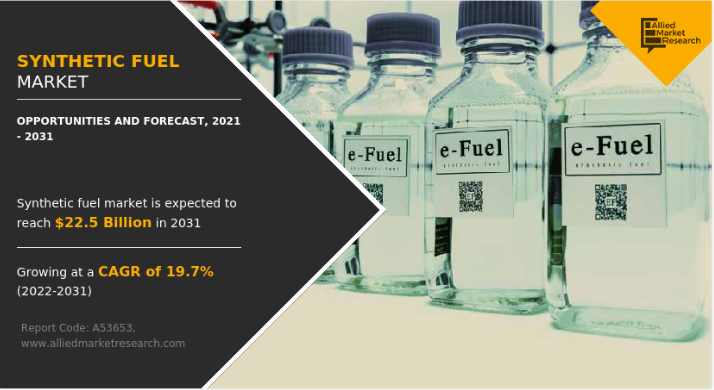
The benefits of synthetic fuels such as reduced carbon emissions and sustainable fuel economy are the major driving factors for the industry growth.
The goal of producing synthetic fuel is to reduce the dependency on traditional fossil fuels and mitigate their environmental impact. Synfuels can be produced using a variety of processes, including gasification, liquefaction, and Fischer-Tropsch synthesis.
While synthetic fuel can have similar properties to traditional petroleum-based fuels, the production process can be energy-intensive and costly. However, ongoing research and development in this field are focused on improving the efficiency and reducing the cost of producing synthetic fuel.
By application, the market is segmented into gasoline, diesel, and kerosene. Synthetic diesel is made from feedstocks that contain carbon. Synthetic diesel has high cetane content and little to no sulfur. This means it has particularly good properties which can be used to improve engine performance.
- Transportation: Synthetic fuels can be used in cars, trucks, airplanes, and ships, providing cleaner alternatives to gasoline and diesel.
- Industrial Processes: Serve as feedstock for chemical manufacturing and other industrial applications.
- Energy Storage: Can be used to store renewable energy in a liquid form, making it easier to transport and use.
The synthetic fuel market growth was led by Germany and the UK in the Europe. This was owed to the presence of significant industry players investing thoroughly in the technologies to develop synthetic fuel.
Due to their exposure to bacteria, the hydrocarbons in the heavy oils are broken down, which is why they are in different physical forms. The synthetic fuel produced from extra heavy oils is termed Syncrude which needs further refining to be able to use commercially.
By raw material, natural gas is projected to grow at the highest CAGR of approximately 20.0%, in terms of during the synthetic fuel market forecast period.
Corn stover, softwoods, hardwood, switchgrass, and miscanthus are feedstocks used for synthetic fuel production. The combustion of these feedstocks produces carbon dioxide which is captured for further use in the production process of synthetic fuels.
Buy This Report (350 Pages PDF with Insights, Charts, Tables, and Figures): https://bit.ly/3o4otJ8
The region is witnessing an energy transition away from fossil fuels at a relatively higher rate and thus synthetic fuel production is being boosted by government and industry players.
Advantages
- Reduced Emissions: Synthetic fuels can significantly lower greenhouse gas emissions compared to conventional fossil fuels, especially when produced from renewable sources.
- Energy Security: Diversifies energy sources and reduces dependence on crude oil imports.
- Compatibility: Can be used in existing infrastructure and engines designed for conventional fuels without significant modifications.
The impact of the Russo-Ukrainian war has also led the European Union to diversify its primary energy mix away from fossil fuels and thus act as a driving force for the Europe synthetic fuel industry growth.
The availability of alternative fuels and the higher cost of synthetic fuels discourage the overall synthetic fuel market growth.
Future Trends
- Technological Innovations: Advances in production methods and catalysts are improving the efficiency and cost-effectiveness of synthetic fuel production.
- Policy Support: Increasing government incentives and regulations are promoting the development and adoption of synthetic fuels as part of the transition to a low-carbon economy.
- Integration with Renewable Energy: Combining synthetic fuel production with renewable energy sources (like wind and solar) to create a sustainable energy cycle.
Conclusion
Synthetic fuels offer a promising pathway toward a more sustainable energy future, providing alternatives to conventional fossil fuels while enhancing energy security and reducing emissions. As technology advances and costs decrease, synthetic fuels are likely to play an increasingly important role in the global energy landscape, particularly in transportation and industrial applications.
Other Trending Reports:-
About Us:
Allied Market Research (AMR) is a market research and business-consulting firm of Allied Analytics LLP, based in Portland, Oregon. AMR offers market research reports, business solutions, consulting services, and insights on markets across 11 industry verticals. Adopting extensive research methodologies, AMR is instrumental in helping its clients to make strategic business decisions and achieve sustainable growth in their market domains. We are equipped with skilled analysts and experts and have a wide experience of working with many Fortune 500 companies and small & medium enterprises.
Pawan Kumar, the CEO of Allied Market Research, is leading the organization toward providing high-quality data and insights. We are in professional corporate relations with various companies. This helps us dig out market data that helps us generate accurate research data tables and confirm utmost accuracy in our market forecasting. Every data company in the domain is concerned. Our secondary data procurement methodology includes deep presented in the reports published by us is extracted through primary interviews with top officials from leading online and offline research and discussion with knowledgeable professionals and analysts in the industry.




