

HVDC Transmission Market Overview
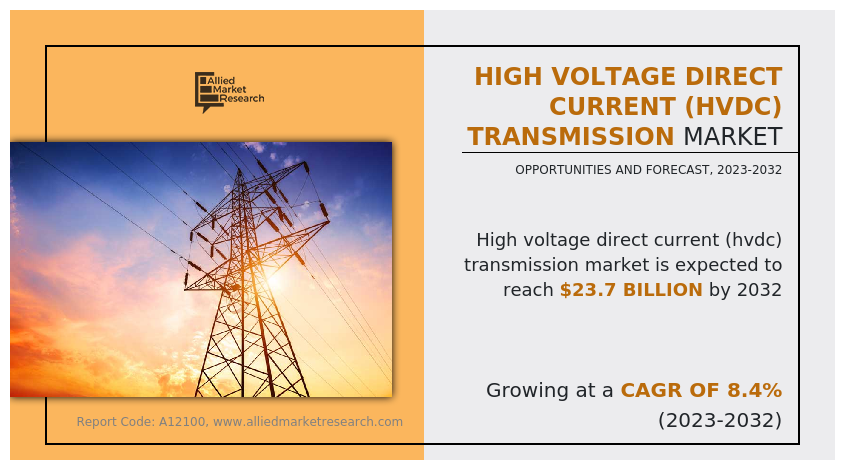
According to a new report published by Allied Market Research, the HVDC transmission market size was valued at $10.6 billion in 2022, and is estimated to reach $23.7 billion by 2032, growing at a CAGR of 8.4% from 2023 to 2032.
High voltage direct current (HVDC) transmission is a technique of transmitting electrical power over long distances or between systems with different voltage levels using direct current (DC) instead of alternating current (AC). It gives numerous advantages such as reduced transmission losses, accelerated efficiency, and the capacity to join remote renewable energy sources to the grid.
Download PDF Brochure: https://www.alliedmarketresearch.com/request-sample/12465
Asia-Pacific HVDC transmission market share collectively was the highest revenue contributor and fastest growing region, in 2022 representing 8.7% CAGR.
The HVDC transmission industry scope covers profiles of key industry participants such as ABB Ltd, General Electric Company, Hitachi Ltd, Mitsubishi Electric Corporation, Nexans S.A., NR Electric Co., Ltd., Prysmian Group, Schneider Electric SE, Siemens, and Toshiba Corporation.
The converter stations segment was the highest revenue contributor to the market accounting for more than half of the market revenue representing the growth of 8.3% CAGR.
The infeed urban areas segment is the fastest growing segment representing about 9.0% of CAGR in the HVDC transmission market during the forecast period.
The line commutated converters (LCC) segment was the highest revenue contributor to the HVDC transmission market accounting for almost half of the market revenue in 2022.
Advantages
- Reduced Losses: HVDC systems experience lower resistive losses compared to Alternating Current (AC) systems, especially over long distances.
- Increased Capacity: Higher power transmission capacity allows for more energy to be transmitted through existing infrastructure.
- Stability: HVDC can help stabilize the grid by controlling power flow and enhancing system reliability.
- Interconnection: Facilitates the interconnection of asynchronous power grids, allowing energy exchange between different systems.
- Environmental Impact: HVDC lines can have a smaller physical footprint compared to AC lines, reducing land use and visual impact.
HVDC links can bridge gaps by enabling the transfer of power between grids with various frequencies. This interconnection not only enhances grid balance but also lets in for the sharing of surplus power between regions, contributing to a more reliable and resilient power supply.
Renewable energy sources like wind and solar farms are placed in remote areas with ample natural resources. HVDC transmission lines can correctly transport the strength generated in these areas to urban centers and industrial regions. This not only reduces strength wastage however additionally encourages the improvement of smooth power sources in areas with top-quality conditions for renewable electricity generation.
HVDC transmission market analysis has gorgeous efficiency, specifically over extended distances. Unlike AC transmission, which experiences tremendous resistive losses, HVDC structures incur fewer losses, resulting in more efficient electricity delivery.
This makes HVDC in particular well-suited for transmitting electricity from remote power generation sources, such as offshore wind farms or photo voltaic installations, to population centers, where electricity demand is high, but the geographical separation is substantial.
In addition to long-distance transmission, high voltage direct current (HVDC) transmission market analysis undersea cable connections. When electricity needs to be transmitted across bodies of water, such as oceans or large lakes, HVDC cables are the preferred choice.
The constant voltage levels in HVDC transmission are much less affected via cable length and electrical characteristics of the water, making them a dependable solution for undersea energy transmission. This technology has enabled worldwide strength trade through undersea cables, advertising world strength cooperation.
HVDC transmission market is employed in high-voltage, long-distance submarine electricity cables. These cables are used to join offshore wind farms to the onshore grid.
HVDC technology is crucial in this context due to its ability to transmit electricity over long distances barring immoderate losses.
By integrating wind energy from offshore farms into the onshore grid, HVDC structures promote the use of renewable power sources and minimize reliance on fossil fuels, thereby assisting in mitigating climate change.
Applications
- Long-Distance Transmission: Ideal for connecting remote renewable energy sources (e.g., wind farms) to urban demand centers.
- Submarine Cables: HVDC is commonly used for underwater transmission, such as interconnecting islands or offshore wind farms.
- Grid Interconnections: Used for linking different national grids, enhancing energy security and stability.
Buy This Report (325 Pages PDF with Insights, Charts, Tables, and Figures): https://bit.ly/3GQSn9V
The high voltage direct current transmission market opportunities are to focus on grid modernization and infrastructure development offers a lucrative opportunity in the high voltage direct current transmission market growth.
HVDC plays a role in reducing greenhouse gas emissions by enabling the environment-friendly transmission of electricity from renewable sources.
By reducing losses during transmission and improving grid stability, HVDC contributes to a more environmentally friendly grid.
Future Trends
- Technological Advancements: Ongoing innovations in converter technology and materials are expected to further enhance HVDC systems’ efficiency and reduce costs.
- Integration with Renewables: As renewable energy sources grow, HVDC will play a critical role in integrating these resources into the grid.
- Smart Grids: HVDC technology is increasingly being integrated into smart grid systems for better control and optimization of energy flows.




