

Global Industrial Ventilation Equipment Market to Reach USD 18.2 Billion by 2031, Growing at a CAGR of 7.3% from USD 9 Billion in 2021
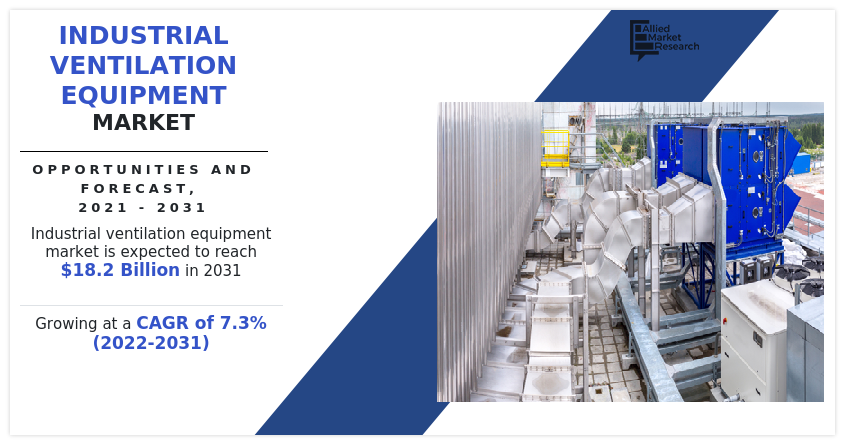
The global industrial ventilation equipment market size at USD 9 billion in 2021, is projected to reach USD 18.2 billion by 2031, exhibiting a robust compound annual growth rate (CAGR) of 7.3% from 2022 to 2031. Industrial ventilation equipment plays a critical role in maintaining indoor air quality (IAQ) by diluting and displacing pollutants in industrial environments. Comprising exhaust systems and fresh air supply systems, these solutions incorporate air filtration, air inlets, and cooling/heating equipment to reduce contaminants by mixing indoor air with clean, fresh air. This comprehensive analysis delves into the market dynamics, segmentation, regional trends, competitive landscape, and growth opportunities shaping the industrial ventilation equipment industry.
𝐃𝐨𝐰𝐧𝐥𝐨𝐚𝐝 𝐏𝐃𝐅 𝐒𝐚𝐦𝐩𝐥𝐞 𝐂𝐨𝐩𝐲@ https://www.alliedmarketresearch.com/request-sample/A13616
Industrial Ventilation Equipment Market Overview
Industrial ventilation equipment is essential for controlling air quality in industrial settings, where processes such as chemical manufacturing, oil and gas production, and building material processing generate harmful pollutants like dust, fumes, and vapors. These systems ensure a safe and healthy working environment by removing contaminants and maintaining adequate oxygen levels. The market is driven by the increasing demand for improved IAQ, rapid industrialization, and stringent government regulations on carbon emissions and workplace safety.
The equipment is categorized into dilution ventilation, which reduces the concentration of toxic and flammable substances, and local exhaust ventilation, which targets specific pollutant sources. The systems are further divided into air supply systems (including axial and centrifugal fans) and exhaust systems, catering to industries such as chemical, manufacturing, oil and gas, and building products. The market’s growth is supported by technological advancements and the rising adoption of energy-efficient and eco-friendly ventilation solutions.
Industrial Ventilation Equipment Market Dynamics
Drivers
The industrial ventilation equipment market is propelled by several key factors. The surge in industrial construction, particularly in developing economies like China, India, and the U.S., has increased the demand for ventilation systems to ensure safe working conditions. Rapid industrialization, driven by population growth, has led to the expansion of industries such as oil and gas, chemicals, and manufacturing, all of which require robust ventilation to manage air quality. For instance, the manufacturing sector in the U.S. and China is witnessing significant growth, further boosting the need for ventilation equipment.
Rising concerns about poor IAQ and its impact on worker health are also driving market growth. Exposure to dust, chemical fumes, and particulates in industrial settings can lead to respiratory and other health issues, prompting companies to invest in advanced ventilation systems. Additionally, government regulations aimed at reducing carbon emissions and promoting green building practices are encouraging the adoption of energy-efficient ventilation equipment. The construction of green buildings, which prioritize sustainability and IAQ, is a significant growth driver, particularly in developed regions.
Restraints
The industrial ventilation equipment market faced challenges during the COVID-19 pandemic, which disrupted global supply chains and halted production in 2020 and early 2021. Lockdowns led to a temporary decline in demand for ventilation equipment, particularly in industries like manufacturing and construction. However, as economies recovered and industries resumed operations by late 2021, the market began to rebound, supported by the reopening of manufacturing facilities and increased focus on workplace safety.
Another restraint is the high initial cost of advanced ventilation systems, which can deter small and medium-sized enterprises (SMEs) from adopting these solutions. The complexity of installation and maintenance also adds to the overall cost, posing a challenge in price-sensitive markets.
Opportunities
Technological advancements in ventilation equipment present significant growth opportunities. The development of energy-efficient systems, such as smart ventilation solutions with automated controls and sensors, is enhancing performance and reducing operational costs. These innovations align with global sustainability goals and appeal to industries seeking to comply with environmental regulations. Additionally, the growing focus on green buildings and the integration of advanced filtration and cooling/heating technologies are expected to drive market expansion during the forecast period.
𝐄𝐧𝐪𝐮𝐢𝐫𝐞 𝐁𝐞𝐟𝐨𝐫𝐞 𝐁𝐮𝐲𝐢𝐧𝐠@ https://www.alliedmarketresearch.com/purchase-enquiry/A13616
Industrial Ventilation Equipment Market Segmentation
The industrial ventilation equipment market is segmented by ventilation type, system type, end-user industry, and region, providing a comprehensive view of its structure and growth potential.
By Ventilation Type
The market is divided into dilution ventilation and local exhaust ventilation. In 2021, the dilution ventilation segment generated the highest revenue, as it effectively reduces the concentration of toxic fumes, particulates, and vapors in industries like oil and gas, manufacturing, and chemicals. This segment is critical for maintaining sufficient oxygen levels and ensuring worker safety.
By System Type
The market is categorized into air supply systems (including axial fans, centrifugal fans, and others) and exhaust systems. Air supply systems are essential for introducing clean, filtered air into industrial spaces, while exhaust systems remove contaminated air. Both systems are integral to maintaining IAQ and are widely used across various industries.
By End-User Industry
The market is segmented into chemical, building products, manufacturing, oil and gas, and others. The building products segment, which includes the production of bricks, cement, sand, and stone, held the largest market share in 2021. These manufacturing processes generate significant dust and chemical fumes, necessitating robust ventilation systems to maintain air quality. The oil and gas and chemical industries are also significant contributors, driven by the need to manage hazardous vapors and ensure worker safety.
By Region
Geographically, the market is analyzed across North America (U.S., Canada, Mexico), Europe (Germany, France, UK, Italy, Spain, Russia, Poland, Netherlands, Sweden, rest of Europe), Asia-Pacific (China, India, Japan, South Korea, Australia, Thailand, Indonesia, Vietnam, rest of Asia-Pacific), and LAMEA (Brazil, Argentina, Saudi Arabia, UAE, South Africa, Nigeria, rest of LAMEA). Asia-Pacific dominated the market in 2021, driven by rapid industrialization, urbanization, and population growth in countries like China, India, and Japan. The region is expected to maintain its lead throughout the forecast period, while LAMEA is projected to register the highest CAGR, fueled by increasing industrial activities in emerging economies.
Competitive Landscape
The industrial ventilation equipment market is highly competitive, with key players focusing on product innovation, partnerships, and acquisitions to strengthen their market position. Major companies include Air System Components, Inc., Cincinnati Fan, EBM-PAPST, Fläkt Group, Greenheck Fan Corporation, Hitachi, Ltd., Howden Group, Johnson Controls International Plc, Loren Cook Company, Munters, Nanfang Ventilator Co., Ltd., Nortek Air Solutions, Polypipe, S&P USA Ventilation Systems, LLC, Systemair AB, Twin City Fan Companies, Ltd., and Yilida Group.
These companies are investing in advanced technologies to develop energy-efficient and smart ventilation systems. For instance, innovations in fan design and automation are enhancing system performance and reducing energy consumption. Strategic collaborations and expansions are also common, enabling companies to cater to diverse industrial needs and expand their global presence.
Key Benefits for Stakeholders
This report offers valuable insights for stakeholders, including:
- Quantitative Analysis: Detailed market size, trends, and growth forecasts from 2021 to 2031.
- Segmentation Insights: Comprehensive breakdown by ventilation type, system type, end-user industry, and region to identify high-growth opportunities.
- Competitive Intelligence: Analysis of key players’ strategies, including product innovation and partnerships, to understand market dynamics.
- Regional Opportunities: Identification of high-potential regions, such as LAMEA, for investment and expansion.
- Market Drivers and Restraints: Insights into factors driving growth and challenges hindering adoption, aiding strategic decision-making.
Conclusion
The global industrial ventilation equipment market is poised for significant growth, driven by increasing industrialization, rising concerns about IAQ, and stringent environmental regulations. Despite temporary setbacks from the COVID-19 pandemic, the market is recovering, with Asia-Pacific leading and LAMEA emerging as a high-growth region. Technological advancements, such as energy-efficient and smart ventilation systems, are creating new opportunities for market expansion. With key players investing in innovation and strategic partnerships, the industrial ventilation equipment market is well-positioned to meet the growing demand for safe and sustainable industrial environments through 2031.




