
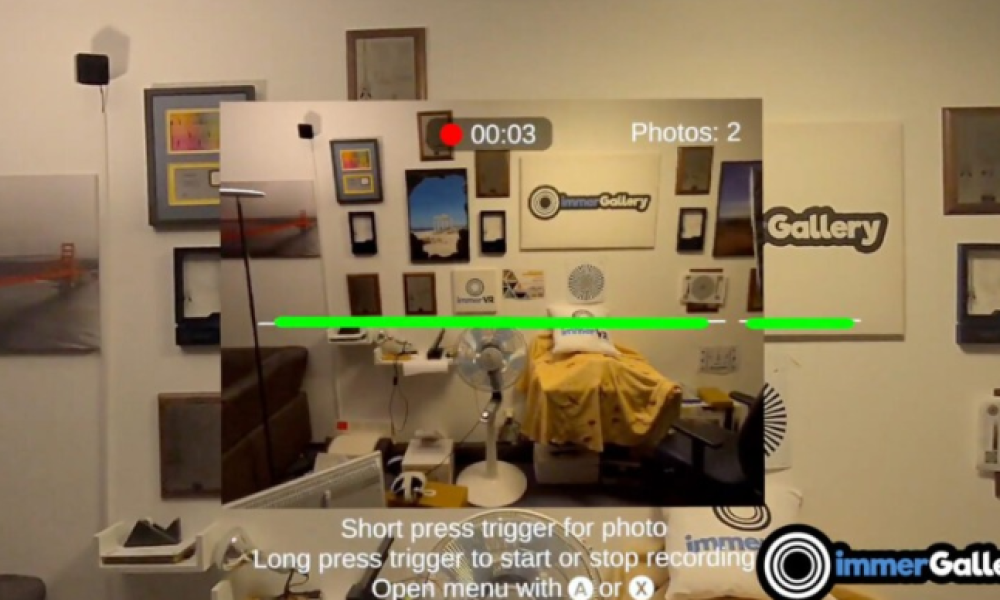
It is reported that Meta (META) Quest 3 has obtained native 3D camera support through immerGallery, and the immerGallery 1.3.5 update brings native 3D camera function.
What is native 3D camera function?
A native 3D camera function refers to the ability of a camera system, either hardware or software, to capture images or videos in three dimensions (3D) without requiring external tools or software to simulate the 3D effect. These functions are typically found in devices such as smartphones, digital cameras, or VR/AR systems that come with built-in 3D capabilities.
Here’s a breakdown of what a native 3D camera function involves:
Stereo Vision: Most native 3D camera systems use two lenses (left and right), similar to how human eyes perceive depth. By capturing two slightly offset images (stereoscopic images), a 3D effect is created when the images are combined.
Depth Mapping: Some cameras use sensors or technologies like infrared to map depth and create a 3D representation of the scene. This allows the camera to capture not just the width and height of objects, but also their depth.
Autostereoscopic Displays: For viewing the 3D content captured by a native 3D camera, some devices also come with autostereoscopic displays that don’t require glasses to view 3D images, making the experience more immersive.
3D Video and Photography: With native 3D functionality, a camera can capture 3D video and still images, which can be viewed on compatible devices or rendered in 3D environments.
The 3D camera function uses Meta’s new Passthrough Camera API, which has ended the experimental stage and is now open to Horizon Store applications, making immerGallery one of the first applications in the official store to implement the API through updates.
Google studies 3D generative “world model”
At the same time, it is reported that Google (GOOG)’s AI research and development organization Google DeepMind is forming a new team to develop generative AI “world models” that can simulate the physical world.
The new team will work with the teams behind Google AI model Gemini, video generation AI Veo, and 3D environment generation AI Genie. Among them, Genie 2 is a world model released last year. This technology can generate diverse interactive 3D game environments in real time based on images and prompts.
In addition, this technology will have a wide range of applications, including the creation of interactive media content and robot training environments. Large companies and emerging technology companies including Nvidia (NVDA) are competing to develop this technology.
It has to be said that in the context of the current wave of digitalization sweeping the world, 3D technology is like a bright new star. With its unique advantages and a wide range of application scenarios, it has realized the “remote control” scene depicted in science fiction movies, changed the way people interact with machines, and profoundly changed the face of many industries.
In fact, 3D technology is a technology that obtains three-dimensional data on the surface of an object by non-contact or contact methods. It can quickly and accurately convert real-world objects into digital models, providing a solid data foundation for subsequent modeling, analysis, design and manufacturing, and greatly shortening the conversion time from physical objects to digital models.
Industry insiders further pointed out that 3D technology has broad application prospects and makes interaction more natural. For example, touchable 3D holograms can be used in education to help students visualize and assemble engine parts; in museums, visitors can interact directly with exhibits without wearing virtual reality equipment.
WiMi innovates holographic 3D interactive technology
It is understood that WiMi (WIMI), as a leader in holographic technology and AR+AI technology, actively embraces cutting-edge technology, has demonstrated a number of innovative achievements in the field of holographic 3D projection technology, and has widely applied it to multiple fields. Based on holographic 3D projection technology, it displays scenes in daily life from different dimensions such as product design concepts, user interaction functions, and applicable scenarios, bringing better technology experience and scenario-based product experience to every user.
At present, WiMi has built a three-dimensional visualization system that supports real-time dynamic updates by integrating computer graphics, augmented reality (AR) and human-computer interaction technology. In addition, WiMi is promoting the deep integration of holographic technology with AI and high-performance computing, aiming to achieve efficient processing of larger-scale data and a more natural interactive experience, and accelerate the creation of an ecological product innovation matrix that integrates functionality, immersion and intelligent interaction.
Conclusion
With the continuous advancement of technology and the continuous expansion of applications, holographic 3D technology will expand its application in emerging fields such as cultural creativity, medical health, education and training, injecting new vitality into the development of digital economy and society. Looking into the future, holographic 3D technology will play an important role in more fields, deepen its application in high-end manufacturing and scientific research, and draw a better blueprint for the future of science and technology.




