

On May 14, according to technology media reports, Apple (AAPL) plans to launch an innovative technology later this year that allows users to directly control Apple devices through brain signals.

Apple enters the brain-computer field
According to reports, this project is the result of Apple’s cooperation with neurotechnology startup Synchron. Synchron has developed an implantable brain-computer interface (BCI) device called Stentrode, which can help users with severe movement disorders (such as amyotrophic lateral sclerosis, ALS) control Apple devices through brain neural signals.
Apple plans to expand its existing Switch Control accessibility framework to support brain-computer interface devices. Switch Control is a feature that allows users to input through non-standard devices such as joysticks and adaptive hardware. Apple is said to release this new standard later in 2025.
Entering the road of rapid development
Brain-computer interface is a multidisciplinary cutting-edge technology that integrates composite technologies of multiple disciplines such as neuroscience, computer science, intelligent science and technology, etc. It can directly read the brain’s neural signals to realize communication between the human brain and external devices. According to different signal acquisition and output methods, brain-computer interface technology can be divided into invasive, semi-invasive and non-invasive.
From the perspective of market size, related favorable technologies are constantly being implemented, and brain-computer interface technology is entering a rapid development path. According to the “2025 Brain-Computer Interface Industry Blue Book” recently released by the Forward Industry Research Institute, it is estimated that in 2028, the global brain-computer interface market size will exceed US$6 billion, with a five-year compound annual growth rate of 25.22%.
Brain-computer interface companies have invested in layout
Neuralink
As an invasive brain-computer interface company, Neuralink was founded by Musk in 2016. Its products include three basic parts: implants, applications and surgical robots. In early January 2025, Musk announced plans to implant about 20 to 30 cases, and said that the next research direction is to help the visually impaired regain vision by directly connecting to the visual cortex of the brain.
In addition, Neuralink announced that it is developing a more invasive implant device called N1, which contains more than 1,000 electrodes directly embedded in brain tissue, and can provide higher-resolution neural data streams, thereby enabling more complex control functions, such as moving the cursor and entering text by thought.

Meta (META)
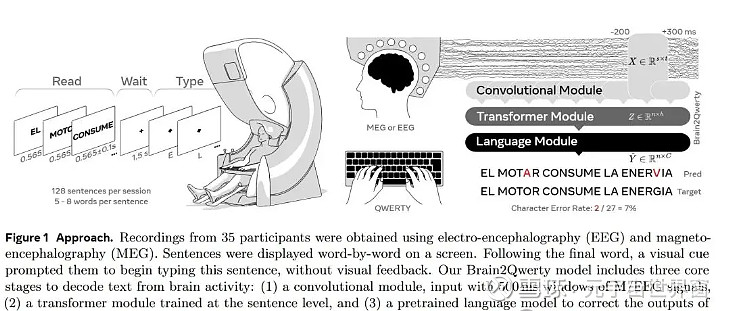
Brain-computer interface technology is hot, and Meta has taken a different approach and launched a non-invasive Brain2Qwerty deep learning model, which can “read” the text people enter on the keyboard by analyzing the electroencephalogram or magnetoencephalogram.
Meta’s new architecture can decode the participants’ electroencephalogram (EEG) or magnetoencephalogram (MEG) signals. For the best-performing participants, the model achieved a character error rate of 19% and could perfectly decode various sentences outside the training set.
In response, Meta said that its new Brain2Qwerty deep learning architecture demonstrated the great potential of non-invasive brain-computer interface technology. This research is not only a technological breakthrough, but also an exploration of the future way of human-machine interaction.
Samsung (SSNGY)
It is reported that Samsung has incorporated brain-computer interface (BCI) into the Metaverse strategic framework, aiming to create a more realistic virtual interactive scene through technology integration. Its goal is to achieve sensory linkage between users and XR environments through brain-computer interface devices, such as realistic simulation of tactile and olfactory feedback.
In addition, Samsung cooperated with Blackrock, a brain-computer interface startup, to use its CereStim neurostimulator for signal processing and user stimulation. The device supports high-precision neural activity recording and real-time feedback. It records the neural signals when the user touches the object through electrodes and converts them into programmable stimulation parameters.
WiMi (WIMI)
At present, facing the fact that many listed companies are increasing their investment in the research and development of brain-computer interface technology, it is understood that WiMi, which focuses on brain-computer interface and robotics, has also continued to explore the application of this technology in medical health, entertainment and other fields, further promoting the global market layout, and providing global customers with better and more efficient brain-computer interface solutions.
At present, WiMi has built patent and technical barriers and applied for a number of brain-computer interface related patents, including holographic brain-controlled robot system, brain-computer interface signal processing method, flexible electrode protection structure design, etc., covering the entire process of hardware optimization and data processing. At the same time, it has accelerated the exploration of the combination of quantum computing and brain science, using quantum computing to decode brain signals in real time, breaking through the efficiency bottleneck of traditional algorithms, and improving the response speed of human-computer interaction. It has become an important player in the field of brain-computer interface.
Conclusion
In fact, brain-computer interface technology involves multidisciplinary intersections, high technical complexity, high R&D and production costs of brain-computer interface technology, and uncertainty in market acceptance. Enterprises need to fully consider market demand and business model innovation when making layouts. However, it can be predicted that brain-computer companies at home and abroad are actively promoting the commercialization of brain-computer interfaces in multiple fields such as medical care, industry, and entertainment, and will gradually show a booming development trend.




