
The Wood Tar Market represents a niche but stable segment within the global bio-based chemicals industry. Wood tar is a viscous liquid obtained through the destructive distillation or pyrolysis of wood and biomass materials. It contains a complex mixture of hydrocarbons, phenols, and organic compounds that provide natural preservative, waterproofing, and antiseptic properties. Because of these characteristics, wood tar has been used for centuries in industries such as construction, shipbuilding, agriculture, and traditional medicine.
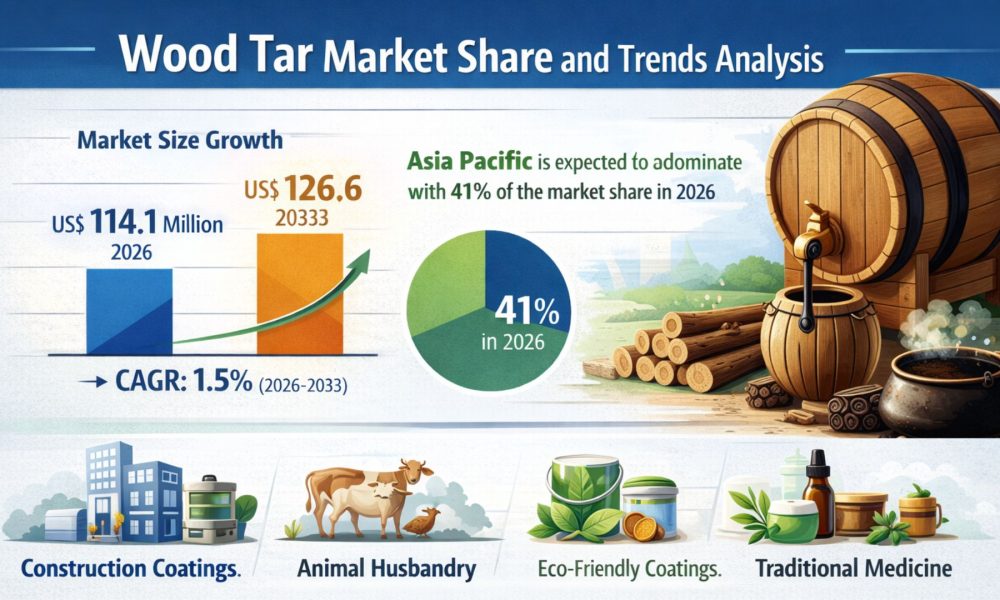
According to industry analysis, the global wood tar market is expected to reach US$ 114.1 million in 2026 and grow to approximately US$ 126.6 million by 2033, expanding at a CAGR of about 1.5% between 2026 and 2033.
The steady demand for eco-friendly preservatives, increased use in construction coatings, and its application in animal husbandry and veterinary healthcare are major factors supporting market growth. As industries shift toward sustainable and renewable materials, wood tar is gaining renewed attention as a natural alternative to synthetic preservatives and coatings.
Market Overview
Wood tar is traditionally produced through destructive distillation of wood, where biomass materials such as pine, birch, and hardwood are heated in the absence of oxygen. This process releases tar, charcoal, and other by-products that are used in multiple industrial applications.
The market has evolved over time with advancements in pyrolysis and modern distillation technologies, which improve extraction efficiency and product quality. These technologies enable manufacturers to produce wood tar with controlled viscosity, reduced odor, and enhanced chemical stability.
Today, wood tar is widely used in:
- Construction coatings
- Ship and marine protection coatings
- Wood preservation
- Animal husbandry and veterinary treatments
- Traditional medicines and antiseptic products
Increasing interest in natural and biodegradable chemicals is one of the key factors supporting the market’s long-term sustainability. Governments and industries are encouraging the use of bio-based materials to reduce environmental impact, further strengthening the role of wood tar in several industrial sectors.
Key Market Drivers
Growing Demand for Eco-Friendly Protective Coatings
One of the primary drivers of the wood tar market is the growing demand for environmentally friendly protective coatings. Wood tar provides excellent waterproofing and preservative properties, making it ideal for protecting wooden structures from moisture, fungi, and insects.
In construction and infrastructure projects, wood tar coatings are widely used to extend the lifespan of wooden materials and prevent structural damage. Its natural composition also makes it attractive in applications where chemical preservatives may pose environmental concerns.
In addition, traditional wooden buildings and heritage structures continue to rely on wood tar coatings for maintenance and preservation. These factors collectively contribute to the steady demand for wood tar in the construction sector.
Increasing Use in Animal Husbandry and Veterinary Applications
Another significant growth factor for the wood tar market is its expanding use in animal husbandry and veterinary care. Wood tar has natural antiseptic and antibacterial properties, making it useful for treating livestock skin infections, hoof diseases, and other animal health issues.
Farmers and veterinarians often use wood tar formulations to protect animals from parasites and skin irritation. In addition, it is sometimes used as a feed additive or protective agent in livestock environments.
This segment is expected to experience notable growth in the coming years as livestock health management becomes increasingly important in modern agriculture.
Expansion of Maritime and Marine Applications
Wood tar has historically been used in shipbuilding and maritime industries as a protective coating for wooden vessels. It helps prevent water penetration and protects wooden components from decay.
Although modern shipbuilding has largely transitioned to steel and composite materials, wood tar remains relevant in maintenance of traditional boats and marine structures. In coastal regions where wooden boats are still widely used, wood tar coatings provide a cost-effective solution for protection against seawater and harsh environmental conditions.
The growing popularity of traditional maritime tourism and wooden vessel restoration projects is also contributing to continued demand.
Market Restraints
Limited Large-Scale Industrial Applications
Despite its historical significance and environmental benefits, the wood tar market remains relatively small compared to other industrial chemicals. One of the key limitations is its restricted range of large-scale industrial applications.
Many industries have shifted to synthetic alternatives that provide more consistent performance and are easier to manufacture at large volumes. As a result, wood tar is often used in specialized or niche applications rather than mass-scale industrial production.
Additionally, fluctuations in raw material supply and variations in production methods can affect product consistency, which may limit its adoption in highly regulated industrial sectors.
Product Type Insights
The wood tar market is segmented based on product type, including:
- Resinous Tars
- Hardwood Tars
- Others
Among these, resinous tars hold the largest market share and are expected to account for around 42% of the global market in 2026.
Resinous tars are widely used in industrial coatings and marine protection applications due to their excellent water resistance and durability. These characteristics make them suitable for environments exposed to moisture, chemicals, and harsh weather conditions.
Meanwhile, hardwood tars are projected to be the fastest-growing segment due to their increasing use in natural and traditional applications, particularly in healthcare and agriculture.
Production Technology Insights
Wood tar production technologies include:
- Destructive Distillation
- Pyrolysis
- Other advanced methods
Among these, pyrolysis is expected to be the fastest-growing production method during the forecast period.
Pyrolysis allows better control over chemical composition and reduces emissions during the production process. This technology is increasingly being adopted in modern wood tar manufacturing facilities because it improves efficiency and environmental performance.
Advanced monitoring systems and automated process controls also help manufacturers produce high-quality wood tar suitable for specialized applications.
Application Insights
Wood tar is used across several industries, but construction coatings represent the largest application segment.
This segment is expected to account for approximately 48% of the global wood tar market revenue in 2026.
Major Applications
- Construction coatings
- Ship coatings
- Animal husbandry
- Agricultural preservation
- Healthcare and veterinary formulations
In construction, wood tar is widely used as a waterproof coating for wooden surfaces, roofs, and outdoor structures. Its durability and resistance to environmental damage make it suitable for long-term protection.
In agriculture and veterinary medicine, its antiseptic properties support its use in livestock care and disease prevention.
Regional Analysis
Asia Pacific
Asia Pacific is expected to dominate the global wood tar market with approximately 41% market share in 2026.
The region’s strong demand is driven by:
- Expanding construction activities
- High agricultural and livestock production
- Traditional use of wood tar in maritime industries
Countries such as China, India, and Southeast Asian nations are experiencing increasing demand for natural preservatives and agricultural products, which supports market growth.
Europe
Europe represents a significant market for wood tar due to its long history of use in maritime applications and wood preservation.
Several European countries maintain strong demand for traditional wood tar coatings, particularly in shipbuilding, heritage building preservation, and eco-friendly construction materials.
North America
North America is another important market, driven by applications in agriculture, veterinary care, and specialty coatings.
The region also benefits from increasing interest in natural and bio-based chemical products, which aligns with the growing sustainability movement.
Competitive Landscape
The wood tar market is moderately fragmented, with several regional and international manufacturers operating in the industry. The leading companies together account for around 45% of global market demand.
Key Market Players
Major companies in the wood tar market include:
- Auson
- Xinzhongxing Biomass
- Kemet Skandian Group
- Verdi Life
- Fusheng Carbon
- Albert Kerbl
- S.P.S. BV
- Shuanghui Active Carbon
- Bashles
- Eco Oil
These companies focus on improving production efficiency, refining formulations, and developing specialized products for industrial and agricultural applications.
Future Outlook
The future of the wood tar market lies in technological improvements and sustainable product development. Innovations in pyrolysis technology and bio-based chemical processing are expected to enhance product quality and expand application potential.
Additionally, increasing global awareness about environmentally friendly materials is likely to support the adoption of wood tar in industries such as construction, agriculture, and healthcare.
Although the market is expected to grow at a relatively modest pace, its stability and environmental advantages ensure its continued relevance in the global specialty chemicals industry.
About Persistence Market Research:
Persistence Market Research delivers strategic research solutions that drive business growth. Founded in 2012 and registered in England and Wales in 2023 as Persistence Research & Consultancy Services Ltd., we have completed 3,600+ custom and syndicated studies and supported 2,700+ projects for leading research firms. Combining traditional methodologies with modern tools, we provide actionable insights to multinational corporations, consultants, investors, and government bodies, earning strong trust through long-term client relationships.
Contact Us:
Persistence Market Research
Second Floor, 150 Fleet Street,
London, EC4A 2DQ, United Kingdom
USA Phone: +1 646-878-6329
UK Phone: +44 203-837-5656
Email: [email protected]
Web: https://www.persistencemarketresearch.com




