
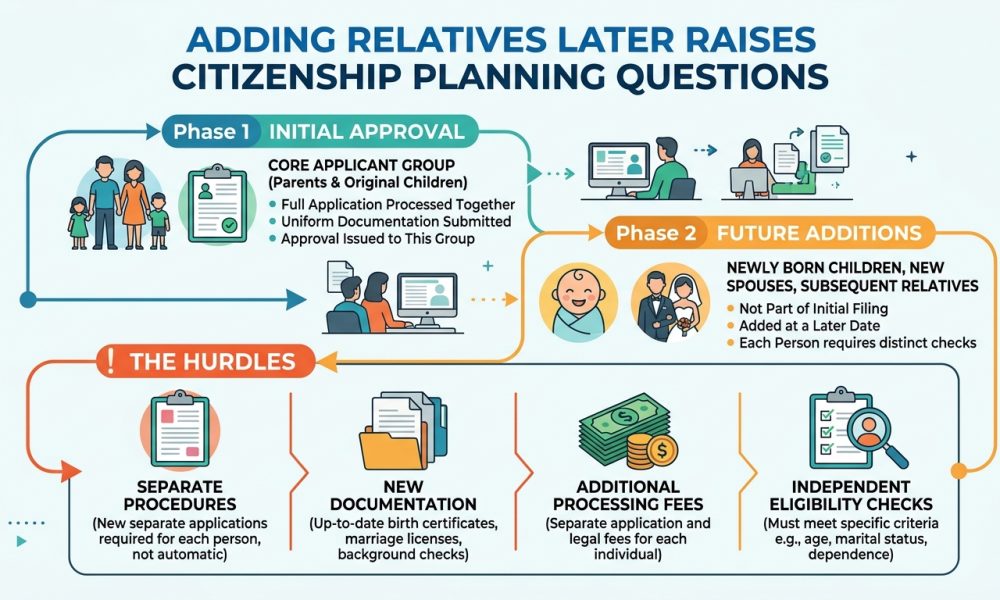
Citizenship-by-investment programs may permit qualifying spouses, newborn children, parents, and other relatives to obtain nationality after the principal applicant’s approval. Still, separate eligibility rules, additional financial contributions, and government screening can complicate adding family members later.
WASHINGTON, DC, November 8, 2026 — Families obtaining second citizenship through government contribution programs are increasingly examining whether they can add relatives after the principal applicant becomes a citizen, recognizing that future marriages, births, and changing dependency circumstances can alter long-term nationality plans.
Although several Caribbean investment citizenship programs allow subsequent family additions, those provisions differ substantially across jurisdictions, particularly on eligible relationships, application deadlines, government payments, and how relatives excluded from original submissions are treated.
For households seeking lasting international mobility, the distinction between including a dependant initially and applying for that person later can influence total expenditure, document preparation, administrative timelines, and whether the entire family eventually receives the same nationality.
Future Family Additions Are Not Automatically Guaranteed
A principal applicant’s successful naturalization does not create an unrestricted entitlement to citizenship for every relative identified later, because each issuing country determines which family relationships qualify under its nationality legislation and investment program regulations.
Some programs recognize newly married spouses, children born after naturalization, and parents who later reach qualifying ages, while others restrict post-approval procedures or require a separate application for relatives previously eligible but omitted.
Families should therefore review future addition provisions before choosing their initial citizenship pathway, especially when circumstances involving adult children, elderly parents, or planned marriages are likely to change in the coming years.
St. Kitts and Nevis Makes an Important Distinction
St. Kitts and Nevis publishes post-citizenship addition rules recognizing a spouse married after the principal applicant acquired citizenship, children born subsequently, and certain parents who reach the relevant qualifying age after naturalization.
Its Citizenship Unit also states that relatives who already qualified but were omitted from the original application may not be able to use the ordinary post-citizenship addition procedure and may instead require a separately sponsored application.
That distinction can substantially affect household planning because deliberately postponing an eligible relative’s application for financial convenience may create different costs and procedures from those available to a genuinely new family member.
The Timing of Marriage Can Affect Eligibility
An applicant who marries after receiving citizenship may be permitted to seek naturalization for the new spouse under the issuing country’s post-approval rules. However,h the marriage itself does not automatically confer the same nationality.
Authorities can require an authentic marriage certificate, personal Identification, background investigations, and payment of the applicable government contribution before considering whether the spouse qualifies under the relevant program provisions.
Applicants planning marriage should establish the applicable procedures and financial commitments in advance, especially when the couple intends to relocate together or depends on citizenship documentation for subsequent international travel arrangements.
St. Kitts and Nevis Publishes Specific Additional Charges
The St. Kitts and Nevis Citizenship Unit lists a US$30,000 fee to add a qualifying spouse or other eligible dependent after approval in principle, with separate charges potentially arising from screening and documentation.
For a qualifying child younger than three who was born after the principal applicant received the citizenship certificate, the published post-citizenship addition fee is US$7,500 under the relevant administrative procedure.
Additional charges for processing, due diligence, registration, and passports can still apply, meaning these figures should not be interpreted as complete quotations covering every expense involved in a subsequent family application.
Saint Lucia Uses a Different Financial Structure
Saint Lucia’s National Economic Fund provides an add-on procedure through which qualifying relatives of a citizen who acquired nationality under the investment program may seek citizenship after the original approval.
Its current official contribution schedule lists US$35,000 to add an eligible spouse, US$25,000 for another qualifying dependent, and US$5,000 for a newborn child aged twelve months or younger.
These figures describe contribution requirements rather than every possible expense, because applicants must still account for applicable screening, processing, official documentation, and professional services before determining the complete cost of adding a family member.
Antigua and Barbuda Recognizes Future Family Relationships
Antigua and Barbuda’s citizenship framework recognizes certain future spouses of principal applicants, spouses of eligible dependent children, and children born to qualifying dependants after approval, subject to the government’s prescribed conditions.
The country’s published eligibility guidance lists a US$50,000 fee to add a future spouse. At the same time, its regulations set different processing charges for children based on their age at the time of application.
Families should pay close attention to the distinction between an applicant’s own newborn child and the child of an existing dependant, because these relationships may fall under different provisions and payment categories.
Age-Related Charges Can Change the Calculation
Antigua and Barbuda’s published post-approval processing schedule identifies US$10,000 for a qualifying dependent child aged five or younger, while a child aged six through seventeen attracts a US$25,000 processing charge.
The regulations also identify US$50,000 for adding a qualifying dependent aged eighteen or older, illustrating why postponing a family application may create financial consequences as children grow older.
Parents should verify the governing age calculation and the precise relationship category before submitting an addition request, particularly when a child’s birthday approaches a threshold that could affect fees or eligibility.
Dominica Provides a More Limited Child Addition Procedure
Dominica’s 2024 citizenship regulations establish a post-citizenship registration procedure for a qualifying child younger than eighteen who is born to or adopted by the principal applicant within five years after citizenship.
The published provisions specify a US$2,000 processing fee, alongside a US$500 naturalization certificate charge and additional background screening requirements for qualifying applicants who reach the applicable screening age.
This framework shows why parents should not assume every child born many years after naturalization can use the same streamlined procedure, especially when statutory time limits apply.
Older Parents May Become Eligible After Naturalization
A parent who does not meet a program’s minimum age or dependency requirements when the principal applicant first applies may later qualify after reaching the relevant threshold or experiencing a material change in circumstances.
St. Kitts and Nevis expressly identifies certain parents who reach its qualifying age after the principal applicant becomes a citizen as potentially eligible under the subsequent family addition arrangements.
However, eligibility still depends on the applicable support, residence, and relationship conditions, meaning the passage of time alone does not necessarily establish a parent’s entitlement to citizenship through the existing family member.
Government Screening Remains Necessary for New Relatives
Adding a family member does not eliminate ordinary due diligence, because the issuing authority may examine personal identity, criminal history, previous nationalities, financial circumstances, and other information relevant to a lawful citizenship decision.
The principal applicant may also face updated verification requirements when a substantial period has elapsed since the original examination, particularly where official rules call for renewed screening or additional documentation.
Families should account for these administrative responsibilities when preparing a post-approval budget, rather than assuming that an earlier successful investigation permanently satisfies screening requirements for every subsequent relative.
Documents Must Establish the New Family Relationship
Applications involving newborn children ordinarily require official birth records establishing parentage, while newly married spouses may need marriage certificates, evidence of prior divorce, and documentation connecting any changed legal names.
Adopted children may require legally recognized adoption orders and related civil records, especially when the adoption occurred in another country or involves requirements for recognizing foreign judicial decisions.
Applicants should obtain authentic evidence from the appropriate issuing authorities and resolve discrepancies through lawful correction procedures, because an existing citizenship certificate cannot substitute for proof of the new relative’s eligibility.
International Policy Changes Create Additional Uncertainty
An October 29, 2026, Reuters investigation into European pressure on Caribbean citizenship programs described negotiations over the future of investment-linked nationality schemes and potential restrictions affecting valuable visa-free travel arrangements.
Those developments do not establish that citizenships already granted have been canceled. Still, they do show why applicants should avoid assuming current program rules or international privileges will remain unchanged indefinitely.
A family planning to add relatives several years after its original application should therefore recognize that later applicants may face different fees, eligibility requirements, or administrative procedures from those originally advertised.
Nationality and Family Immigration Are Separate Questions
An existing citizen may hold the right to live and work in the issuing country. Still, that status does not automatically grant equivalent citizenship or residence rights to every spouse, child, or extended relative.
The U.S. Department of State’s dual-nationality guidance also explains that Americans who acquire another nationality generally retain applicable United States legal obligations and passport requirements, underscoring the importance of assessing each person’s status separately.
Families intending to relocate outside the citizenship-issuing country must also investigate the destination’s own immigration rules, because another nationality does not automatically provide permanent settlement or employment permission elsewhere.
Alternative Immigration Options May Sometimes Be Necessary
When a relative cannot qualify for addition under a citizenship-by-investment program, the family may need to investigate ordinary naturalization, residence permits, family sponsorship, or another lawful immigration route available in the relevant jurisdiction.
These alternatives can involve different evidence, residence periods, financial requirements, and government decisions, meaning a rejected family addition should not automatically be interpreted as proof that no lawful pathway exists.
A practical family strategy should identify which members qualify immediately, which may become eligible later, and which require independent solutions before making major financial or relocation commitments.
Professional Contracts Should Address Future Family Additions
Households reviewing second passport planning through Amicus International Consulting should request written explanations of current dependent eligibility, potential future additions, applicable government fees, and who is responsible for preparing subsequent applications.
Professional agreements should distinguish guaranteed administrative services from outcomes controlled by foreign governments, while explaining whether future assistance requires a new retainer or additional documentary and screening expenses.
Applicants should also keep copies of their original application records, citizenship certificates, marriage and birth documents, and official payment confirmations, since those materials may matter during later family reviews.
Privacy Planning Must Preserve Accurate Family Records
Families seeking lawful anonymous living and personal privacy planning should understand that confidentiality measures do not remove the responsibility to disclose legally relevant family relationships when applying for another nationality.
Government authorities may require evidence connecting parents, children, spouses, and previous legal names, particularly when relatives acquire citizenship at different times or through separate administrative procedures.
Accurate records help maintain consistency across future passport applications, residence requests, and family documentation, while unsupported attempts to conceal relevant relationships can create serious legal and administrative complications.
The Complete Budget Should Include Future Obligations
A family budget should separate the original citizenship contribution from later dependent payments, renewed background investigations, document preparation, passport issuance, and the professional assistance tied to later applications.
These expenses can become substantial when several adult relatives seek citizenship after the principal applicant, especially if the program charges more for older dependants or requires separate sponsored applications.
Maintaining sufficient financial reserves allows families to respond to legitimate changes without assuming that the amount originally paid for citizenship includes every future household addition or related government service.
Long-Term Family Planning Begins Before the First Application
Applicants considering future family additions should evaluate foreseeable marriages, births, aging parents, educational changes, and evolving dependency circumstances before choosing a jurisdiction or committing to a nonrefundable contribution.
Current official regulations provide a starting point, but families should recognize that later applications are governed by the requirements in effect when the responsible government authority considers the request.
Ultimately, adding relatives later raises citizenship planning questions because the principal applicant’s approval cannot replace individual eligibility, documented family relationships, current government fees, and the separate official decisions necessary to extend nationality to subsequent family members.




