
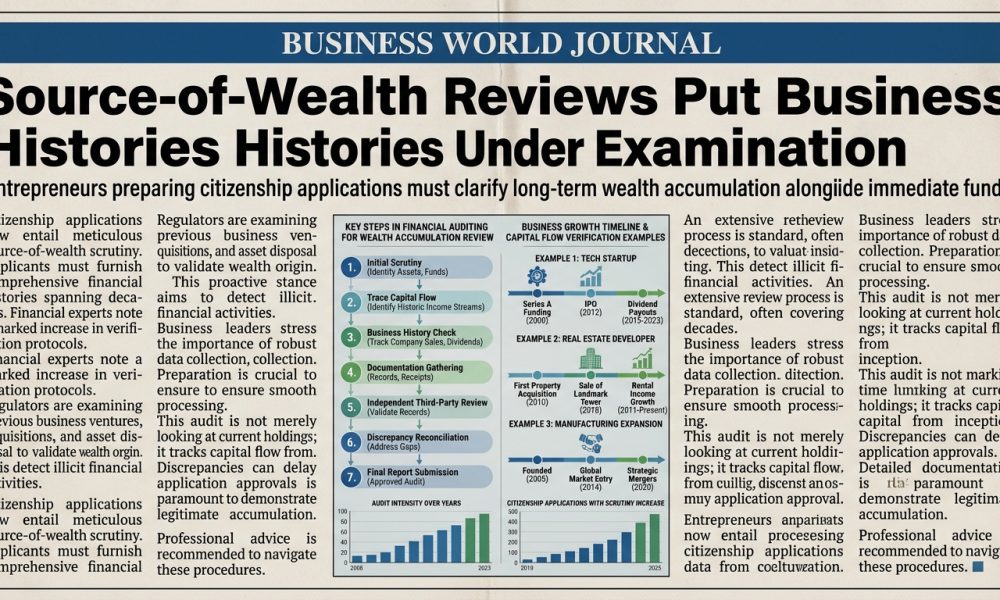
Entrepreneurs applying for second citizenship must explain how businesses, investments, and transactions built their wealth, while separately documenting the legitimate origin of the precise funds committed to a qualifying government program.
WASHINGTON, DC, November 8, 2026 — Entrepreneurs exploring citizenship by investment face financial examinations that reach far beyond their latest bank balances, requiring credible accounts of how companies developed, assets changed ownership, and profits accumulated throughout their professional lives.
A government-approved contribution may satisfy a program’s financial threshold. Still, it cannot replace evidence explaining whether the applicant genuinely owns the resources, obtained them lawfully, and can document the commercial activity behind significant changes in wealth.
This distinction is increasingly important for internationally active business owners whose assets may involve partnerships, holding companies, property transactions, family businesses, and accounts in several jurisdictions with different documentary and reporting standards.
Source of Wealth and Source of Funds: Answer Separate Questions
Source of wealth explains the origins of an applicant’s overall financial position. In contrast, source of funds identifies the provenance of the particular payment being invested or contributed, including how it reached the account used for transfer.
A founder might have accumulated wealth through twenty years of manufacturing operations while financing citizenship from a recent sale of securities, requiring separate evidence for the original business success and the immediate investment proceeds.
Dominica’s Citizenship by Investment Unit made this distinction explicit in its June and July 2026 guidance, identifying financial verification, employment history, business activity, and independent checks among the components of its nationality screening process.
A Large Balance Does Not Tell the Whole Story
A bank statement showing enough cash for a government contribution establishes an account position on a specific date. Still, it cannot alone explain whether the money originated from earnings, inheritance, loans, dividends, or company distributions.
Investigators may therefore request agreements, statements, accounting records, and explanatory documents linking significant deposits with identifiable economic events, especially when funds passed through several institutions before reaching the applicant’s personal account, as part of an independently reviewed record.
Rather than concentrating only on the final transfer, entrepreneurs should preserve a clear chronology connecting the underlying economic activity, the original recipient, any subsequent transfers, and the person legally entitled to contribute.
Business Ownership Requires a Coherent Historical Account
Company founders should be prepared to explain incorporation dates, changes in shareholders, acquisitions, mergers, and their own rights to business profits, because corporate revenue does not automatically constitute the personal wealth of every owner.
Shareholder registers, formation certificates, financial statements, and distribution approvals can clarify the relationship between an enterprise’s commercial performance and assets eventually held by an individual seeking another nationality, across the relevant years of operation.
Where a company has operated across several jurisdictions, legitimate differences between local accounting systems may require explanation. However, an inconsistency is not proof of wrongdoing and should be evaluated against original records and context.
Company Sales Can Produce Complicated Evidence Trails
An entrepreneur financing citizenship after selling a business may have a persuasive source-of-funds explanation, provided the sale agreement, ownership records, completion statement, and banking confirmations reconcile with the actual money received and the financial evidence remains internally consistent.
A headline acquisition value is rarely interchangeable with the cash paid to one shareholder, particularly when debt repayment, transaction costs, contingent payments, minority interests, or deferred consideration influence the final personal proceeds, under the binding terms of the transaction.
Applicants should distinguish money already received from amounts still contingent on performance, while documenting whether proceeds were paid to an individual, an investment vehicle, or a company requiring another lawful distribution, as reflected in the final settlement documentation.
Dividends and Retained Earnings Must Be Distinguished
Business owners sometimes describe accumulated company profits as personal assets without showing when those earnings were legally distributed, a distinction that can become material when citizenship funds originate from corporate accounts, under the company law governing those distributions.
Relevant records may include annual accounts, board resolutions, shareholder agreements, dividend statements, and banking entries documenting transfers from the company to the person funding the citizenship application, along with correspondence explaining the commercial decisions involved.
A consistent narrative should explain both the enterprise’s capacity to make a distribution and the individual’s entitlement to receive it, without portraying ordinary business turnover as independently available personal cash, under applicable company law and accounting standards.
Holding Companies and Trusts Increase Documentation Needs
A lawful group structure may include operating subsidiaries, investment holding companies, partnerships, and trusts, each with a distinct legal role that investigators must understand before accepting claims of beneficial ownership.
Organization charts can help identify relationships, but supporting incorporation documents, registers, trust deeds, or distribution records may still be needed to establish who controls assets and authorizes particular transfers, where separate entities hold overlapping financial interests.
Transparent disclosure matters because placing funds in a structure does not eliminate financial verification, and a transfer from a related company can raise additional questions about the recipient’s rights and the underlying commercial purpose.
Property Sales and Inheritance Require Different Records
Selling a valuable property may provide citizenship funds through a legitimate transaction. Still, authorities can request acquisition records, title information, settlement statements, and evidence showing how the proceeds reached the relevant account.
Inheritance can require probate documents, estate accounts, beneficiary records, and distribution confirmations, particularly when assets moved across borders or were administered through several executors and financial institutions, especially for estates administered in multiple jurisdictions.
Neither circumstance is inherently suspicious, but each demands evidence appropriate to the event, not a generic declaration that a family member or historical investment provided the money, with a clear chain of ownership records.
Loans and Family Gifts Should Be Characterized Accurately
An applicant receiving financial assistance from relatives may need to identify whether the payment was a gift, repayable loan, or distribution of jointly owned assets, because those arrangements create different legal and financial implications.
A signed gift letter may help explain intent. Still, it does not necessarily establish the donor’s source of wealth or resolve questions about a substantial transfer from an unfamiliar account without additional evidence of the underlying transaction.
Similarly, describing borrowed capital as personal savings would create an avoidable inconsistency. At the same time, clear documentation of the lender, agreement, repayment terms, and funds can support an accurate assessment of a legitimate arrangement for later review by independent financial investigators.
Recordkeeping Standards Offer a Practical Starting Point
The Internal Revenue Service’s business recordkeeping guidance explains why companies should preserve materials showing income, expenses, transactions, and the basis of property, information that can also assist entrepreneurs reconstructing an authentic financial history.
Tax records prepared for one jurisdiction are not a substitute for a citizenship authority’s documentary checklist. Still, consistent financial statements and supporting transaction records can make explanations easier to substantiate independently, in the country making the nationality determination.
Applicants with older businesses should determine which original records remain accessible, identify legitimate gaps, and seek qualified help explaining missing materials without recreating documents that falsely appear to be contemporaneous originals, where records have been lawfully destroyed.
Independent Due Diligence Goes Beyond Submitted Statements
Dominica describes a review involving government-authorized agents, its Citizenship by Investment Unit, outside investigators, and receiving-bank checks, creating separate opportunities to compare an applicant’s declarations with available external information, at several distinct stages of government review.
Potential subjects include employment history, criminal background, sanctions, politically exposed person status, adverse media, and business interests, with additional questions possible when financial transactions or personal details remain unclear, through inquiries tailored to the individual applicant.
A reliable presentation should anticipate verification instead of assuming that an impressive professional biography or a letter from an intermediary makes corporate ownership, investment proceeds, or earlier disclosures immune from scrutiny during any independent review of supporting records.
International Policy Pressure Reinforces Screening Concerns
An October 29, 2026, Reuters report on European pressure affecting Caribbean investor citizenship programs described concerns over security and visa-free access, alongside the considerable public revenue that participating governments receive from approved applicants.
That debate does not establish that legitimate entrepreneurs should be excluded. Still, it explains why governments have incentives to conduct credible investigations and handle applicants’ financial backgrounds responsibly throughout the citizenship adjudication process.
Families should distinguish ongoing diplomatic negotiations from final legal changes, while recognizing that other governments partly control a passport’s foreign travel privileges and cannot be guaranteed through contribution payments in the years after a successful application.
Mandatory Interviews Test Personal Consistency
Dominica requires applicants aged sixteen and older to attend mandatory interviews, giving investigators a chance to clarify professional history, financial claims, and inconsistencies that might otherwise be hard to interpret from documents alone.
Entrepreneurs should be able to describe the broad evolution of their businesses and major sources of wealth accurately, without treating the interview as an opportunity to substitute confident claims for missing official evidence.
Authorized representatives can organize records and explain procedural expectations. Still, they cannot attend in place of applicants or guarantee that a favorable interview will result in final citizenship approval, regardless of the contribution’s value.
Family Funding Can Create Additional Verification Questions
When one entrepreneur funds a joint application for a spouse, children, or qualifying parents, the principal contribution may have a clear payer even though individual relatives remain subject to separate identity and eligibility requirements.
Families should avoid assuming shared household membership eliminates these questions, particularly when several relatives maintain separate businesses, accounts, or residence histories that must be accurately disclosed and may have different sources of wealth.
Application Timing Should Allow for Complex Files
Dominica indicates a general processing period of approximately three to six months. Still, it acknowledges that complicated business structures, missing financial records, international information requests, supplementary investigations, and additional inquiries into previously undisclosed transactions may lengthen review.
An entrepreneur with substantial assets may therefore face a slower assessment than an applicant with a simpler financial history, even when both qualify for the same contribution category and submit documents promptly, because authorities may need external documentary confirmation.
Travel bookings, property commitments, and business relocation plans should account for that uncertainty, because approval in principle, completion of financial contributions, legal naturalization, and passport issuance are distinct stages that separate authorities must complete.
Accurate Explanations Matter More Than Elaborate Presentations
A carefully written business chronology can help investigators by identifying verifiable events, dates, company interests, transfers, and supporting exhibits without obscuring uncertainty beneath excessive language or unsupported valuations, in a form that can be easily checked against records.
Professional advisers may help reconcile figures and organize authentic materials. Still, their work should never involve invented invoices, fabricated financial statements, concealed ownership interests, or misleading descriptions of funds, even when original paperwork is difficult to locate.
Where an old transaction cannot be reconstructed completely, the responsible approach is to explain the limitation and provide reliable alternative evidence where accepted, allowing the government to decide whether the record is sufficient.
Citizenship Does Not Rewrite Earlier Financial History
A person obtaining another nationality retains the historical facts associated with earlier companies, taxes, property, and financial accounts, even when new residence opportunities or different passport arrangements become available, under those jurisdictions’ laws and records.
The assessment of a citizenship application should therefore be separate from any suggestion that another passport erases prior business associations, removes Identification and reporting duties imposed by regulated institutions, or permits inaccurate reporting of previous transactions.
For entrepreneurs considering international restructuring, obtaining qualified cross-border advice before transferring assets may matter, because nationality recognition and lawful treatment of financial transactions involve different legal questions under laws governing taxation, ownership, and disclosure.
Passport Security Cannot Replace Financial Evidence.
A biometric passport can contain electronically authenticated identity information. Still, a successful chip scan does not establish whether the holder’s underlying business history was complete or their citizenship contribution came from lawful sources.
Amicus International Consulting explains this distinction in its guide to passport NFC chip scanning and verification results, which separates technical document authentication from government decisions regarding legal status and administrative validity, without promising broader verification beyond the chip.
Applicants should keep original citizenship records and relevant financial documentation separate, recognizing that electronic security protects aspects of a travel document without independently certifying earlier commercial transactions that may be needed for later official review.
Professional Planning Should Begin With an Evidence Inventory
Entrepreneurs exploring lawful second passport planning with Amicus International Consulting can start by listing major businesses, ownership changes, substantial distributions, asset sales, and the precise financial route intended to support the qualifying contribution.
An organized inventory should identify which records are already available, which require certified copies or translation, and which potential inconsistencies merit legal or accounting review before the file reaches government investigators, with the responsible original issuers clearly identified.
This preparation can reduce avoidable delays and clarify legitimate questions. Still, it cannot guarantee approval, replace independent screening, authorize a private consultant to waive government requirements, or exempt an applicant from truthful disclosure.
A Defensible Financial History Supports the Entire Application
For a successful entrepreneur, the central challenge is often not demonstrating that sufficient money exists, but showing how legitimate economic activity created wealth and how specific funds became available for a citizenship contribution.
The strongest application presents a proportionate, consistent, and independently verifiable account of ownership, earnings, distributions, and transfers, addressing uncertainties candidly rather than hiding them behind an attractive summary of financial success, even when transactions involve several business entities.
Ultimately, source-of-wealth reviews examine business histories because lawful nationality approval depends on more than purchasing power; it requires credible personal disclosures, reliable financial evidence, and a government decision based on the complete record.




