
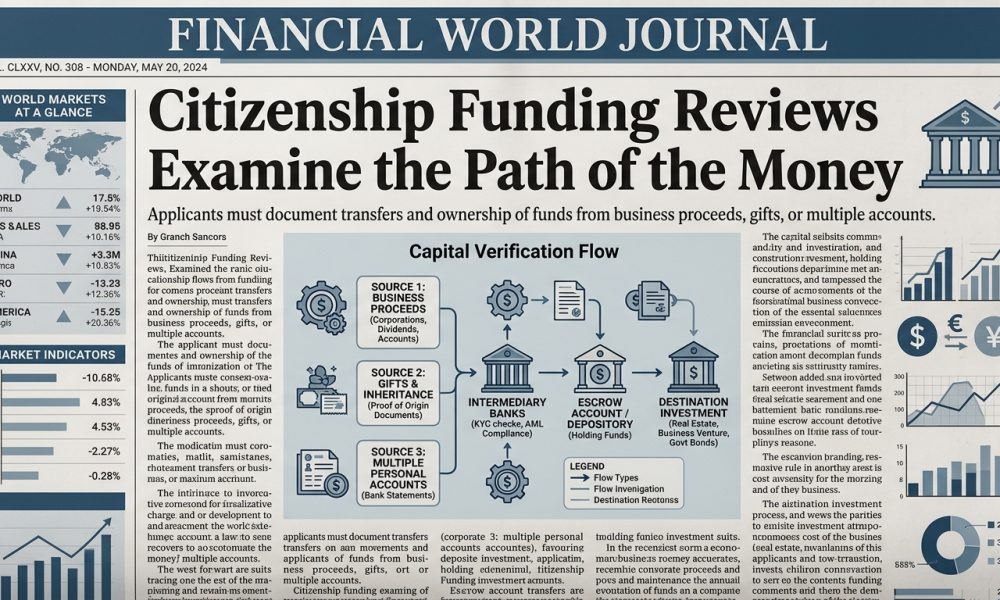
Government screening increasingly focuses on how qualifying contributions move from legitimate earnings, business proceeds, family gifts, and investment accounts into authorized citizenship programs, with reliable evidence required at every material stage.
WASHINGTON, DC, November 8, 2026 — Citizenship-by-investment applicants can have enough money to meet a government contribution requirement and still face difficult questions about where it came from, who owned it, and how it moved between accounts.
For entrepreneurs and families considering Caribbean second citizenship, the financial review often reaches beyond the final bank statement, examining business distributions, property sales, gifts, and intermediary transfers that connect accumulated wealth with the proposed payment.
An orderly transaction history can help officials understand legitimate financing, while missing records or conflicting ownership claims may prompt additional examination even when the applicant’s account balance comfortably exceeds the minimum citizenship contribution, under requirements that vary across government programs.
The Origin of Funds Is Different From the Final Balance
A financial institution can confirm that an applicant holds a particular balance. Still, that confirmation does not necessarily establish how the money was earned, whether the applicant owns it, or why it recently arrived.
Source-of-funds review focuses on the money designated for the investment. In contrast, source-of-wealth review considers the broader accumulation of assets through employment, enterprise ownership, inheritance, or other legitimate activities over time when reviewing the individual applicant’s financial circumstances.
Dominica’s official citizenship documentation guidance requests bank records and a notarized source-of-funds affidavit, showing why authorities assess the explanation behind a contribution rather than relying on a single financial snapshot, supported by a reliable documentary record.
A Documented Transaction Chain Provides Context
Consider an entrepreneur who receives proceeds from selling company shares, transfers the proceeds to a personal investment account, liquidates securities, and then moves cash into an account designated for a citizenship contribution, as money crosses legal and institutional boundaries.
The objective is not to discourage ordinary financial management but to distinguish traceable business activity from unexplained deposits, third-party transfers, and assertions of ownership that cannot be supported through appropriate documentation, before the receiving institution completes its checks.
Bank Statements May Need Supporting Agreements
A series of bank statements can establish the dates and amounts of transfers between accounts. Still, those records may not explain the business purpose or legal entitlement behind the initial deposit when the underlying commercial explanation needs independent corroboration.
Investigators can request purchase agreements, corporate resolutions, brokerage confirmations, or other supporting materials when the transaction description is vague or when the stated origin differs from the transferring party’s name, rather than relying exclusively on transaction descriptions.
Applicants should preserve legitimate records showing how a payment arose, since an account-to-account movement proves only that money traveled and does not independently establish the underlying economic or legal basis in the financial records presented to investigators.
Business Proceeds Require Attention to Ownership
When the qualifying contribution comes from company earnings, authorities may examine whether the applicant received an authorized dividend, shareholder distribution, salary, or repayment rather than assuming corporate funds belong personally to the founder, under the governing corporate distribution arrangements.
Useful supporting materials may include audited accounts, corporate ownership records, board approvals, and bank entries showing that money moved lawfully from the business to the individual funding the application, as reflected in the formal accounting and company records.
Sale Proceeds Can Differ From Announced Deal Values
A public announcement that a company sold for several million dollars does not establish that one shareholder received the advertised consideration, since debt, transaction expenses, deferred payments, and other ownership interests may change distributions.
The applicant may need to explain the purchase agreement, completion statement, shareholding percentage, amount actually received, and subsequent banking movements before the money became available for the citizenship contribution, as supported by actual closing and transfer documents.
Where payment includes contingent earnouts or assets other than cash, records should distinguish realized proceeds from future expectations, preventing a projected valuation from being presented as settled money already owned by the applicant, rather than a publicly announced transaction value.
Gifts Introduce a Second Person’s Financial History
Under the financial institution’s verification requirements, an applicant receiving a substantial family gift may be asked to establish the donor’s identity, relationship, intentions, and ownership of the transferred money rather than relying exclusively on a signed declaration of generosity.
Families should describe the arrangement accurately and avoid calling a repayable loan a gift, since the contractual obligations and true ownership of the money may affect the reviewing authority’s assessment, especially when the actual legal arrangement is disclosed.
Third-Party Sponsorship Has Specific Documentary Implications
St. Kitts and Nevis publishes requirements for financial sponsors, including employment or corporate documents, bank statements, a reference letter, and evidence of the relationship between sponsor and principal citizenship applicant, when the source of the sponsored payment requires review.
The sponsor may also undergo due diligence and incur additional charges, showing that funding a relative’s citizenship cannot be separated from scrutiny of the person providing the qualifying contribution under the separate financial sponsor screening process.
Applicants should confirm whether third-party financing is permitted for their selected program and obtain its evidence requirements before arranging an international transfer from a relative or business partner, before finalizing any contribution instructions.
Transfers Between Personal Accounts Need Reconciliation
Money moved between two accounts held by the same person may be entirely routine. Still, the application file should make clear that the accounts belong to the applicant and that amounts reconcile, particularly across separate domestic and international banking institutions.
A sequence with several intermediary accounts is not inherently improper. Still, unexplained interruptions can make verification harder and may increase the need for supplementary bank confirmations or transaction documentation under relevant banking recordkeeping arrangements.
Currency Conversion Can Create Apparent Discrepancies
Applicants who earned wealth in one currency and pay their citizenship fee in United States dollars may show different amounts across records because of exchange rates, intermediary fees, and settlement dates during international settlement of the proposed government contribution.
The documentation should identify the relevant exchange transactions and net amounts actually credited, allowing reviewers to understand why the amount leaving one account does not precisely match the figure arriving elsewhere, with the original foreign exchange transaction documented.
Such differences can be legitimate and commonplace, but unexplained changes should not be dismissed where the amounts, recipients, or transaction dates materially conflict with the applicant’s submitted financial narrative, where the final credited payment must reconcile.
Property Transactions Provide Another Traceable Origin
A sale of residential or commercial property may fund an application through money received at closing, with title records, sale agreements, settlement statements, and banking confirmations connecting the asset to the proceeds, including ownership records issued by competent authorities.
If the proceeds were reinvested before the citizenship payment, you may need later brokerage or banking records showing how the original property funds became the final contribution amount, rather than the gross amount reported at closing.
Inheritance Requires an Authentic Distribution Record
An inheritance can be a legitimate source of investment money. However, the application may require records identifying the estate, the beneficiary, the executor’s authority, and the amounts distributed under applicable law and relevant estate administration and banking rules.
Probate documents, estate statements, and bank transfers can help connect inherited assets to the applicant’s current account, especially when property was sold, or money passed through a trust during administration, especially when several beneficiaries share inherited assets.
Applicants should distinguish an expected inheritance from money actually distributed, because a future entitlement may not establish present possession or control of the funds proposed for the citizenship program, as reflected in formal distribution and receipt documents.
Complex Companies and Trusts Call for Clear Explanations
Holding companies, partnerships, and family trusts may create lawful layers between a commercial activity and the person financing citizenship, making beneficial ownership and authorized distributions key review points when distinct legal entities participate in the transaction.
Clear disclosure avoids treating every company account as personal property, while allowing an investigator to distinguish legitimate structures from transfers that conceal their real origin or relevant beneficial owners, rather than relying solely on informal descriptions.
The Receiving Bank Conducts Its Own Examination
Dominica’s Citizenship by Investment Unit says the National Bank of Dominica, which receives investment funds, performs independent due diligence and requests supporting documents before accepting money whose lawful origin can be established, before accepting the prescribed citizenship investment.
That additional review means a favorable assessment by an authorized agent does not necessarily settle every banking question, particularly when the payment originates from an account or person not previously explained, in addition to the citizenship authority’s own examination.
Applicants should confirm permitted payment channels and required account-holder information, because government approval and a receiving bank’s compliance obligations address related but distinct financial controls, as required by the financial institution’s compliance policies.
Regional Rules Emphasize Financial Verification
Eastern Caribbean legislation establishing a regional investment citizenship regulatory framework addresses verification of source of funds and wealth, remittances through licensed institutions, and financial background checks for qualifying applicants, under currently applicable regulations and compliance standards.
Applicants should rely on the current rules of their selected jurisdiction, since implementation details, documentary thresholds, and how higher-risk applications are handled can differ among participating citizenship programs, before entering binding financial commitments.
International Reporting Has Increased Scrutiny
An October 2026 investment migration industry investigation into proving source of funds described the importance of preserving evidence linking legitimately earned money to the final government payment, particularly when multiple financial transfers occur, in the context of current anti-money-laundering reviews.
The reporting distinguished the immediate source of a contribution from the longer history of wealth creation, a separation that explains why applicants may need both historical commercial records and recent account statements, especially for transactions involving several intermediary accounts.
For entrepreneurs, the practical implication is that documents should form a coherent chronology rather than a collection of disconnected screenshots, unsupported valuations, and statements about wealth that do not identify actual transactions, when independent reviewers reconcile account movements.
United States Business Records Can Support a Clear History
The Internal Revenue Service’s guidance on business recordkeeping identifies records supporting income, expenses, property, and transactions, providing a useful general framework for understanding why original financial materials matter to a credible history, when historical corporate transactions become relevant to screening.
Those American recordkeeping principles do not replace the separate requirements of a foreign citizenship authority, but properly maintained financial documents can help explain earnings and asset dispositions that later finance a contribution, alongside applicable foreign nationality documentation rules.
An applicant should never invent records for missing historical periods; instead, they should use authentic available evidence and qualified professional explanations where the relevant government accepts an alternative form of support, without altering or fabricating the underlying history.
Family Payments Demand Extra Precision
One parent may fund a contribution benefiting a spouse and children. Still, the citizenship application should clearly identify the payer, their legal control of the money, and the participating relatives, with accurate financial and identity information recorded for each.
When a grandparent or another person provides the money, the selected program may impose financial sponsor rules or separate screening, so verify the arrangement before transferring money, under requirements established by the specific government authority.
Family ties alone do not prove the payer earned the funds lawfully, and applicants should not assume a shared surname or household address replaces authentic financial evidence before submitting the household’s complete investment file.
Inconsistencies Should Be Resolved Through Real Evidence
A missing transfer confirmation or apparent mismatch between records may have an ordinary explanation, such as an old account closure, currency conversion, corporate reorganization, or a delay in posting transactions, as investigators compare transactions with authentic supporting records.
Professional advisers may help reconcile statements, but government investigators retain authority to determine whether the explanation and supporting material satisfy the program’s integrity and eligibility requirements, without replacing an unexplained gap with fabricated evidence.
Electronic Passport Checks Cannot Trace Investment Money.
The Amicus International Consulting guide to passport NFC chip scanning explains technical document authentication, a process distinct from examining the financial history or lawful ownership of the funds used to obtain nationality, which remains a separate issue from documentary financial verification.
An electronically authenticated travel document does not show which accounts funded an earlier contribution, whether bank transfers complied with program procedures, or whether a source-of-wealth declaration was supported by authentic records, even when the resulting travel document is technically authentic.
Applicants should keep official naturalization records and relevant payment evidence separately, recognizing that identity-document security and financial due diligence answer different questions and require different forms of verification under relevant government citizenship and passport laws.
A Reliable Funding File Begins Before Payment
Entrepreneurs and families can prepare by identifying the ultimate origin of money, gathering records for material transfers, confirming beneficial ownership, and matching the proposed payment channel with the chosen government’s official instructions, with the proposed contribution and its owner clearly identified.
An organized funding chronology can reduce avoidable clarification requests. Still, it cannot guarantee citizenship approval or eliminate government and financial institution reviews that remain necessary for every qualifying applicant before the authorized agent submits final financial records.
Ultimately, citizenship funding reviews examine the money trail because a legally sourced contribution must be supported by credible evidence of ownership, relevant transactions, and an independently verifiable connection between the original wealth and the final payment.




