
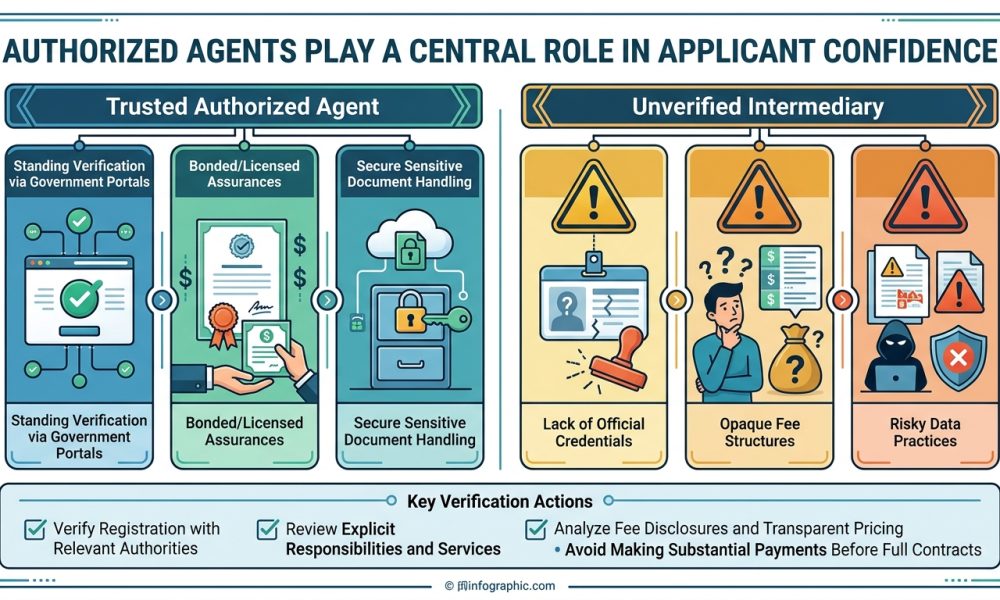
Prospective second citizenship applicants should verify official licensing, understand the differences between advisers and authorized filing agents, and establish clear protections for personal documents, payments, and communication before entering an investment migration agreement.
WASHINGTON, DC, November 8, 2026 — Families exploring citizenship by investment increasingly confront an important question before selecting a country or transferring a contribution: whether the person handling their application is actually authorized to represent them before the responsible government.
The distinction matters because an attractive website, international office, or favorable testimonial cannot independently establish legal authority to file nationality applications, handle sensitive financial information, or communicate official government decisions on a client’s behalf.
As Caribbean governments strengthen supervision of citizenship intermediaries, applicants should examine who is licensed, which services marketing representatives can handle, and what contractual safeguards apply if circumstances change or an application encounters problems.
Official Authorization Is More Than a Marketing Claim
Dominica’s Citizenship by Investment Unit says applications must reach the authority through a government-authorized agent, and prospective citizens cannot submit materials directly or appoint any consultant who advertises migration expertise under the published nationality procedures.
Its public agent register lists licensed representatives permitted to act for applicants, providing a starting point for independent verification that is more dependable than a logo copied onto promotional material or an unsupported claim of official connections.
Before signing, clients should compare the representative’s exact legal name and contact information with the current government listing, then confirm whether the person they speak with belongs to that authorized organization at the time of engagement.
Different Intermediaries Perform Different Functions
An international marketing company may introduce a prospective applicant to a program. At the same time, a licensed local agent prepares the official submission and communicates with the country’s citizenship unit under its specific rules, under the relevant government framework.
Dominica distinguishes authorized agents from registered subagents and licensed promoters, with the primary agent responsible for supervising permitted promotional activities and ensuring communications accurately reflect the government’s current requirements and eligibility conditions, including public-facing promotional representations.
A family dealing with several intermediaries should request a written explanation of each organization’s role, including who collects documents, issues invoices, forwards government instructions, and remains accountable for the formal citizenship application throughout the process.
Independent Verification Should Come Before Document Sharing
An initial inquiry may involve little personal information. Still, a completed citizenship file can contain passports, birth records, bank statements, residential histories, criminal clearances, and information identifying spouses or children across several jurisdictions.
Applicants should confirm the authorized agent’s standing before handing over those records, particularly when introductions arrive through social media, encrypted messaging services, referral networks, or a company using a name different from the registered filing entity.
A legitimate representative should be able to explain how the applicant can independently verify authorization with the relevant citizenship authority, without demanding immediate payment or discouraging direct checks against official government information, using independently available official records.
Government Registers Need Current Status Checks
St. Kitts and Nevis publishes an official list of authorized agents and separately identifies blocked, suspended, and probationary intermediaries, demonstrating why old brochures or historic relationships cannot establish a firm’s present standing, rather than relying on historical credentials.
A representative licensed when an applicant first made contact may have a changed regulatory status before formal submission, making a second verification appropriate when the engagement has continued for several months.
Applicants should also distinguish similar company names and overseas affiliates, because approval of one registered entity does not necessarily extend to every related business, independent referral service, or employee claiming the same authorization.
Due Diligence Starts With the Representative
Dominica describes authorized agents as performing preliminary know-your-client checks and reviewing application materials before official submission. At the same time, the citizenship unit and independent agencies conduct additional government-level financial and background investigations before further independent government verification.
That division of responsibility means an agent can identify missing records and explain screening questions. Still, it cannot certify that a final government investigation will approve an individual’s criminal, financial, or immigration history after reviewing the complete evidence.
Clients should expect careful preliminary questioning about identity, source of wealth, employment, residence, and family relationships, rather than treating the absence of questions as evidence that a contribution will guarantee nationality, during the earliest consultation stages.
Professional Agreements Should Define Deliverables
A written engagement should identify the exact entities providing services, the jurisdiction involved, the application route, the proposed family members, and the activities covered by the initial professional fee and subsequent charges, before the first payment occurs.
It should distinguish document assembly, translations, legal review, government filing, interview coordination, post-approval payment assistance, and passport applications, because these services do not necessarily fall under one fixed-price arrangement or timetable in the service contract.
Applicants should ask who will notify them about missing materials, how quickly official correspondence will be forwarded, and whether a designated contact remains responsible if the original adviser departs during processing, without losing continuity of representation.
Payment Instructions Require Separate Authentication
The contribution owed to a government program differs from fees payable to an agent, translator, investigator, or legal adviser. Hence, an itemized invoice is essential to understand what each proposed transfer covers.
Applicants should verify the permitted recipient, account details, payment milestone, refund rules, and applicable banking charges before sending funds, especially when instructions change unexpectedly, or a third-party account appears late in the process.
Neither a professional retainer nor a qualifying government contribution represents citizenship approval by itself, and a responsible intermediary should make that distinction clear when requesting signatures, payment authorizations, or additional financial documentation throughout the official naturalization process.
Confidentiality Requires Defined Handling Practices
Citizenship files can expose highly sensitive information about relatives, company ownership, investment accounts, addresses, and Identification documents, so applicants should ask how the representative stores, transmits, and limits access to those materials within the complete application package.
The engagement should explain whether translators, subcontractors, foreign offices, and independent screening firms may receive relevant records, along with the applicable retention procedures and the lawful basis for sharing information with authorities, in accordance with disclosed confidentiality arrangements.
Promises of absolute secrecy conflict with applications that require truthful disclosure to government investigators, so secure handling and limited authorized access are more credible safeguards than claims that identity information will never be shared.
Marketing Assurances Must Match Government Rules
Representatives sometimes emphasize fast processing, remote interviews, or family-inclusive contributions. Still, those statements need qualification when individual eligibility, document readiness, and screening outcomes can change the government’s decision or timetable, without acknowledging key procedural requirements.
A claim that no residence is required does not automatically mean every applicant can avoid personal interviews, biometric procedures, notarized declarations, or later visits imposed under the issuing country’s current citizenship legislation and administrative procedures.
Applicants should preserve copies of material representations made before payment and seek written clarification whenever an advertisement conflicts with the government schedule, especially regarding eligibility thresholds, refund rights, or mandatory appointments, before authorizing an irreversible financial commitment.
Applicants Must Attend Their Own Required Interviews
Dominica requires applicants aged sixteen or older to attend mandatory interviews, generally via secure virtual arrangements, and explicitly states that an authorized agent cannot attend or answer questions on the applicant’s behalf as part of official identity screening.
The representative may organize scheduling and explain the process. Still, truthful personal participation remains necessary because the interviewer may ask about identity, financial sources, residential history, and information in submitted records and supporting financial information.
Families should confirm the rules for older dependents and any accessibility or language arrangements beforehand, rather than assume one interview with the principal applicant completes the screening obligations for the entire household, under the published interview arrangements.
Approval Belongs to Government, Not the Agent
An authorized filing agent can prepare a complete application and communicate with the citizenship authority. Still, the government remains responsible for deciding whether the applicant satisfies the statutory conditions for naturalization, under the specific nationality legislation.
Dominica’s published procedure separates background investigations and approval in principle from the later qualifying contribution and formal issuance of naturalization certificates, underscoring why favorable preliminary feedback is not equivalent to a completed passport.
Consumers should reject any claim that a private adviser can guarantee sovereign approval, bypass sanctions checks, fabricate supporting records, or deliver government-issued nationality documents outside the relevant official processes, regardless of the proposed contribution amount.
Family Applications Demand Person-by-Person Review
A quotation covering several relatives can be misleading if an adult child, parent, or sibling does not satisfy the program’s dependency criteria, even though the principal applicant qualifies financially and passes initial screening.
Authorized representatives should assess each proposed relative’s age, relationship, citizenship, marital status, education, and relevant financial dependency before including that person in a family contribution category or projecting passport delivery, before setting a combined price.
The adviser should also explain whether later additions are possible and what government charges apply, since marriage, childbirth, graduation, or changes in household circumstances can alter future eligibility and financial commitments, after an initial citizenship grant.
Source-of-Funds Reviews Cannot Be Delegated Away.
Entrepreneurs may use company sale proceeds, dividends, gifts, inherited money, or trust distributions to finance citizenship, and each arrangement can require documents establishing ownership and a legitimate path into the final payment account.
An agent can help assemble corporate records and transaction explanations, but cannot replace the applicant’s responsibility to provide genuine evidence or the receiving financial institution’s independent obligations to examine incoming investment funds, regardless of the intermediary’s assurances.
A trustworthy representative should identify inconsistencies for lawful correction instead of proposing invented invoices, misleading declarations, artificial ownership histories, or unexplained transfers designed to conceal the actual financial source and any underlying irregularities.
Cross-Border Advertising Adds Another Verification Layer
A company may advertise Caribbean nationality services from a major international business center while relying on a separate, locally authorized firm to lodge an application, adding clarity to the contractual chain within a regulated local framework.
The governing agreement should identify whether the marketing firm acts as a promoter, referral partner, subcontractor, or principal service provider, and which licensed entity is responsible for official submissions and compliance, before requesting sensitive personal documents.
Before proceeding, applicants should establish how complaints and document requests will be handled if disputes arise between the overseas marketing office and the authorized local filing representative during government assessment, and who remains contractually responsible.
International Scrutiny Raises the Stakes for Intermediaries
An October 29, 2026, Reuters report on European pressure affecting Caribbean citizenship programs described concerns about security and visa-free travel alongside the significant revenue those programs generate for participating governments, affecting the international investment migration sector.
The debate does not establish that every intermediary or investor presents a risk. Still, it helps explain why governments are strengthening standards for authorized representatives, marketing practices, identity screening, and financial integrity across different regions and programs.
Applicants should treat accurate guidance about changing visa privileges as part of professional competence, rather than accepting claims that one favorable passport ranking or previous approval guarantees permanent international travel benefits, during a period of regulatory change.
American Citizens Retain Existing Legal Duties
The U.S. Department of State’s dual-nationality guidance explains that Americans who acquire another nationality generally retain applicable United States obligations, including requirements governing the use of an American passport when entering or leaving the country.
A citizenship intermediary should not portray a second passport as an automatic solution to tax reporting, court orders, identity checks, or other existing legal responsibilities that remain subject to the relevant jurisdiction’s laws.
Clients with cross-border businesses, retirement accounts, trusts, or complex family circumstances may need independent legal or tax advice alongside citizenship representation, because those separate subjects require professional qualifications beyond application administration in the legally responsible jurisdiction.
Passport Authentication Cannot Verify Agent Authority.
Modern biometric passports can contain electronically protected identity data. Still, a successful chip reading does not establish that an agent was licensed, government fees were properly paid, or a previously submitted application was complete.
The Amicus International Consulting guide on scanning passport NFC chips and understanding the results explains how technical checks differ from official determinations about identity documents and their current administrative status, in routine international travel preparation.
Applicants should therefore preserve the agent agreement, official receipts, application correspondence, naturalization certificates, and final passport records as separate evidence, recognizing that electronic authentication answers only a limited set of technical questions throughout the applicant’s nationality history.
Independent Advice Can Support an Informed Choice
Families exploring lawful second passport planning through Amicus International Consulting should examine the relevant government agent register, family eligibility, fee schedule, and document requirements before committing to a particular representative or nationality program.
A well-organized application may reduce avoidable omissions, but even thorough preparation cannot guarantee the government’s decision or prevent policy changes that affect future eligibility, processing standards, or foreign visitor privileges, as regulations evolve.
Applicant Confidence Depends on Verifiable Responsibility
A credible citizenship relationship begins with an identifiable authorized agent, clearly assigned responsibilities, transparent fees, and procedures for protecting documents, responding to government questions, and resolving problems without obscuring the decision-maker’s authority, throughout the applicant’s entire case.
Families should revisit an intermediary’s official standing at major milestones and keep copies of key communications, because authorization, financial commitments, and applicant circumstances can change between an initial consultation and formal naturalization.
Ultimately, authorized agents play a central role in applicant confidence not because they can sell approval, but because a properly regulated representative can guide applicants through evidence requirements while leaving citizenship decisions to government.




