
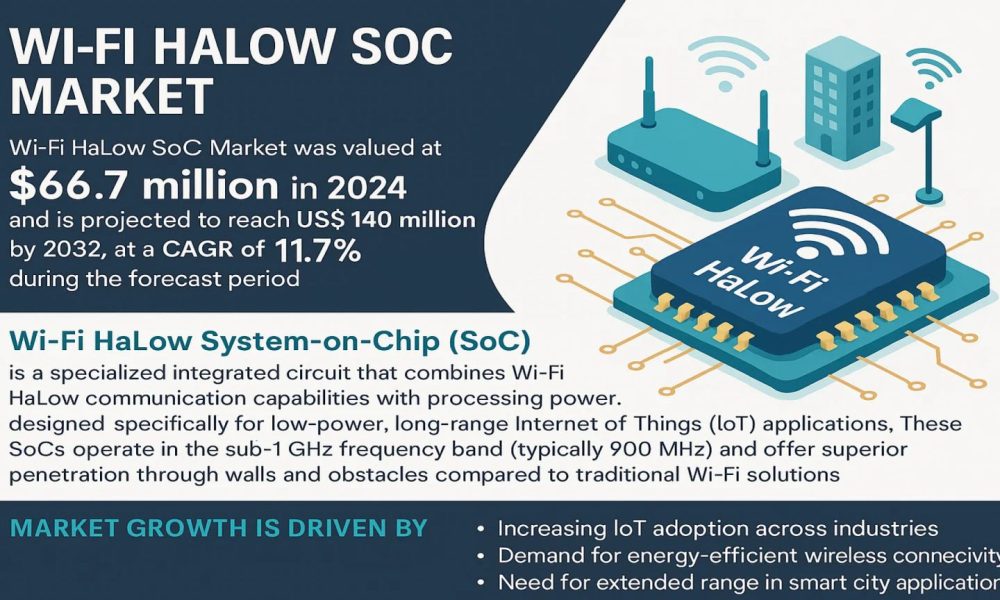
Wi-Fi HaLow SoC Market was valued at 66.7 million in 2024 and is projected to reach US$ 140 million by 2032, at a CAGR of 11.7% during the forecast period.
Wi-Fi HaLow System-on-Chip (SoC) is a specialized integrated circuit that combines Wi-Fi HaLow communication capabilities with processing power, designed specifically for low-power, long-range Internet of Things (IoT) applications. These SoCs operate in the sub-1 GHz frequency band (typically 900 MHz) and offer superior penetration through walls and obstacles compared to traditional Wi-Fi solutions.
The market growth is driven by increasing IoT adoption across industries, demand for energy-efficient wireless connectivity, and the need for extended range in smart city applications. However, deployment challenges in crowded RF environments may restrain growth in certain regions. Leading manufacturers including Newracom, Morse Micro, and Qualcomm are driving innovation in this space with advanced SoC designs that enable applications in smart agriculture, industrial automation, and health monitoring systems.
Receive Your Sample Report at No Cost- https://semiconductorinsight.com/download-sample-report/?product_id=117894
MARKET DYNAMICS
MARKET DRIVERS
Proliferation of IoT Devices Fuels Demand for Wi-Fi HaLow SoCs
The exponential growth of IoT-connected devices is a primary driver for the Wi-Fi HaLow SoC market, projected to reach 29 billion connected endpoints globally by 2027. Wi-Fi HaLow’s ability to provide long-range connectivity (up to 1 km) with low power consumption makes it ideal for battery-operated IoT devices. Unlike traditional Wi-Fi, HaLow operates in the sub-1 GHz spectrum, enabling better wall penetration and wider coverage – critical features for applications like smart agriculture and industrial IoT. Recent product developments, including Morse Micro’s MM6108 production samples released in Q1 2024, demonstrate the technology’s readiness for mass IoT deployments.
Energy Efficiency Advantages Accelerate Market Adoption
Wi-Fi HaLow SoCs consume up to 90% less power than conventional Wi-Fi solutions, enabling battery life measured in years rather than hours. This power efficiency is driving adoption in markets where frequent battery replacement is impractical, such as remote sensors and wearable medical devices. Smart city deployments are leveraging these benefits – a single HaLow access point can connect thousands of low-power sensors across urban infrastructure while maintaining years of maintenance-free operation. With energy efficiency becoming a key purchasing criterion across industries, Wi-Fi HaLow presents a compelling value proposition.
The technology’s ability to maintain connectivity in challenging environments while conserving power creates new possibilities for IoT applications previously constrained by battery limitations.
Recent Developments in Wi-Fi HaLow SoC Market:
- Integration in IoT Devices:
Leading semiconductor manufacturers have started integrating Wi-Fi HaLow System-on-Chip (SoC) solutions into IoT devices such as smart meters, industrial sensors, and smart home appliances. This integration is improving low-power, long-range connectivity for IoT applications. - Partnerships & Collaborations:
Companies like Texas Instruments and NXP Semiconductors have formed strategic partnerships to accelerate the development and deployment of Wi-Fi HaLow SoCs, focusing on enhanced connectivity, security, and energy efficiency. - Advancements in Low-Power Technology:
Recent SoC releases emphasize ultra-low power consumption, enabling battery-operated devices to last longer, which is critical for industrial IoT and smart agriculture applications. - Regulatory Approvals and Standardization:
Wi-Fi HaLow technology has seen increased adoption after regulatory bodies in the U.S., Europe, and Asia approved sub-1 GHz bands for long-range IoT communication. Standardization by the Wi-Fi Alliance has boosted industry confidence in deploying HaLow SoCs at scale. - Product Launches Targeting Industrial Applications:
New SoC products launched in 2025 are optimized for industrial automation, logistics, and smart city deployments, offering improved range (up to 1 km) and enhanced network reliability. - Rising Investment in Research & Development:
Companies are investing heavily in R&D to expand HaLow SoC capabilities, including support for mesh networking, higher data rates, and stronger cybersecurity features.
MARKET OPPORTUNITIES
Industrial IoT Presents High-Growth Potential for Wi-Fi HaLow SoCs
The industrial automation sector represents the most promising opportunity for Wi-Fi HaLow adoption, with the Industrial IoT market projected to surpass $100 billion by 2026. HaLow’s combination of long range, penetration capabilities, and moderate bandwidth perfectly matches industrial requirements for connecting sensors across large facilities. Recent pilots in manufacturing plants have demonstrated HaLow’s ability to replace wired sensor networks while providing superior flexibility and lower installation costs. As Industry 4.0 initiatives accelerate globally, Wi-Fi HaLow is positioned as a compelling wireless alternative for industrial applications.
Smart agriculture applications also show strong potential. HaLow’s kilometer-scale connectivity enables cost-effective monitoring across vast agricultural operations, from soil sensors to livestock tracking. With the precision agriculture market growing at over 12% annually, Wi-Fi HaLow SoC providers have significant expansion opportunities in this sector.
Receive Your Sample Report at No Cost- https://semiconductorinsight.com/download-sample-report/?product_id=117894
List of Leading Wi-Fi HaLow SoC Manufacturers
- Qualcomm Incorporated (U.S.)
- Broadcom Inc. (U.S.)
- Newracom (South Korea)
- Morse Micro (Australia)
- MediaTek Inc. (Taiwan)
- Newratek (China)
- Taixin Semiconductor (China)
Segment Analysis:
By Type
Maximum Bandwidth: 2 MHz Segment Holds Significant Share Due to Low-Power IoT Connectivity Needs
The Wi-Fi HaLow SoC market is segmented based on type into:
- Maximum Bandwidth: 2 MHz
- Primary sub-applications: Low-power IoT sensors, wearables, and smart meters
- Maximum Bandwidth: 4 MHz
- Primary sub-applications: Security cameras, industrial monitoring, and wireless audio devices
- Others
- Includes emerging bandwidth configurations for specialized IoT applications
By Application
Industrial Automation Leads Market Adoption Due to Long-Range Connectivity Requirements
The market is segmented based on application into:
- Industrial Automation
- Includes wireless machine monitoring and factory automation systems
- Smart Agriculture
- Covers agricultural sensors and remote monitoring systems
- Smart Cities
- Includes traffic management and public safety applications
- Smart Home and Health Monitoring
- Encompasses medical devices and home automation systems
By End User
Industrial Sector Accounts for Major Adoption Due to Robust IoT Infrastructure Needs
The market is segmented based on end user into:
- Industrial Sector
- Consumer Electronics
- Healthcare Providers
- Agricultural Enterprises
- Municipal Authorities
Other Topic- Thermal Switches Market
CONTACT US:
City vista, 203A, Fountain Road, Ashoka Nagar, Kharadi, Pune, Maharashtra 411014
[+91 8087992013]




