
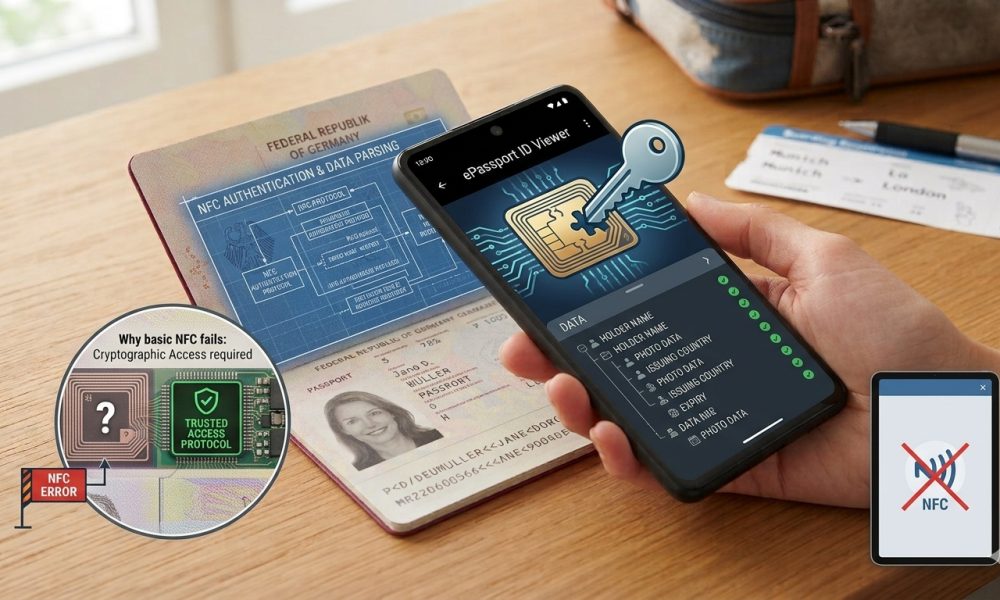
Specialized software handles document access protocols and interprets the structured identity information stored inside electronic passports.
WASHINGTON, DC, October 2, 2026 — A smartphone may contain the same general Near Field Communication hardware used for payments, access cards, and consumer tags, but reading an electronic passport successfully requires specialized software that understands the document’s security protocols, structured files, cryptographic protections, and identity data.
A basic NFC application can often detect ordinary tags and display simple records. Yet, an electronic passport behaves more like a secure contactless computer containing standardized travel-document applications whose contents become meaningful only when appropriate software establishes access and correctly interprets the resulting information.
Electronic Passports Are Not Ordinary NFC Tags
Many everyday NFC tags contain comparatively simple records that compatible phones can retrieve immediately, allowing a generic application to display text, web addresses, identifiers, or other information without performing a specialized identity-document security procedure.
Electronic passports use contactless technology differently because their chips implement standardized machine-readable travel-document structures, access controls, secure messaging, biometric records, signed security information, and other elements designed specifically for government identity credentials rather than consumer tagging.
The NFC Radio Is Only the Communications Layer
Thesmartphone’ss NFC hardware provides the physical means to exchange radio-frequency messages with a compatible passport chip. Still, that capability alone does not explain which electronic application to select or how to request protected passport information.
Specialized passport software supplies the higher-level logic needed to recognize the document, establish the appropriate electronic session, interpret returned files, and determine which security procedures the particular passport generation supports.
The Passport Application Must Be Understood Correctly
An electronic passport contains a defined travel-document application whose files follow internationally standardized structures, so the reader needs software that can identify those structures and request information according to the expected protocol.
A generic NFC utility designed primarily for consumer tags typically has no reason to understand passport data groups, security objects, access-control information, digital-signature structures, biometric Image formats, or the relationships among those components.
The Physical Passport Usually Provides the Starting Information
Before ordinary protected information becomes available, specialized software commonly captures information from the physical passport’s machine-readable zone. It uses selected document values during the chip-supported electronic access procedure.
The ICAO electronic passport security specifications describe mechanisms including Basic Access Control and Password Authenticated Connection Establishment, which regulate access and establish protected communication between electronic travel documents and compatible inspection systems.
A Basic NFC App Does Not Automatically Understand PACE
Password Authenticated Connection Establishment, commonly called PACE, uses document-associated information in a cryptographic exchange to create strong session keys before protected communication proceeds between the passport and reader.
Software must recognize whether the passport supports PACE, process the relevant access information, complete the required exchange, and then continue communication through the secure session established by that procedure.
Older Documents Can Require Different Access Procedures
Electronic passports have evolved over many years, so some legitimate documents rely on Basic Access Control, while newer implementations can support PACE or additional mechanisms associated with more advanced electronic passport generations.
Specialized software therefore needs compatibility across different document generations, rather than assuming that every passport the smartphone encounters responds to a single universal access method.
Secure Messaging Changes the Electronic Conversation
After an appropriate access procedure succeeds, subsequent communication can become encrypted and integrity-protected through secure messaging, meaning the reader can no longer treat commands and responses like unprotected, ordinary NFC records.
The software must maintain the session’s cryptographic state, process protected messages correctly, and recognize when additional passport procedures replace or strengthen the session keys already in use.
Passport Files Have Defined Meanings
Electronic passport information is organized into standardized files and data groups whose contents represent particular categories of identity, biometric, security, or document information rather than appearing as one simple block of readable text.
A specialized application understands those categories and can translate the underlying electronic structures into recognizable information such as names, dates, document details, facial images, and security-validation results.
Data Groups Need Proper Interpretation
Individual passport data groups can contain different kinds of records, including machine-readable identity information, the holder’s facial Image, optional additional biometrics, chip-authentication information, and other standardized elements associated with the document.
Simply retrieving a sequence of bytes provides limited value unless the software understands which data group produced them, how that information is encoded, and how it relates to the document’s broader security structure.
The Facial Image Is Not Just an Ordinary Photo File
The biometric portrait stored inside an electronic passport follows standardized biometric structures. An application must extract and interpret it correctly before it can display it or use it for legitimate identity-verification purposes.
Specialized passport-reading software performs that interpretation automatically, allowing users to see the electronically stored reference portrait without needing to understand the underlying biometric data container.
The Document Security Object Requires Cryptographic Processing
Electronic passports also contain a signed security object that holds cryptographic reference values tied to protected data groups, allowing capable software to determine whether retrieved information remains consistent with what the issuing authority originally signed.
A generic NFC application can theoretically encounter electronic bytes associated with those structures without any meaningful way to validate their signature, certificate relationships, or cryptographic references.
Reading and Authenticating Are Different Operations
Specialized passport software may first retrieve electronic information and then perform Passive Authentication to determine whether that information remains associated with a legitimate digital signature and unchanged protected records.
A simpler application might display the same visible data successfully without performing that additional Authentication, showing why the phrase “read the passport” should not automatically be interpreted as “authenticated the passport.”
Trusted Certificates Are Required for Stronger Validation
Digital signatures are useful only when the application can link them to trusted public certificates issued by the issuing government, creating a recognized cryptographic chain rather than accepting any signature just because it exists.
Professional passport software can maintain or receive the certificate information needed for this process. At the same time, a generic NFC reader usually has no passport-specific trust store to evaluate international issuing credentials.
Certificate Coverage Can Affect the Result
Even purpose-built passport applications can produce incomplete Authentication results when their trusted certificate collection lacks information required for a particular issuing authority, despite the underlying document being entirely legitimate.
The strength of mobile verification therefore depends not only upon correct cryptographic software but also upon the quality, currency, and completeness of the trust material available to the application.
Some Applications Perform Anti-Cloning Checks
Electronic passports can support mechanisms such as Active Authentication or Chip Authentication that provide additional evidence concerning whether the current chip possesses protected cryptographic credentials associated with the legitimate document.
Supporting those procedures requires considerably more passport-specific logic than ordinary NFC tag reading because the software must understand the relevant security information and correctly evaluate cryptographic interactions performed during the live session.
Specialized Software Recognizes Which Checks Are Available
Not every passport supports the same Authentication mechanisms, so purpose-built software must examine the document’s electronic information and determine which procedures can legitimately be performed.
A missing security mechanism can reflect the document generation rather than fraud, making protocol awareness essential before software interprets an unavailable check as a suspicious result.
Sensitive Biometrics Can Require Additional Authorization
Some passports store fingerprints or other secondary biometrics behind stronger access protections, preventing ordinary readers from retrieving those records even after standard electronic communication is established.
Terminal Authentication can require inspection equipment to present recognized authorization credentials before the chip releases protected biometric information, meaning consumer software cannot bypass restrictions simply by having ordinary NFC access.
A Generic NFC Utility Cannot Create Government Authorization. Communicating with an electronic passport does not provide the credentials needed for privileged biometric access, because those permissions depend on cryptographic authorization infrastructures managed by issuing and inspection authorities.
Specialized software can understand that protected data exist while correctly recognizing that the current reader lacks authorization, which is fundamentally different from treating inaccessible files as corrupted or absent.
Smartphone Operating Systems Add Their Own Requirements
Mobile platforms impose permissions and application-level controls governing access to NFC hardware, meaning developers need software specifically configured for contactless identity-document communication rather than relying upon unrestricted Background access.
Professional mobile passport-reading frameworks therefore combine operating-system integration with travel-document protocols, allowing the application to coordinate camera capture, NFC communication, cryptographic processing, and structured result interpretation within one controlled workflow.
Commercial SDKs Combine Several Specialized Functions
Current platforms such as the Regula Document Reader SDK combine machine-readable zone recognition, document Identification, RFID processing, biometric data extraction, and selected authenticity checks within software designed specifically for identity documents.
This illustrates why passport scanning differs substantially from ordinary NFC reading: the useful result depends on coordinating optical recognition, contactless communication, security protocols, document structures, and Authentication procedures, not merely detecting a radio-frequency tag.
The Camera and NFC Reader Work Together
Purpose-built passport applications commonly begin with the smartphone camera because optical capture of the data page provides machine-readable information that helps initiate the electronic session with the chip.
The workflow therefore combines two separate smartphone capabilities: the camera reads the physical credential, and the NFC interface communicates with its electronic counterpart before comparing information from both sources.
Optical Character Recognition Needs Passport Awareness
A generic camera app can photograph the machine-readable zone. Still, specialized document software recognizes its standardized structure, parses its fields, validates check digits, and converts the characters into values relevant to passport processing.
That interpretation reduces manual entry and helps ensure that electronic access uses correctly captured document information rather than an arbitrary text string produced by ordinary image-recognition software.
Check Digits Help Detect Capture Errors
Machine-readable passport fields include standardized check digits that let specialized software identify many transcription or optical-recognition errors before those values enter the chip-access process.
A basic NFC utility ordinarily does not handle that preliminary document validation because it communicates with generic tags rather than interpreting the physical and electronic sides of a government identity credential together.
A Successful Connection Still Requires Data Parsing
Once the phone establishes communication, the returned information may include binary structures, encoded text, images, certificates, signatures, security parameters, and other data that need specialized processing before it becomes understandable.
Purpose-built applications translate those structures into meaningful results for users, while ordinary NFC tools may expose little more than technical identifiers or raw information without providing a useful interpretation of the passport.
Authentication Results Also Need Interpretation
A specialized application can distinguish whether a security procedure passed, failed, remained unsupported, or could not be completed because required trust information was unavailable, giving the user far more context than a single overall result.
That distinction matters because an unsupported anti-cloning check is not equivalent to a failed one, just as a missing country certificate is not equivalent to proof that the passport’s digital signature was forged.
Different Apps Can Reach Different Levels of Verification
One purpose-built application might retrieve only standard chip information. At the same time, another can perform Passive Authentication, issuer-certificate validation, Active Authentication, Chip Authentication, facial comparison, or additional consistency checks depending upon its design.
Users should therefore evaluate what a passport application actually performs rather than assuming every specialized NFC reader provides identical conclusions merely because each can display information from an electronic passport.
Consumer Apps Can Demonstrate the Difference Clearly
Applications such as ReadID Me let passport holders experience the electronic workflow directly by scanning the data page and then establishing NFC communication with the chip, rather than relying on a generic tag-reading interface.
The process demonstrates that passport reading requires coordinated document capture, access establishment, secure communication, structured data interpretation, and optional security validation rather than a single uncomplicated NFC request.
Basic Tag Formats Are Not the Passport’s Main Language
Many consumer NFC applications focus on common tag formats for sharing relatively simple records. At the same time, electronic passports rely on smart-card communication structures and machine-readable travel-document applications designed for secure government identity use.
The fact that both technologies use short-range wireless communication does not make their application logic interchangeable, just as two networked computers can use similar radio hardware while running entirely different secure protocols.
The Passport Chip Can Refuse Improper Requests
A properly functioning electronic passport does not need to cooperate with every request generated by nearby NFC software because its operating environment enforces supported protocols, application selection, access controls, and protected-file permissions.
A generic NFC application’s failure to retrieve meaningful passport information can therefore reflect normal security behavior rather than evidence that the chip is missing, defective, or improperly programmed.
Reading Raw Data Would Not Provide Complete Verification
Even software capable of retrieving raw passport files would still need to interpret cryptographic signatures, validate hashes, evaluate certificates, understand supported security mechanisms, and connect the electronic records with visible document information before producing a useful authenticity assessment.
Passport verification therefore depends upon what the application understands about the retrieved information rather than merely whether it can copy electronic bytes from the contactless interface.
Physical Inspection Remains Outside the NFC Session
Specialized chip-reading software cannot independently establish whether ultraviolet artwork, watermarks, tactile printing, optical devices, laser engraving, binding, or other physical passport characteristics remain genuine and intact.
Professional verification consequently combines electronic results with physical examination rather than treating sophisticated NFC processing as an automatic replacement for inspection of the actual booklet.
Holder Verification Requires Another Function Again
Reading and authenticating the passport chip also does not automatically establish that the person presenting the document is its rightful holder, because electronic communication concerns the credential rather than the individual carrying it.
A separate facial or other authorized biometric comparison can connect the traveler with the authenticated identity information when the verification environment supports that additional procedure.
Current Passport Status Usually Comes From Outside the Chip
A passport can remain electronically authentic after its government reports it lost, stolen, canceled, or revoked because the chip’s original signed information does not necessarily change when an administrative status event occurs later.
Specialized NFC software therefore cannot substitute automatically for official status databases unless the application operates within an authorized system that separately receives current government information.
Professional Systems Combine More Than One Technology
Government and commercial identity-verification systems can integrate camera capture, NFC communication, document-reference databases, cryptographic certificate stores, biometric comparison, physical-image analysis, and server-side verification into one coordinated workflow.
The NFC interface is only one component in that environment, so specialized software must connect radio communication with the other technologies needed to interpret and verify the passport meaningfully.
Software Quality Determines What the Hardware Can Accomplish
Two smartphones containing similar NFC hardware can produce dramatically different passport-verification results when one runs sophisticated travel-document software, and the other uses a basic consumer tag-reading utility.
The distinction shows that the phone’s radio is not the decisive element because useful passport processing depends on protocol implementation, data interpretation, certificate management, cryptographic verification, and careful presentation of the resulting evidence.
Specialized Software Does Not Eliminate Security Boundaries
Purpose-built applications remain subject to the restrictions imposed by the passport itself, meaning professional software cannot legitimately retrieve protected information for which the current inspection system lacks the required authorization.
This limitation highlights a key feature of electronic passport design: greater software sophistication improves legitimate interpretation without turning specialized applications into universal tools that bypass access controls.
The International Standard Makes Specialized Readers Possible
ICAO standardization gives passport-reading software a common framework for recognizing electronic travel-document structures issued by many different governments rather than requiring completely unrelated technology for every country.
That interoperability lets well-designed smartphones and inspection systems process international ePassports while still respecting the access controls, cryptographic requirements, and document-generation differences implemented by individual issuing authorities.
Passport Reading Is Really a Sequence of Specialized Tasks
A useful mobile scan can involve recognizing the document, capturing the machine-readable zone, validating its structure, establishing chip access, negotiating secure communication, selecting the passport application, retrieving data groups, decoding biometrics, and performing supported Authentication procedures.
A basic NFC application generally addresses only the underlying radio communication portion of that sequence, leaving most of the travel-document-specific work necessary for a meaningful passport result unperformed.
The Difference Explains Many Failed Consumer Scans
Users sometimes conclude that a passport has no functioning chip when an ordinary NFC app fails to display useful information, even though the software may lack the protocols needed to communicate with electronic travel documents correctly.
Testing with a reputable passport-specific application provides more meaningful evidence because the software is designed around the document structures and access mechanisms that legitimate ePassports actually use.
Specialized Apps Still Have Different Limits
Even among passport-specific applications, capabilities vary according to certificate coverage, supported security protocols, platform restrictions, biometric functions, physical-document analysis, and whether processing occurs entirely on the device or uses additional infrastructure.
A successful result should therefore be interpreted based on the exact checks performed, rather than assuming specialized software automatically reproduces every capability found in government border-control systems.
The Software Makes Structured Passport Data Understandable
Through Amicus International Consulting’s passport security resource, readers can examine how electronic access, secure messaging, digital signatures, chip Authentication, physical inspection, biometrics, and status verification contribute different evidence during modern passport examination.
Specialized passport software plays an important role in that architecture because it converts standardized electronic structures and cryptographic procedures into results that users, identity professionals, and inspection systems can interpret meaningfully.
NFC Hardware Opens the Radio Connection, but Software Does the Passport Work
Reading an electronic passport requires more than detecting a contactless chip because specialized software must understand how the document grants access, protects its communication, organizes its identity records, represents biometric information, and exposes cryptographic evidence concerning authenticity.
A basic NFC application typically lacks that passport-specific intelligence, so it cannot perform the coordinated access, Authentication, and verification required for meaningful examination of an electronic travel document.
The smartphone supplies convenient radio hardware, but specialized travel-document software ultimately transforms that hardware into a passport reader by implementing the international standards and security procedures that make protected electronic identity information usable without treating the chip like an ordinary consumer tag.




