
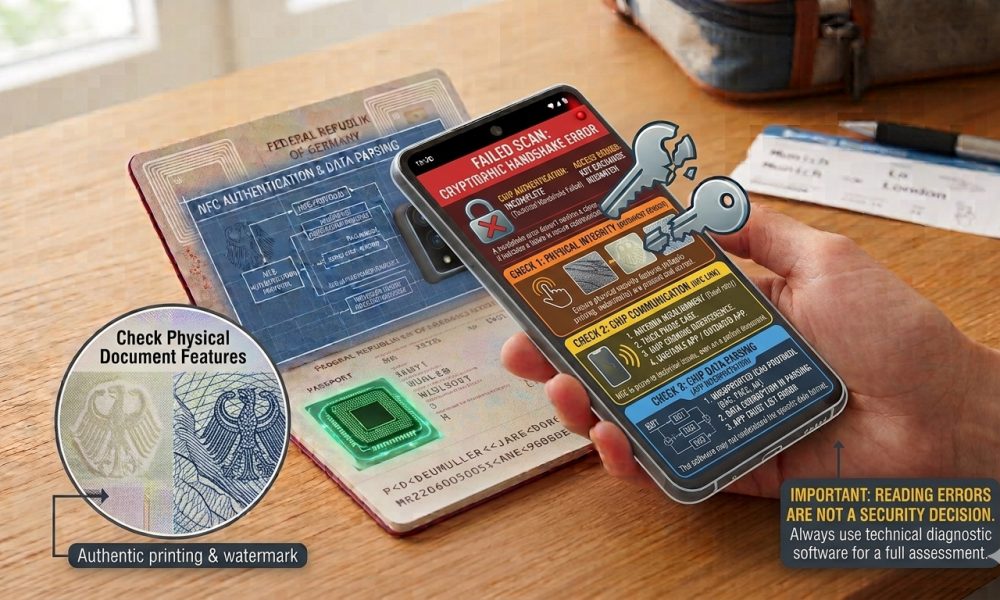
Reading errors require careful interpretation because technical problems can prevent access to an otherwise functioning chip.
WASHINGTON, DC, October 2, 2026 — When a smartphone passport Application reports that it cannot detect or read an electronic chip, the result can be concerning. Still, that failure alone does not establish that the passport is counterfeit, improperly issued, or missing its expected electronic component.
A failed mobile read can result from antenna alignment, incorrect machine-readable information, software compatibility, protective cases, unstable NFC communication, damaged electronics, incomplete certificate coverage, or other technical circumstances that require careful interpretation before conclusions about authenticity are justified.
A Failed Read Is a Technical Result, Not an Authenticity Verdict
The key distinction is between a smartphone failing to communicate with a passport and an Authentication system positively establishing that a passport contains fraudulent electronic information, because those outcomes represent fundamentally different kinds of evidence.
The ICAO ePassport validation guidance specifically recognizes that a passport may fail to respond because it is not electronic or because an electrical problem prevents an otherwise electronic passport from communicating with the inspection reader.
Several Steps Occur Before the Chip Can Be Fully Checked
A smartphone passport scan usually involves optical capture of the identity page, interpretation of the machine-readable zone, establishment of chip access, NFC communication, protected messaging, retrieval of electronic records, and whatever Authentication procedures the particular Application supports.
Failure anywhere within that sequence can prevent the user from reaching later Authentication stages, which means an Application reporting an unsuccessful scan does not necessarily reveal which component actually caused the problem.
The Camera Scan Can Fail Before NFC Even Begins
Many passport-reading applications first capture the machine-readable zone because selected information from those standardized lines helps establish the electronic access procedure used by the passport chip.
If the Application misreads a single digit in the passport number, birth date, expiration date, or associated check information, the electronic interaction can fail even if the contactless chip and smartphone hardware remain fully operational.
Glare Can Cause Incorrect Machine Readable Information
Security laminates, polycarbonate surfaces, overhead lights, smartphone flashes, page curvature, and reflective passport features can create glare that obscures one or more machine-readable characters during Camera capture.
A user may therefore encounter what appears to be an electronic chip failure when the underlying problem actually occurred during optical recognition several seconds before the Application attempted NFC communication.
Manual Entry Can Sometimes Resolve an Optical Problem
Purpose-built passport applications often let you enter or correct machine-readable information manually when the Camera can’t accurately recognize printed characters under the available lighting conditions.
This alternative helps distinguish optical recognition difficulties from genuine contactless communication problems without requiring any physical modification, opening, or potentially damaging examination of the government-issued passport.
NFC Antenna Alignment Is Another Frequent Cause
A smartphone and passport communicate through two hidden antenna systems that must be close enough and aligned well enough for reliable contactless communication to begin and remain stable throughout the electronic reading session.
Because phone manufacturers and passport issuers can place their antennas in different locations, a position that works immediately with one device combination can fail with another equally legitimate combination.
Small Position Changes Can Produce Large Differences
NFC passport communication occurs over a very short range, meaning moving the smartphone only a modest distance across the booklet can transform an unsuccessful reading attempt into a stable electronic connection.
Users unfamiliar with this characteristic may understandably interpret repeated failures as evidence that the document contains no working chip when the phone is being held away from the passport antenna’s strongest coupling area.
The Phone Should Usually Remain Still After Detection
Once a passport Application indicates that NFC communication has started, maintaining the phone’s position becomes important because the electronic session may continue. In contrast, the Application retrieves several records and performs supported security procedures.
Moving the phone immediately after the first vibration or progress indicator can interrupt a legitimate reading attempt before the software finishes obtaining the information it needs.
Intermittent Communication Can Look Like a Dead Chip
A marginal antenna position can allow the smartphone to detect the passport briefly before losing the connection during data retrieval, producing repeated starts and failures that users may interpret as an electronic defect.
In reality, the chip may respond correctly whenever coupling is sufficient, but normal movement prevents the contactless session from staying stable long enough for the app to finish processing.
Phone Cases Can Weaken the Connection
Protective smartphone cases add physical distance between the handset’s NFC antenna and the passport, which can matter when the two components already need proximity for reliable communication.
Cases containing magnets, metal plates, card holders, or other materials can add interference, making temporary removal a reasonable troubleshooting step before concluding the passport’s electronic condition.
Passport Covers Can Cause Similar Problems
Aftermarket passport wallets, protective sleeves, travel organizers, and RFID-blocking products can interfere intentionally or unintentionally with the same radio-frequency communication needed for an authorized smartphone passport scan.
Removing those accessories allows the phone to communicate more directly with the booklet and eliminates one obvious explanation for a scan that repeatedly fails despite correct Application procedures.
RFID Blocking Can Prevent Legitimate Reading Too
A product designed to reduce unauthorized RFID or NFC communication cannot distinguish automatically between an unwanted reader and a passport holder deliberately attempting to scan the document with authorized software.
A passport enclosed within effective blocking material can therefore appear completely unresponsive until the protective accessory is removed, while the chip itself remains fully functional and unchanged.
Different Smartphones Produce Different Reading Experiences
Two phones with NFC hardware can behave differently with the same passport because antenna placement, receiver sensitivity, controller design, operating-system implementation, and Application integration vary across manufacturers and generations.
A document that repeatedly fails on one handset but reads normally on another provides useful evidence that the original problem may involve the first device rather than the passport.
NFC Capability Alone Does Not Guarantee Passport Compatibility
A smartphone can support ordinary contactless payments or consumer NFC tags without necessarily providing identical performance with every electronic travel-document configuration encountered internationally.
Software support, NFC technology characteristics, operating-system interfaces, and passport generation can all affect whether the device completes the specialized communication needed for an ePassport reading session.
Generic NFC Apps Can Produce Misleading Results
Electronic passports are not ordinary consumer NFC tags containing simple unrestricted records, because access protocols and secure messaging regulate communication before protected identity information becomes available.
A generic NFC utility that reports no readable information therefore provides weak evidence of passport authenticity, especially when the software was never designed to understand electronic machine-readable travel documents.
Specialized Passport Software Is a Better Test
Purpose-built applications understand machine-readable information, electronic passport access procedures, secure messaging, structured data groups, biometric records, digital signatures, and supported anti-cloning mechanisms, rather than merely searching for a generic NFC record.
The ReadID Me Application provides one example of passport-specific mobile software whose published troubleshooting guidance notes that failed NFC readings frequently involve antenna alignment, covers, document positioning, or compatible-tag differences rather than fraud.
Software Version Can Affect Compatibility
Passport-reading applications evolve as developers add support for newer operating systems, devices, protocols, and document implementations, meaning an outdated Application can encounter problems that a current supported version handles successfully.
Updating reputable passport-specific software can therefore be a reasonable troubleshooting step before treating repeated technical failures as evidence that something is wrong with the travel document.
Operating-System Changes Can Affect NFC Behavior
Mobile operating systems control the Application interfaces used to access NFC hardware, and major updates can change permissions, session handling, supported functionality, or other technical behavior that affects passport-reading applications.
A scanning problem that appears suddenly after a phone update may therefore require an Application update or configuration change rather than investigation of a passport that previously functioned correctly.
Document Condition Can Affect the Electronic Component
A passport remains a physical object that can bend, compress, absorb moisture, endure temperature changes, and suffer accidental impacts and years of repeated handling, creating the possibility that an antenna or electronic connection becomes damaged.
Such damage can make a legitimate government-issued document electronically unreadable without transforming the booklet into a counterfeit passport, because authenticity and hardware condition remain separate characteristics.
Electronic Failure Can Occur Without Visible Damage
A passport antenna is embedded within the document and can potentially develop an electrical problem that leaves little obvious evidence visible on the exterior of the booklet.
An apparently pristine passport can therefore experience contactless communication difficulties, just as another heavily worn passport can continue reading successfully despite significant cosmetic deterioration around its covers and pages.
Visible Damage Also Does Not Prove Electronic Failure
Bent corners, worn covers, scratches, faded exterior printing, or other normal signs of use can make a passport look well traveled without necessarily affecting the contactless electronics inside the document.
Judging chip functionality from cosmetic condition alone can be as misleading as judging passport authenticity solely by whether a consumer smartphone establishes an NFC connection.
A Damaged Chip Does Not Automatically Invalidate the Booklet
Whether an electronically unreadable passport remains acceptable for travel depends on the policies of the issuing government and receiving border authorities, not on a consumer Application’s interpretation of a failed scan.
A legitimate passport can remain identifiable through physical security features, machine-readable information, government records, and traditional inspection methods, even when its electronic component malfunctions.
Official Systems Expect Unreadable Chips to Occur
ICAO operational guidance recognizes that an ePassport may not respond to inspection equipment and directs authorities to consider whether an electrical issue or other explanation prevents normal communication.
That approach matters because border-security systems should investigate unexplained electronic failure without automatically treating every traveler carrying an unreadable electronic passport as possessing a counterfeit document.
Unreadable Chips May Receive Additional Examination
A failed chip read can reasonably cause an inspection system or officer to examine the passport more closely because authorities lose an important electronic source of Authentication evidence when the chip cannot be accessed.
Additional scrutiny does not mean fraud has already been established, because closer examination aims to determine whether a technical malfunction, ordinary damage, alteration, or another explanation accounts for the failure.
Physical Security Features Become More Important When NFC Fails
When inspectors cannot retrieve electronic information, they can still examine polycarbonate construction, laser personalization, holographic devices, ultraviolet artwork, microprinting, watermarks, booklet binding, perforations, and other physical characteristics associated with the document.
These independent safeguards ensure that passport Authentication does not collapse completely merely because one electronic component becomes unavailable during inspection.
The Machine Readable Zone Still Provides Useful Information
Even when the contactless chip cannot be read, the printed machine-readable zone can provide standardized identity and document information for conventional processing and comparison with appropriate government systems.
The physical passport therefore retains several inspection functions separate from the NFC component, another reason electronic failure and document counterfeiting should not be treated as synonymous conclusions.
A Failed Read Is Different From Failed Cryptographic Authentication
An Application that cannot communicate with the chip has not necessarily reached the point where it can test the digital signature protecting the electronic passport information.
By contrast, software that successfully retrieves electronic records and then determines that a cryptographic signature is invalid produces a fundamentally different result that deserves separate interpretation and potentially much greater concern.
Missing Trust Certificates Create Another Kind of Inconclusive Result
A passport Application can read chip information successfully yet still be unable to validate the issuing country’s signature because the software lacks the trusted certificate needed to complete the Authentication chain.
That situation should be distinguished from both NFC communication failure and a demonstrably invalid digital signature, because each outcome provides different evidence and requires different interpretation.
A Consumer App May Have Limited Certificate Coverage
Mobile applications can maintain certificate collections of varying completeness, particularly when designed as consumer demonstration tools rather than components of an official national border system with extensive trust infrastructure.
An Application that marks a country-signature check as unavailable or inconclusive may therefore be revealing a limitation of its certificate store rather than identifying fraud within the passport.
A Successful NFC Read Does Not Prove Authenticity Either
The caution around failed scans works in both directions because a successful chip read should not automatically be interpreted as definitive proof that the entire passport is authentic and valid.
Stronger verification requires digital-signature Authentication, appropriate certificate trust, supported anti-cloning procedures, comparison with the physical document, holder verification, and current government status information where those checks are relevant.
A Genuine Chip Can Exist in a Passport Requiring Further Examination
Electronic records can authenticate successfully while authorities still identify concerns involving physical alteration, holder identity, booklet construction, current status, or another component outside the chip-validation process.
Passport security therefore depends upon several independent checks rather than a simplistic model in which successful NFC means genuine and unsuccessful NFC means counterfeit.
A Counterfeit Can Also Attempt to Disable Electronic Examination
Although technical problems often explain failed readings, inspectors cannot ignore the possibility that someone deliberately interfered with electronics to prevent comparison between protected chip information and altered physical personalization.
This possibility explains why persistent chip failure may justify closer examination without supporting the much stronger conclusion that failure itself proves deliberate manipulation.
Patterns of Evidence Matter More Than One Error Message
A failed mobile read becomes more informative when considered alongside the passport’s physical characteristics, machine-readable information, behavior on another compatible device, government records, and results from professional inspection equipment.
One consumer Application error provides relatively little context, while several independent inconsistencies pointing toward the same concern can justify a more substantial investigation by qualified authorities.
Testing Another Compatible Phone Can Help Isolate the Problem
When one smartphone repeatedly fails, trying the same passport on another supported device with a reputable passport-specific app can help determine whether the original phone is contributing to the problem.
A successful reading on another device strongly suggests that the first failure involved phone hardware, software, alignment, or configuration rather than complete absence of a functioning passport chip.
Failure Across Several Devices Still Does Not Prove Fraud
If several compatible phones fail to read the same document, the evidence becomes more consistent with a passport-side communication problem, but that finding still does not establish why the problem exists.
A damaged antenna, defective chip, manufacturing issue, or deliberate interference can produce superficially similar results, making official inspection more appropriate than speculation based upon consumer scanning alone.
Passport Holders Should Avoid Destructive Testing
Cutting, peeling, puncturing, aggressively bending, heating, separating layers, or otherwise modifying the document to locate or test its electronics can damage security features and create serious additional problems.
Non-destructive troubleshooting through reputable software, careful positioning, removing external accessories, comparing it with another compatible device, and seeking help from the issuing authority provide a safer, more meaningful approach.
Government Issuers Remain the Authority on Document Status
A smartphone Application can report technical observations but cannot independently determine whether the issuing government still recognizes a passport as valid, whether a replacement is required, or whether a malfunction affects travel eligibility.
Persistent concerns about an unreadable chip should therefore ultimately be addressed through the passport’s issuing authority rather than through escalating experiments with consumer NFC software.
Current Administrative Validity Is Separate From Chip Function
A perfectly functioning passport chip can remain readable after authorities cancel, revoke, or record the document as lost because those administrative changes do not necessarily modify the electronic component remotely.
Conversely, an electronically damaged passport can remain a genuinely issued document, showing why chip operation and administrative validity should never be treated as equivalent concepts.
Holder Identity Is Separate Again
Neither a failed nor successful smartphone reading automatically establishes whether the person possessing the passport is the legitimate holder represented in the document.
Facial comparison, human inspection, or other authorized identity checks address that different question, reinforcing the broader principle that passport verification depends upon several independent forms of evidence.
Consumer Scanning Is Useful When Its Limits Are Understood
A reputable smartphone Application can confirm that a device communicates with the passport, retrieve electronically stored information, and potentially perform meaningful Authentication procedures, making mobile scanning a valuable personal and professional tool.
Its usefulness becomes greatest when users interpret each result according to the specific check performed rather than converting a connection problem into a sweeping conclusion about the entire passport.
Failed Scans Should Be Classified More Precisely
Instead of describing every unsuccessful attempt as a failed passport, users and verification systems benefit from distinguishing camera-recognition failure, access-control failure, NFC detection failure, interrupted communication, unsupported protocol, missing certificate, and cryptographic Authentication failure.
These categories correspond to very different technical circumstances, and understanding the distinction can prevent ordinary problems from becoming misleading claims about counterfeit documents or invalid government issuance.
The Same Principle Applies at Professional Borders
Official inspection systems also distinguish between unreadable chips and electronically authenticated documents rather than treating contactless communication as the only measure of legitimacy, because genuine travelers can encounter equipment or document malfunctions.
Professional procedures can escalate uncertain cases toward additional physical examination, alternative readers, government databases, or secondary inspection instead of relying upon one electronic result as a final Judgment.
Multiple Security Layers Prevent One Failure From Becoming Decisive
Through Amicus International Consulting’s passport security resource, readers can examine how NFC communication works alongside physical safeguards, machine-readable information, digital signatures, chip Authentication, biometric comparison, and government status verification.
The layered architecture matters because one unavailable electronic feature does not eliminate the other evidence authorities can use when evaluating the passport and the traveler presenting it.
An Error Message Needs Context Before It Becomes Evidence
A smartphone failing to read an electronic passport can result from antenna alignment, protective materials, camera-recognition mistakes, software compatibility, device limitations, document damage, or interruption during the contactless session, making the failure inherently ambiguous without further examination.
Users should therefore treat repeated mobile scanning problems as a reason to troubleshoot methodically and, when necessary, consult the issuing authority rather than assuming that an unreadable chip automatically proves the passport is counterfeit.
Modern passport verification works precisely because it does not depend upon one smartphone, one Application, one antenna interaction, or one electronic result, but instead combines several independent forms of evidence before authorities reach meaningful conclusions about authenticity, validity, and identity.




