
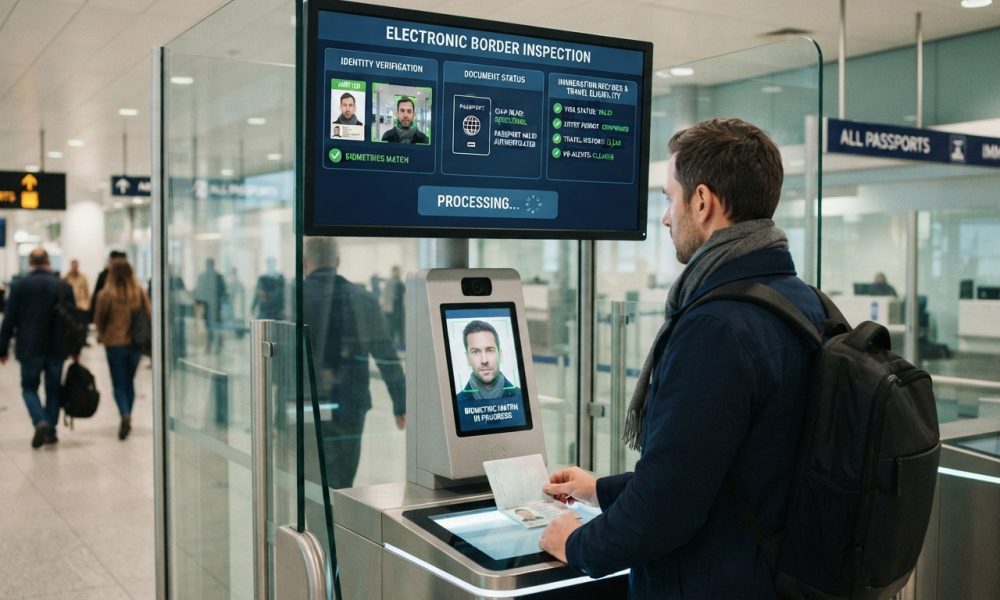
Electronic inspection can combine identity verification with document status, immigration records, and travel-eligibility checks.
WASHINGTON, DC, October 10, 2026 — Millions of international travelers pass through automated passport control gates at airports every year, often believing these sophisticated machines compare their faces with passport photos before letting them enter another country.
Behind the familiar glass barriers and facial recognition cameras, however, modern automated border control systems can perform multiple identity, document Authentication, immigration, and security checks that extend far beyond the photographic comparison passengers see.
Although procedures vary by country, automated border control technology increasingly operates within broader national immigration infrastructures, linking passport Information to electronic travel permissions, document status records, border-crossing histories, and relevant security systems.
These developments reflect an international shift toward digitally managed borders, where authorities seek to accelerate the movement of legitimate travelers while maintaining the ability to identify invalid documents, immigration irregularities, and potential security concerns.
Understanding these additional checks matters as governments expand biometric border processing, introduce digital immigration records, and replace traditional passport stamps with electronic systems that store increasingly detailed travel information.
The Passport Photograph Is Only the Beginning
The most visible function of an automated border gate is facial recognition, which compares an Image captured by the gate’s Camera with a trusted reference photograph linked to the traveler’s electronic passport.
When a passenger positions a passport on the document reader, the equipment generally retrieves Information from the machine-readable zone and, where supported, communicates with the passport’s embedded contactless electronic chip.
The gate then captures a live facial Image, processes relevant biometric characteristics, and determines whether the new photograph sufficiently resembles the reference Image stored in the electronic travel document.
This process helps establish that the individual presenting the passport is likely the person to whom the issuing government originally issued the document, but facial resemblance alone cannot establish legal admissibility.
An individual may closely resemble the passport photograph while holding a document that has since been reported stolen, canceled by the issuing authority, or linked to immigration restrictions that require further examination.
Consequently, automated border control systems may combine the facial comparison result with other Information from government systems before deciding whether the passenger can proceed through the gate without additional inspection.
Electronic Passport Authentication Establishes Document Integrity
Before authorities can confidently rely on the personal Information in an electronic passport, they need assurance that a legitimate issuing authority created the document and that its electronic contents remain unaltered.
Modern biometric passports contain digitally signed Information, including biographical details and a facial Image, which authorized inspection systems can authenticate using cryptographic certificates associated with the issuing country’s passport infrastructure.
The International Civil Aviation Organization explains that electronic passport validation uses digital signature verification to establish the Authenticity and integrity of Information stored within an electronic travel document.
During this process, compatible border inspection systems verify the document’s electronic signature against appropriate trusted certification Information, allowing authorities to determine whether the protected data remains consistent with its original issuance.
The ICAO Public Key Directory supports this process by facilitating the exchange of certificate Information between participating authorities, although governments can also obtain suitable verification certificates through other authorized arrangements.
Successful signature verification shows that the digitally protected Information has not been modified since signing, but it does not independently establish whether the physical passport remains valid for international travel.
Additional Authentication mechanisms, when supported by both the passport and inspection equipment, can help determine whether the electronic chip is genuine rather than an unauthorized copy of previously issued passport data.
These distinctions matter because verifying the integrity of electronic identity Information serves a different security function than checking whether a government has canceled, revoked, or otherwise invalidated a document.
Document Status Can Be Checked Against Government Records
A passport may contain authentic electronic signatures, accurate personal Information, and a functioning contactless chip yet still be unsuitable for travel because its issuing authority has since changed its status.
Governments maintain administrative records identifying documents that have expired, been revoked, or been reported missing, and relevant border inspection systems may consult these records when evaluating travelers arriving at international checkpoints.
These checks matter because electronic chip Authentication primarily establishes the provenance and integrity of protected passport data, not that the issuing government continues to recognize the document as valid.
For example, a passport reported lost may remain physically intact and electronically readable, even though the issuing authority has already canceled it and distributed relevant Information through authorized law enforcement channels.
Canadian authorities explain that they cancel passports reported lost or stolen and distribute relevant records through national policing and border systems, while also sharing information through international cooperation mechanisms.
Where appropriate connections and screening policies exist, automated inspection systems can use document-status Information to identify cases that require additional assessment before permitting the passenger to proceed.
However, not every automated gate accesses every available document database, and the specific records consulted depend on national infrastructure, international information-sharing arrangements, system configuration, and applicable legal requirements.
INTERPOL Records Provide an Additional Security Resource
One significant international resource available to authorized border authorities is INTERPOL’s Stolen and Lost Travel Documents database, which supports identifying travel documents reported as invalid.
According to INTERPOL’s official description of its travel document database, participating countries can contribute records of stolen, lost, revoked, invalid, and stolen blank travel documents, allowing authorized authorities to check their status.
The database supports international cooperation by making relevant document Information available to authorized users, including immigration authorities and frontline law enforcement personnel operating at airports and other international border crossings.
However, an important distinction exists between the availability of INTERPOL Information and its actual use during an individual automated inspection, because access does not mean every gate performs every possible international database query.
Some jurisdictions incorporate relevant screening into broader border management platforms, while others rely on separate enforcement systems or officers to conduct particular checks when circumstances require additional investigation.
An INTERPOL document record also differs from an assessment of the person presenting that document, because the database identifies reported document circumstances rather than independently determining the traveler’s criminal responsibility.
When authorities encounter a potential database match, established procedures may require further confirmation of document Information, review of the underlying record, and assessment by an authorized official before making consequential decisions.
These safeguards matter because Information discrepancies, outdated administrative records, or similarities between document details can create situations where automated screening requires human interpretation rather than immediate conclusions.
Immigration Databases Determine Whether Entry Requirements Are Satisfied
Even when a passport is genuine and the facial comparison succeeds, border authorities must determine whether the traveler satisfies the immigration conditions established by the country they intend to enter.
Those conditions can include nationality-based entry privileges, visa requirements, residence permissions, permitted travel purposes, previous immigration decisions, and compliance with the applicable rules governing the duration of authorized stays.
Automated border systems may therefore communicate with national immigration platforms that associate passport details with electronic visas, residence permissions, travel authorizations, or other records relevant to entry eligibility.
The United Kingdom provides a practical example of this approach, where eligible travelers using automated gates may need valid digital immigration permission, such as an Electronic Travel Authorization or recognized electronic immigration status.
British government guidance acknowledges that authorities can refer passengers for further examination when they need to verify identity, assess immigration eligibility, or resolve issues with digital travel permission.
Such referrals show why a successful biometric comparison cannot independently authorize entry, since immigration decisions involve legal conditions that facial recognition software cannot establish by measuring physical resemblance alone.
A traveler may have a legitimate passport and matching biometric Information but lack the visa, electronic authorization, or immigration record required for admission under the destination country’s entry rules.
Conversely, an individual may hold valid permission but face difficulties if relevant immigration records are linked to an earlier passport number or are not properly linked to the document presented.
These circumstances illustrate how the growing relationship between travel documents and government databases makes accurate administrative Information increasingly important for travelers who depend on automated immigration processing.
Previous Entries and Exits Can Influence Border Decisions
Automated border processing also interacts with systems designed to record international arrivals and departures, giving immigration authorities Information about previous travel movements where national legislation authorizes such records.
Historically, many immigration authorities relied heavily on passport stamps and manually reviewed travel histories when determining whether visitors had complied with permitted periods of temporary residence or short-term admission.
Electronic border management systems increasingly replace or supplement those physical records with databases that record the date, location, and other relevant details associated with a person’s entry or departure.
The European Union’s Entry/Exit System is a prominent example, becoming fully operational on April 10, 2026, after a phased introduction that began in October 2025.
The system records relevant personal Information, travel document details, and biometric identifiers for covered non-EU travelers, along with records of their entries, exits, and applicable refusals of entry.
These electronic records help border authorities calculate periods of permitted short-term stay and identify circumstances in which a traveler may have exceeded the duration authorized under applicable immigration rules.
For travelers subject to the system, an automated identity check can therefore form part of a broader immigration assessment that considers both the identity presented and the travel history maintained by authorities.
However, EES registration and automated eGate clearance are not identical processes, and individual countries can use different combinations of staffed checkpoints, self-service equipment, biometric enrollment stations, and automated gates.
The distinction matters because a centralized travel history database does not mean every border gate independently evaluates every immigration rule or makes all relevant admission decisions without human involvement.
National Security Screening Extends Beyond Facial Recognition
Border control authorities also maintain systems to identify individuals who require additional attention because of applicable security alerts, law enforcement Information, or administrative restrictions affecting international travel.
Depending on national law and operational arrangements, relevant screening may involve domestic watchlists, immigration enforcement records, international alerts, or Information exchanged between authorized government agencies under established cooperation agreements.
Such checks differ fundamentally from facial recognition because they assess records or alerts associated with identity Information rather than determining whether two biometric photographs likely depict the same individual.
A facial comparison might find sufficient similarity between a traveler and an authenticated passport Image, while a separate screening process identifies an administrative or security issue that requires further consideration.
The systems involved do not necessarily operate through a single international database, and government agencies generally establish their own rules regarding access, matching procedures, Information sharing, and responses to potential alerts.
INTERPOL notices also require careful interpretation because they represent different forms of international police cooperation, and an alert does not automatically constitute an international arrest warrant or establish criminal guilt.
Automated border technology can help officials by flagging relevant Information, but applicable legislation, operational procedures, and authorized decision-making still govern its legal consequences.
Why Nationality and Passport Type Matter
Not every traveler can use every automated border gate because governments typically restrict eligibility based on criteria that may include citizenship, age, immigration status, travel document characteristics, and specific bilateral arrangements.
For example, the United Kingdom allows several categories of foreign nationals to use its automated gates if they meet applicable eligibility requirements, including having appropriate travel documents and required digital immigration permissions.
Other countries may reserve certain automated lanes for their own citizens, permanent residents, citizens of designated partner countries, or travelers participating in approved trusted-traveler or border-facilitation programs.
These rules explain why two passengers arriving on the same flight may receive different instructions despite possessing technologically similar electronic passports with functioning chips and authenticated facial images.
Nationality also shapes the legal framework because returning citizens, foreign visitors, permanent residents, and individuals with special immigration status may have different rights and obligations at the border.
Consequently, an automated system must operate within the legal requirements that apply to the traveler, rather than treating a technologically advanced passport as universal authorization to enter.
A Failed eGate Check Does Not Automatically Indicate Fraud.
When an automated gate refuses to open, passengers sometimes assume facial recognition has flagged an identity issue or that government databases have detected a serious security concern.
In reality, automated processing can fail for many reasons, including difficulty reading documents, poor biometric Image quality, unsupported passport features, invalid digital permissions, equipment malfunctions, or situations that require additional inspection.
Changes in facial appearance, unsuitable Camera positioning, lighting conditions, and temporary obstructions can affect biometric comparisons even when the passenger legitimately holds the passport presented to the machine.
Electronic passport readers can also have technical difficulties communicating with contactless chips, which can prevent completing an inspection without showing that the passport itself is fraudulent.
The British government identifies technical faults, questions about travel documents, and immigration eligibility concerns as circumstances that can lead to passengers being directed away from automated gates.
Importantly, a referral means continuing the inspection through another process, not proof that the individual has violated immigration law or presented a counterfeit document.
Human border officers remain responsible for resolving many circumstances that automated systems cannot conclusively assess, including identity discrepancies, administrative complications, and cases requiring evaluation of additional evidence.
The Difference Between Electronic Authentication and Legal Validity
One of the most frequently misunderstood aspects of electronic passport inspection involves the distinction between confirming that Information originated from an issuing government and determining whether a traveler may lawfully cross a border.
Electronic signature validation concerns the integrity and trusted origin of protected passport data, whereas document status checks consider whether the issuing authority continues to recognize the travel document.
Biometric comparison checks whether the person presenting the passport matches its trusted reference photograph, while immigration screening addresses separate questions about nationality, travel permission, prior immigration activity, and legal admissibility.
Security screening may add another independent dimension by identifying relevant records or alerts, although the availability and use of these systems vary substantially across countries and border control programs.
A fully authenticated electronic passport can therefore pass its cryptographic checks without guaranteeing successful biometric recognition. In contrast, a successful facial comparison cannot independently resolve questions about travel permission or document validity.
Understanding these distinct functions helps explain why a modern eGate cannot accurately be described as merely a Camera connected to an electronic passport reader, even when the visible passenger interaction appears remarkably simple.
Privacy and Information-Sharing Rules Remain Important
As border control becomes increasingly digital, handling biometric Information and immigration records raises important questions about personal privacy, government accountability, and retaining sensitive Identification data.
Electronic passports contain Information that inspection systems can retrieve under applicable access protocols, while connected immigration systems may separately hold arrival records, previous applications, travel authorizations, and additional personal Information.
These sources serve different purposes, and a border authority’s ability to authenticate a passport chip does not inherently grant unrestricted access to every database containing Information about the traveler.
ICAO specifically distinguishes electronic passport signature validation from exchanging passport holders’ personal Information because the cryptographic certificates used to establish document Authenticity do not contain individual travel histories.
Privacy protections therefore depend not only on passport design but also on the legislation, administrative safeguards, access controls, and retention policies governing the connected systems used during border processing.
Travelers should also recognize that deleting a temporary Image captured by a local inspection device does not necessarily delete separate government records associated with the crossing.
The distinction becomes increasingly significant as authorities introduce biometric travel programs that can involve multiple organizations, including immigration agencies, airport operators, airlines, and technology providers performing different operational responsibilities.
Contactless Processing Is Changing the Traveler Experience
Another technological development involves automated border inspection methods that reduce or eliminate the need for eligible passengers to physically place their passports on a document reader during the crossing process.
In October 2026, the United Kingdom published updated guidance on introducing contactless border processing, initially for British citizens at selected airport eGates, with a phased expansion planned.
Under this approach, eligible travelers may have their identities verified through facial recognition without presenting their passports directly to a gate reader, although they must continue carrying valid travel documents.
The British government says ordinary immigration and security checks continue under the contactless arrangement, showing that removing physical document interaction does not eliminate underlying border clearance requirements.
This development also highlights the growing separation between the passenger’s visible actions and the Information processing performed by government infrastructure, where identity verification can depend on previously established digital records.
Nevertheless, contactless immigration processing remains subject to eligibility requirements, technological limitations, and national policy decisions, so the new approach may not operate the same way across international borders.
Why Different Countries Produce Different eGate Results
International travelers may notice that the same electronic passport passes through automated controls in one country while requiring manual examination in another, even when the document remains valid and unchanged.
These variations can reflect differences in nationality eligibility, supported passport technologies, biometric comparison settings, immigration requirements, government database connections, and the operational policies applied by the destination authority.
One jurisdiction may rely heavily on electronic residence Information, while another incorporates additional travel history systems or requires manual checks for certain categories of foreign visitors.
Differences in the availability of electronic certificates and Authentication capabilities can also affect document inspection, although governments may use alternative procedures when certain automated verification functions cannot be completed.
Consequently, passing through one country’s automated border system should not be taken as proof that every subsequent inspection will produce the same result under different legal and technological conditions.
The outcome of each border inspection ultimately depends on the Information available to the responsible authority and the specific entry requirements governing that individual crossing at the time it occurs.
The Future of Automated Border Control
Governments continue to develop border management systems that combine authenticated electronic documents, biometric identity verification, digital immigration permissions, and electronic arrival and departure records in increasingly coordinated processing environments.
These developments can reduce repetitive manual procedures and help authorities process large passenger volumes while preserving mechanisms to refer travelers whose circumstances cannot be resolved through automated checks alone.
At the same time, expanding electronic Information sharing requires careful attention to database accuracy, proportionality, legal safeguards, and the potential consequences of incorrect matches or outdated immigration records.
The future of automated inspection will therefore depend not only on improvements in facial recognition and electronic passport technology but also on the reliability of administrative systems supporting border decisions.
For travelers, the practical implication is straightforward: carrying a genuine electronic passport and matching its photograph remain essential, but those conditions represent only part of the requirements for successful international entry.
A Border eGate Is an Identity and Immigration Checkpoint.
The familiar automated gate represents the visible endpoint of a much broader border management process, bringing together identity verification, document Authentication, immigration eligibility, and relevant screening procedures within a tightly controlled environment.
Although the exact checks differ by jurisdiction, the underlying objective remains the same: authorities must establish confidence in the travel document, assess the person presenting it, and determine whether applicable entry conditions have been met.
A successful facial comparison can help confirm a traveler’s relationship to an electronic passport. Still, it cannot independently validate every legal, administrative, or security condition tied to international movement.
As governments increasingly connect automated inspection equipment to electronic immigration infrastructure, travelers will need to understand these separate layers to distinguish routine biometric checks from broader border clearance procedures.
Ultimately, an automated border gate answers not simply whether a passenger looks like the person in a passport photograph, but whether the available evidence supports clearance under the rules governing that crossing.




