
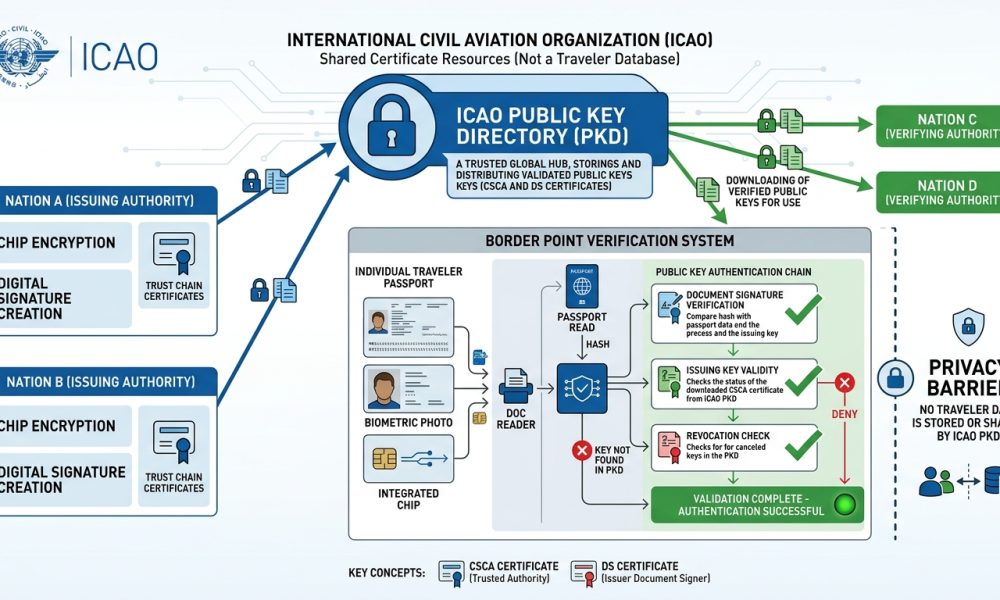
Shared certificate resources support international document Authentication without serving as a database of individual travelers.
WASHINGTON, DC, October 10, 2026 — As governments expand automated border inspection systems and electronic passport verification, a specialized international infrastructure operated under the International Civil Aviation Organization provides essential cryptographic Information that helps immigration authorities authenticate travel documents issued by foreign governments.
Known as the ICAO Public Key Directory, or PKD, this international certificate exchange system enables participating authorities to obtain Information needed to verify digital signatures embedded within electronic passports, supporting the integrity and Authenticity of electronically stored identity Information.
Although travelers may associate international passport systems with immigration databases, biometric surveillance networks, or centralized repositories of personal Information, the Public Key Directory serves a fundamentally different function: it distributes cryptographic materials rather than individual travel histories.
This distinction matters because automated airport inspection equipment increasingly relies on electronic passport Authentication, facial recognition, and connected immigration systems to evaluate international travelers before letting them proceed through border checkpoints.
Understanding the PKD requires examining how governments digitally sign electronic passports, how receiving countries establish trust in foreign certification authorities, and why successful document Authentication does not automatically establish immigration eligibility or confirm a passport’s current administrative validity.
The ICAO Public Key Directory Supports International Document Trust
The International Civil Aviation Organization developed the Public Key Directory to address a growing challenge created by the worldwide adoption of electronic passports, which require foreign border authorities to verify digital signatures issued through separate national cryptographic infrastructures.
Without an organized mechanism for exchanging trusted certificate Information, governments would need to establish and maintain extensive bilateral arrangements with numerous foreign issuing authorities, creating considerable administrative complexity and opportunities for outdated or incomplete verification resources.
The ICAO Public Key Directory provides a centralized infrastructure for participating authorities to exchange the certificates, revocation Information, and related cryptographic materials needed to authenticate electronic machine-readable travel documents.
It helps border inspection systems determine whether electronically protected Information can be traced to an appropriate issuing authority and whether the relevant data remains unchanged from the Information originally signed during document production.
The directory does not independently determine whether a traveler may enter another country, and its cryptographic verification function should not be confused with separate immigration screening, law enforcement databases, or biometric Identification systems.
Instead, the PKD supports one foundational aspect of electronic border security by helping countries obtain the verification materials needed to authenticate passports issued outside their own national document production and certification infrastructures.
Electronic Passports Depend on Cryptographic Signatures
Modern electronic passports contain contactless integrated circuits that store digitally encoded identity Information, including biographical details and facial photographs, alongside technical security structures designed to protect the Authenticity and integrity of the stored records.
During passport issuance, the issuing authority uses a protected private signing key to generate a digital signature for the document’s electronic Information, creating cryptographic evidence that receiving inspection systems can later evaluate.
This signature lets compatible border equipment determine whether protected chip Information matches the data approved during issuance, provided the inspection system has the appropriate verification certificates and trusts their origin.
The underlying security principle relies on asymmetric cryptography, which uses mathematically related private and public keys to let an issuing authority sign electronic Information while authorized receiving systems verify that signature.
A properly configured verification process can detect unauthorized modifications to signed electronic Information because changes to protected data groups produce inconsistencies when the system compares newly calculated cryptographic values against authenticated reference values.
Nevertheless, digital signature verification does not encrypt every passport record or hide Information from inspection authorities, because its primary purpose is Authentication and integrity Protection rather than general confidentiality.
Why Foreign Border Agencies Need Certificate Information
An electronic passport issued by one government may be presented thousands of miles away to immigration authorities using equipment from different manufacturers and connected to entirely separate national border management systems.
To authenticate the passport’s electronic contents, the receiving authority’s inspection infrastructure must obtain trustworthy public verification keys associated with the issuing country’s cryptographic signing system and the specific certificates used during document production.
A public verification key lets the receiving inspection system assess a digital signature. Still, the system must also verify that the certificate containing the key genuinely belongs to the authority it claims to represent.
Without that assurance, a fraudulent party could present electronically signed Information alongside unauthorized certificates and try to persuade an inadequately configured inspection system that the signatures reflect legitimate government issuance.
The PKD addresses the international exchange problem by providing relevant cryptographic resources through a structured framework, reducing the complexity of obtaining certificate Information from numerous governments that issue electronic travel documents.
However, access to certificate Information does not itself establish the legal or operational decision to trust every certificate, because receiving countries remain responsible for determining which certification authorities satisfy their verification policies.
Country Signing Certification Authorities Form the Trust Foundation
The Country Signing Certification Authority, commonly abbreviated as CSCA, is the foundational trust authority within an electronic passport issuing country’s cryptographic infrastructure, establishing a national basis for validating subordinate document-signing credentials.
Each issuing government establishes its CSCA framework to authenticate documents issued under its authority, using carefully controlled cryptographic credentials and certificate management procedures designed to protect the integrity of passport-signing operations.
The CSCA issues or authorizes Document Signer Certificates, which identify the operational signing keys used to create the digital signatures associated with the electronic Information stored inside individual travel documents.
When a foreign border agency authenticates a passport, the inspection system must establish a trusted relationship between the document’s signing certificate and the appropriate national CSCA certificate recognized by the receiving authority.
This relationship creates what security specialists call a chain of trust, connecting the electronically signed passport Information to a government certification authority whose public key the receiving authority has independently accepted as authentic.
Crucially, an issuing country’s CSCA certificate cannot become trustworthy merely because its contents identify a government, since receiving authorities must establish trust through appropriate independent procedures before relying upon the certificate.
Document Signer Certificates Connect Passports With Issuing Authorities
Document Signer Certificates provide the intermediate cryptographic connection between individual electronic passports and the national signing authority, allowing inspection systems to evaluate signatures produced during the official passport issuance process.
Each certificate contains a public verification key associated with an authorized document-signing operation, along with certification Information that lets the receiving authority assess its relationship to the issuing government’s trusted CSCA.
During electronic passport verification, the inspection system evaluates the digital signature protecting the document’s electronic Information. It determines whether the associated Document Signer Certificate can be validated through the established national trust chain.
Governments may use many Document Signer Certificates over time as they issue new passports, replace signing credentials, and manage cryptographic security policies to limit exposure from potential key compromise.
These operational realities make reliable certificate distribution especially important because border agencies must recognize documents signed with multiple historical and current credentials, rather than relying on a single certificate for every passport.
The PKD helps meet that requirement by letting participating issuing authorities distribute relevant Document Signer Certificates to receiving systems that need them to authenticate international documents consistently.
What Information the Public Key Directory Actually Contains
The Public Key Directory primarily distributes cryptographic materials associated with electronic travel document Authentication, including Document Signer Certificates, Certificate Revocation Lists, and digitally signed Master Lists containing relevant national certification authority certificates.
According to ICAO’s electronic passport technical guidance, participating authorities can upload the certificates and related validation resources needed to support international verification of government-issued electronic travel documents.
Although participating states also provide CSCA certificates for validation, they are not ordinarily distributed as individual downloadable PKD entries; instead, authenticated collections are made available through appropriate signed Master Lists.
These resources allow receiving governments to verify whether document-signing credentials belong to recognized issuing authorities, whether relevant certificates have been revoked, and whether protected electronic passport data remains consistent with authorized signatures.
The directory does not contain a centralized record of every electronic passport issued worldwide, nor does it provide an international registry linking individual passport holders with their travel movements or immigration histories.
That distinction separates the PKD from national border management databases, which may contain biographical Information, photographs, travel authorizations, entry records, and other personal details collected under the applicable laws of individual countries.
The ICAO Master List Simplifies Certificate Distribution
A key component of the international verification framework is the Master List, a digitally signed collection of Country Signing Certification Authority certificates assembled to make trusted certificate Information easier to distribute and manage.
Rather than requiring every receiving country to acquire each national CSCA certificate through a separate bilateral exchange, a Master List provides a structured collection of certificates obtained and authenticated through established procedures.
The ICAO Master List contains CSCA certificates submitted by participating authorities through designated diplomatic arrangements, allowing receiving governments to obtain a substantial collection of foundational verification materials from a common international source.
ICAO reported that its Master List issued on July 15, 2026, contained 579 certificates from participating authorities, reflecting the number of trust certificates included rather than the number of countries or individual passports represented.
The Master List is digitally signed to protect its integrity and establish its provenance, allowing receiving authorities to verify that the distributed collection has not been improperly modified after its authorized preparation.
Nevertheless, receiving countries remain responsible for determining whether to recognize individual certificates in the Master List as trusted authorities for their own electronic passport verification systems.
Certificate Exchange Does Not Automatically Establish Trust
A key principle of electronic passport Authentication is that obtaining a public certificate and deciding to trust the issuing authority are separate processes that require different technical and administrative safeguards.
The PKD facilitates certificate distribution and provides structured validation resources, but participating governments must independently determine how they recognize, approve, and maintain trust in foreign national signing authorities.
According to ICAO guidance on validating national signing certificates, receiving states must establish trust in CSCA certificates through appropriately independent mechanisms rather than relying solely on standard certificate distribution channels.
Authorities may consider authenticated diplomatic exchanges, approved certificate sources, government security policies, and other recognized methods when determining whether to accept a foreign CSCA certificate as a trust anchor.
This distinction protects against situations in which a technically valid digital signature is produced using credentials not legitimately associated with the government identified in the electronic document.
Consequently, the effectiveness of international electronic passport Authentication depends not only on mathematical verification but also on the operational procedures governments use to establish and maintain trusted certification relationships.
Passive Authentication Uses These Shared Resources
The primary cryptographic procedure for verifying electronic passport Information is Passive Authentication, which uses the issuing authority’s trusted public verification credentials to examine the document’s digital signature and protected electronic data.
During inspection, compatible equipment reads the relevant security Information from the passport chip, identifies the associated Document Signer Certificate, and evaluates whether the certification chain leads to an accepted national signing authority.
The system also calculates cryptographic hash values from protected electronic data groups and compares those results with authenticated values contained within the passport’s digitally signed Document Security Object.
When the signature, certificate relationship, and protected data values meet the applicable verification requirements, the system has evidence that the Information originated through the recognized issuing infrastructure and has not changed since signing.
The PKD supports this process by providing certificate resources that receiving governments can use in their own inspection systems, rather than requiring ICAO to perform every passport verification centrally.
This architecture allows immigration authorities to maintain national control over their inspection procedures while benefiting from an internationally coordinated mechanism for distributing the cryptographic materials required for electronic document Authentication.
The Directory Is Not a Worldwide Passport Holder Database
One persistent misconception about international electronic passport technology is that ICAO maintains a comprehensive database of the names, photographs, biometric records, and travel histories of every individual holding an electronic passport.
The Public Key Directory does not perform that function because it exchanges document Authentication credentials rather than centrally collecting personally identifiable Information extracted from international travelers’ passports.
The certificates distributed through the PKD identify cryptographic signing authorities and contain public verification Information. Still, they do not function as individual passport records containing the personal details of ordinary document holders.
A border agency reading a passenger’s electronic passport obtains relevant identity Information from the document itself and may separately consult national immigration systems, rather than retrieving that person’s complete identity record from the PKD.
Similarly, governments maintaining electronic records of arrivals, departures, visa decisions, or immigration enforcement actions operate those systems under separate legal and institutional arrangements unrelated to the PKD’s certificate distribution function.
This separation helps travelers distinguish the cryptographic infrastructure that supports document Authentication from the broader border security systems that may process personal Information during an international inspection.
The PKD Is Not an INTERPOL Watchlist
The Public Key Directory also differs from international law enforcement databases that help authorities identify travel documents reported lost, stolen, revoked, or otherwise invalid through authorized government information-sharing arrangements.
INTERPOL maintains its Stolen and Lost Travel Documents database to check the status of reported documents, while the ICAO PKD distributes cryptographic certificates that authenticate protected electronic Information.
A passport could therefore successfully pass digital signature verification using certificates obtained through PKD-supported channels while appearing in a separate document status system because the issuing government subsequently canceled it.
Conversely, a passport may remain legally valid. At the same time, an inspection system cannot complete electronic Authentication because the necessary certificate Information is unavailable, the chip cannot be read, or the verification equipment encounters an error.
These possibilities demonstrate why digital signature Authentication, document status screening, and immigration eligibility assessments must be treated as distinct functions rather than interchangeable indications of whether a traveler can cross a border.
The existence of international certificate exchange also should not be interpreted as evidence that ICAO independently conducts criminal Background checks, approves individual travelers, or determines whether foreign nationals may enter particular countries.
Certificate Revocation Lists Address Compromised Signing Credentials
A key element of the PKD is Certificate Revocation Lists, commonly called CRLs, which issuing authorities use to communicate Information about cryptographic certificates that should no longer be trusted under applicable validation procedures.
A government may revoke a document-signing certificate after identifying a security compromise or another circumstance that makes continued reliance on the corresponding credentials inappropriate for Authentication.
Receiving authorities can incorporate relevant revocation Information into their certificate validation processes, helping inspection systems avoid relying unquestioningly on signing credentials that an issuing authority has formally withdrawn.
These lists reflect the status of electronic signing certificates rather than the administrative validity of individual passports, making them fundamentally different from records that identify documents reported lost, stolen, or canceled.
Because a single signing credential may be associated with numerous passports issued during its operational lifetime, certificate compromise can create verification challenges requiring careful technical assessment and coordinated responses by affected authorities.
Revocation Information therefore supports an ongoing trust management process that extends beyond initial document issuance, allowing governments to respond to changes that affect the security of previously accepted cryptographic credentials.
Successful PKD-Supported Verification Has Important Limits
A successful electronic passport signature check provides meaningful assurance about the integrity and trusted origin of protected digital Information. Still, it does not independently establish every characteristic required for a complete document inspection.
Passive Authentication primarily verifies digitally signed Information and does not necessarily prove that the physical integrated circuit is the original chip installed during government production, because copied signed data can retain valid signatures.
Additional cryptographic mechanisms, including Active Authentication or Chip Authentication where implemented and supported, can provide further evidence concerning chip Authenticity through procedures designed to resist unauthorized duplication.
Likewise, a valid electronic signature does not establish that the passport remains unexpired, uncanceled, or legally acceptable for travel, because those conditions depend on administrative records and applicable national legislation.
Nor does the PKD determine whether the person presenting the passport resembles its authenticated photograph, since biometric matching requires a separate comparison between the stored reference Image and the traveler being inspected.
These distinctions explain why modern border systems combine cryptographic document Authentication with other identity and eligibility controls rather than treating a single electronic signature verification result as complete border clearance.
What Happens When a Verification Certificate Is Missing
International inspection systems can struggle when the required Document Signer Certificate or trusted national certification Information is unavailable, even if the traveler’s electronic passport is genuine.
Such circumstances may arise because certificate exchanges remain incomplete, an inspection system has not received current verification resources, or the issuing country uses credentials that the receiving authority has not yet incorporated into its trust infrastructure.
A missing certificate prevents the system from completing the relevant verification step with the available materials. Still, it does not automatically establish that the issuing government produced an unauthorized or counterfeit document.
Border authorities may address these circumstances through alternative verification sources, updated certificate resources, technical examination, or established manual inspection procedures depending on national operational policies and the available equipment.
This limitation also applies to consumer smartphone applications that read electronic passports, since a successful chip communication session does not guarantee that the Application possesses all certificates needed for complete Passive Authentication.
Travelers interpreting electronic passport reader results should therefore distinguish a confirmed cryptographic failure from a verification that could not be completed because the software lacked suitable trust Information.
Participation and International Cooperation Strengthen Verification
The usefulness of a shared certificate infrastructure generally increases as more issuing authorities contribute appropriate signing certificates and receiving governments integrate those resources into functioning electronic passport Authentication systems.
Participation alone, however, does not ensure that every border checkpoint in a participating country performs full electronic Authentication, since implementation depends on national equipment, operational practices, and verification policies.
Governments must also maintain reliable procedures for uploading new credentials, updating revoked certificate Information, managing signing authority changes, and ensuring that relevant technical resources remain available to their inspection systems.
The international framework provides common technical standards while allowing participating authorities to decide how they trust certificates and how Authentication results influence broader border inspection procedures.
Such cooperation becomes particularly important when receiving countries process passports issued under different generations of electronic document technology, using varying signing credentials, certificate policies, and supported security protocols.
Without dependable exchanges and appropriate trust management, the security advantages of electronically signed passports may be reduced because the receiving inspection system cannot fully authenticate Information the issuing government has protected.
The Privacy Implications of Shared Cryptographic Infrastructure
The distinction between certificate distribution and personal Information processing has significant privacy implications, especially as international discussions increasingly link electronic passport verification to biometric surveillance and broader immigration information-sharing arrangements.
The PKD’s certificate exchange model lets governments authenticate signed electronic passport Information without requiring ICAO to maintain a centralized repository of every international traveler’s personal identity records.
Nevertheless, border agencies conducting individual inspections may collect or process Information from passports and connected government systems, subject to separate legal requirements and institutional data management policies.
The absence of individual traveler records within the PKD therefore does not mean that electronic border processing involves no personal Information, because the passport reader and immigration infrastructure perform additional functions beyond certificate retrieval.
It is also important to distinguish certificate Authenticity from restrictions on Information access, since digitally signed public certificates can be exchanged widely without granting receiving organizations unrestricted authority to obtain unrelated government identity records.
For travelers, this separation clarifies which technologies authenticate documents, which systems compare biometric Information, and which government databases may contain individual immigration or security records.
Future Digital Travel Credentials Will Continue to Require Trusted Issuers
As governments consider new digital travel credentials and more extensive automated border processing, establishing trusted origins and detecting unauthorized modification will remain central to international electronic identity verification.
Future inspection systems may increasingly rely on electronic credentials presented through approved digital channels rather than requiring every identity verification process to begin with the physical reading of a traditional passport booklet.
These developments could change how travelers present Information, but governments will still need mechanisms to verify cryptographic signatures, manage trusted certification authorities, and respond when security credentials are compromised.
The international experience gained through the ICAO PKD provides a framework for understanding how multiple governments can exchange Authentication materials without establishing one centralized authority responsible for every immigration decision.
Nevertheless, new document formats and verification environments may require additional technical specifications, updated certificate management arrangements, and carefully coordinated security practices to maintain interoperability between different national systems.
The broader objective remains to support reliable international identity document Authentication while preserving individual governments’ separate legal authority to determine immigration eligibility and apply domestic border security requirements.
International Passport Trust Depends on More Than Technology
The ICAO Public Key Directory shows how a shared international infrastructure can help governments authenticate electronic passports without collecting personal Information about every individual traveling across national borders.
Its principal contribution is distributing cryptographic verification materials, including Document Signer Certificates, revocation Information, and Master Lists, that support authenticating digitally signed travel document Information issued by recognized authorities.
These resources help receiving countries strengthen electronic passport verification while retaining independent responsibility for trust decisions, biometric checks, administrative document status assessments, and immigration eligibility determinations under their own laws.
The effectiveness of this arrangement depends on continuing international cooperation, secure management of government signing credentials, reliable certificate exchange, and appropriate implementation of electronic Authentication procedures throughout national border inspection systems.
For travelers, the important distinction is that the ICAO PKD helps establish confidence in the Authenticity of electronically protected passport Information, rather than operating as an international database of personal identities, movements, or immigration decisions.
As automated borders become more technologically interconnected, this separation between cryptographic document trust and individual traveler screening will remain fundamental to understanding how modern electronic passport Authentication supports international mobility and security.




