
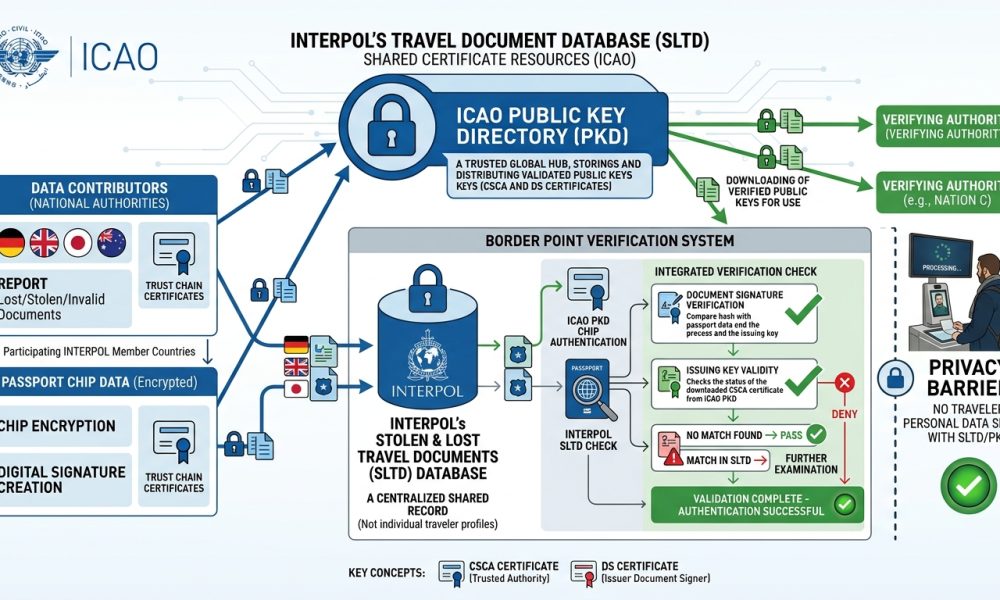
Participating authorities can consult shared records to identify passports that require further examination.
WASHINGTON, DC, October 10, 2026 — As international border authorities strengthen electronic passport inspection and automated identity verification, INTERPOL maintains a global law enforcement database that gives participating countries a critical resource for identifying travel documents reported lost, stolen, revoked, or otherwise invalid.
The system, known as the Stolen and Lost Travel Documents database, lets authorized officials compare passport Information against records submitted by issuing countries, helping immigration authorities detect documents whose administrative status may have changed after they were issued.
Unlike biometric facial recognition systems, which assess whether a traveler resembles a reference photograph, or cryptographic passport Authentication, which examines the integrity of electronic Information, this international database focuses on the reported status of specific travel documents.
Its role has grown as governments expand automated border inspection, integrate international police Information into national screening platforms, and introduce digital travel systems that can flag potential document problems before passengers complete immigration procedures.
For travelers, understanding how the database operates helps explain why an authentic passport can trigger further inspection, why documents reported missing generally cannot be reused, and why a database match requires careful interpretation rather than an automatic assumption of wrongdoing.
The International Database Behind Passport Status Screening
INTERPOL operates the Stolen and Lost Travel Documents database, commonly abbreviated as SLTD, to help authorized law enforcement and border authorities identify passports and other travel credentials whose reported administrative status may require additional examination.
According to INTERPOL’s official description of the SLTD database, the system contains Information about documents reported stolen, lost, revoked, invalid, or stolen before personalization, allowing participating authorities to conduct international status checks.
The organization’s published Information identifies approximately 138 million records within the database, illustrating the substantial volume of compromised or invalid travel credentials reported through participating national authorities and international police cooperation channels.
INTERPOL also reports that officials conducted about 3.6 billion database searches in 2023, producing 232,423 positive matches, though these historical figures should not be interpreted as a current annual measure of criminal incidents.
These statistics illustrate the operational importance of international document screening while highlighting the distinction between a database match, an administrative document status concern, and evidence establishing that an individual traveler has committed a criminal offense.
Why Authentic Passports Can Become Invalid
A passport’s physical and electronic security features primarily establish that a document was legitimately manufactured and that protected identity Information remains consistent with records approved during its original government issuance.
However, a passport’s legal validity can change after issuance, especially when the legitimate holder reports it missing, an issuing authority cancels it, or another legally authorized administrative decision alters its status.
A passport reported stolen may still contain authentic holograms, laser-engraved Identification Information, a functioning electronic chip, and valid cryptographic signatures, even though the issuing government has formally recorded the document as unsuitable for continued travel.
This distinction explains why passport status screening serves a different purpose than conventional document Authentication, since legitimate manufacturing and unchanged electronic data cannot independently establish a document’s continued administrative validity.
For border authorities, combining physical examination, electronic Authentication, and document status Information provides stronger assurance than relying on any single security mechanism when determining whether a presented travel credential requires additional investigation.
How Countries Submit Passport Records to INTERPOL
National governments remain responsible for determining the administrative status of passports they issue. In contrast, designated law enforcement and passport management agencies coordinate the recording and distribution of relevant Information through approved national procedures.
INTERPOL specifies that only the country responsible for issuing a document can contribute its status record to the SLTD database, and submissions must go through the country’s National Central Bureau or another appropriately authorized law enforcement organization.
This restriction helps preserve the link between the issuing authority and the passport record, preventing unrelated countries from independently adding status Information about foreign documents without authorization from the responsible government.
Depending on national arrangements, Information may originate with a passport office, immigration agency, or police authority before being transmitted through the country’s established international law enforcement communications and document reporting infrastructure.
The effectiveness of this process depends on timely reporting, accurate document identifiers, reliable national Information systems, and procedures to correct or update records when authorities discover discrepancies in previously submitted Information.
What Information a Document Status Record Contains
The SLTD database is designed to identify particular travel documents rather than maintain a complete biographical profile of every individual who possesses, formerly possessed, or may have attempted to use a listed passport.
Document Identification numbers, issuing country Information, document classifications, and reported status categories provide the core Information necessary for authorities to compare credentials against records contributed by the responsible issuing governments.
Depending on the underlying reporting arrangements, additional administrative Information may support verification or follow-up inquiries. However, the database should not be confused with national immigration files containing comprehensive individual travel histories.
This distinction matters because the Information needed to determine whether a passport was reported stolen is fundamentally different from the evidence required to establish a person’s identity, immigration status, or possible criminal responsibility.
A matching passport number and issuing country can warrant further examination, but officials must still determine whether the record matches the document presented and whether its reported status remains accurate.
Frontline Officers Can Access Shared Records
INTERPOL provides participating countries with secure international police communications infrastructure that supports access to appropriate law enforcement databases, including records concerning stolen, lost, revoked, and otherwise invalid travel documents.
The organization’s I-24/7 communications network connects authorized national law enforcement organizations. It can extend relevant database access to approved frontline locations, including airports, seaports, and international land border crossings.
According to INTERPOL’s guidance on frontline database access, participating countries can make international screening resources available to authorized border officers, allowing relevant records to support immediate inspection decisions.
This arrangement can enable officers to compare travel documents with international Information while also consulting national immigration systems and other authorized records needed to assess the circumstances of a particular border crossing.
However, access arrangements differ by jurisdiction, and international database connectivity does not mean every immigration checkpoint conducts identical searches or maintains continuous access to all available INTERPOL Information.
How Electronic Passport Checks Interact With Database Screening
Modern electronic passports store digitally protected identity Information that compatible inspection equipment can retrieve through contactless communication, allowing authorities to authenticate selected data and compare a passenger’s face with a trusted reference photograph.
An inspection system may separately use passport identifiers obtained from the machine-readable zone or electronic chip to initiate document status checks through approved national or international screening infrastructure.
These processes serve complementary purposes: the electronic signature provides evidence of the integrity and issuing origin of protected data. At the same time, the document status query checks whether the passport has been reported invalid.
A successful cryptographic verification result does not prevent a document from appearing in the SLTD database, since administrative cancellation generally occurs through government records rather than by physically modifying the passport’s original electronic signature.
Similarly, a document status search cannot independently determine whether a contactless chip is genuine or whether the person presenting the passport corresponds to the legitimate holder, making additional identity verification important.
Automated Border Gates May Incorporate Document Screening
Automated passport control gates increasingly combine electronic document reading, biometric facial comparison, and immigration eligibility checks, allowing routine border processing to proceed without a direct interview with an officer in every case.
Depending on national system design, a gate or its connected border management infrastructure may also screen relevant document status before making an automated clearance decision for an eligible traveler.
When a passport identifier produces a potential international status match, the automated process may require additional review rather than immediately permitting the passenger to proceed, subject to applicable national procedures.
Nevertheless, specific checks vary by country and checkpoint, so travelers should not assume every automated gate independently accesses INTERPOL records or follows the same international screening sequence.
A failed automated inspection also does not prove a passport has been reported stolen, because poor biometric Image quality, chip communication problems, immigration eligibility requirements, and equipment faults can produce similar referrals.
What Happens When a Database Search Produces a Match
A positive database result, sometimes called a hit, indicates that the searched document Information corresponds to a record available through the relevant screening system, creating grounds for further examination by authorized officials.
Such a result does not automatically establish that the person presenting the passport stole it, intentionally misused it, or committed an immigration offense, since the circumstances behind the document record may differ considerably.
INTERPOL’s published operational guidance emphasizes confirming relevant document identifiers and, when necessary, coordinating with the contributing authority, allowing officials to distinguish accurate records from potential errors or misunderstandings.
Depending on the circumstances, authorities may review the passport, consult the responsible issuing country, examine supporting Identification, and determine whether the document’s reported status requires administrative or law enforcement action.
This verification process matters because border officials must distinguish a physical credential’s status from the traveler’s legal position and personal conduct.
A Database Hit Is Not an International Arrest Warrant
The SLTD database should not be confused with INTERPOL’s systems for circulating international notices, criminal intelligence, or requests for cooperation concerning particular individuals wanted by national law enforcement authorities.
For example, a Red Notice concerns an international request to locate and provisionally arrest an individual under applicable legal arrangements. In contrast, an SLTD record concerns the status of a particular travel document.
Therefore, a passport’s presence in SLTD does not, by itself, establish that its owner is wanted for prosecution, subject to Extradition proceedings, or linked to a criminal investigation.
A legitimate traveler may appear at a border carrying a previously canceled passport without realizing that reporting it missing caused the issuing government to permanently invalidate the document.
Authorities must assess the actual circumstances rather than treating a document status record as conclusive evidence about the person’s identity, intentions, or criminal responsibility.
Stolen Blank Passports Present a Different Security Challenge
One category supported by INTERPOL’s database involves stolen blank passports, which are genuine government document booklets removed from authorized custody before the issuing authority completes personalization and assigns them to legitimate holders.
These materials raise distinct security concerns because their physical construction may include authentic security paper, specialized printing, holographic elements, and other features that ordinarily help officials recognize genuine government travel documents.
However, possessing an authentic blank booklet does not prove the document was lawfully issued, and unauthorized personalization may create discrepancies between the physical material and official government issuance records.
Recording stolen blank passport stock lets issuing authorities share Information about compromised materials, helping foreign border officials recognize that genuine document components do not necessarily prove legitimate government authorization.
These records reinforce why international passport security requires administrative verification alongside physical examination, especially when suspicious documents contain authentic manufacturing features but lack a legitimate issuance history.
The Relationship Between Document Fraud and Identity Theft
Stolen passports may be used in attempted impersonation or identity fraud, particularly when individuals seek to exploit genuine government-issued materials rather than manufacture an entirely counterfeit document.
In these situations, biometric facial comparison, physical security examination, and administrative document screening provide different forms of evidence that can help authorities determine whether a credential has been presented by its legitimate holder.
The database supports this broader assessment by identifying documents whose issuing governments have reported status concerns. However, the Information alone cannot establish the circumstances of possession or the Authenticity of every associated identity claim.
Additional inspection may include reviewing the traveler’s circumstances, examining supporting Identification, consulting relevant national records, and determining whether the passport’s physical or electronic characteristics indicate tampering or unauthorized alteration.
These complementary procedures matter because identity fraud can involve genuine documents, altered documents, copied electronic Information, or fabricated records, each posing different challenges for border authorities and document-examination specialists.
INTERPOL Provides Separate Resources for Counterfeit Documents
In addition to the SLTD database, INTERPOL maintains specialized document examination resources that help authorized officers identify counterfeit or altered travel credentials through technical reference Information and recognized security characteristics.
The organization’s FIELDS initiative, developed with Frontex, provides visual guidance on genuine document models and security indicators to help frontline officers spot suspicious printing, personalization, or physical construction.
The INTERPOL FIELDS database complements document status screening by supplying reference material for examining potentially counterfeit credentials, rather than serving as another register of passports reported lost or stolen.
This distinction matters because a counterfeit passport may never have been legitimately issued and therefore may not correspond to an authentic document status record maintained by the responsible national authority.
Conversely, a genuine stolen passport may have legitimate manufacturing characteristics while appearing in SLTD because the responsible government changed its administrative status after issuance.
Airlines and Other Approved Organizations Can Support Screening
Although INTERPOL’s principal database users are authorized government and law enforcement organizations, selected private-sector screening arrangements can also help identify compromised travel documents before international border arrival.
INTERPOL’s I-Checkit initiative enables approved private-sector participants to submit designated identity document Information for screening through controlled arrangements, supporting earlier Identification of certain documents reported missing or otherwise requiring attention.
Such partnerships may involve aviation or maritime travel operators, but participation depends on applicable arrangements and does not give every commercial company unrestricted, direct access to international police databases.
Advance screening can help identify potential document problems before departure, reducing disruptions that might otherwise occur after passengers travel internationally and present questionable credentials to destination immigration authorities.
Nevertheless, approval to board an aircraft remains separate from a government decision to admit a traveler, and commercial document screening cannot replace the legal responsibilities of authorized border officers.
National Databases Remain Essential to Border Decisions
International Information exchange supplements, rather than replaces, the domestic records maintained by passport-issuing authorities, immigration departments, national police organizations, and other agencies responsible for administering travel documentation.
A government may maintain records concerning canceled passports, replacement documents, judicial restrictions, immigration decisions, and other administrative conditions that do not all appear within the SLTD database.
Consequently, a search returning no international document status match should not be interpreted as comprehensive confirmation that the passport satisfies every national administrative requirement or remains legally acceptable for travel.
Receiving countries may consult multiple authorized systems to assess a document. In contrast, the issuing country’s own records remain especially important when determining whether a passport has been formally canceled or replaced.
This layered approach supports more reliable border decisions by recognizing that international document status records are one source of relevant Information, not an exhaustive global registry of passport validity.
Reporting Delays and Database Accuracy Require Attention
The reliability of international passport screening depends on the accuracy and timeliness of Information supplied by issuing countries, including the proper Identification of documents whose status has changed.
Delays between an initial loss report, national administrative processing, and transmission to international records may affect when foreign authorities can identify a compromised document through a shared database search.
Errors in passport numbers, document classifications, or other identifying details can also complicate matching, making accurate reporting and appropriate pre-correction procedures key elements of international law enforcement cooperation.
A system may return incomplete Information when relevant records have not yet been contributed or made available through the particular screening arrangements used by the receiving country.
These limitations explain why a negative database result cannot, on its own, guarantee that a document remains valid, just as a positive result requires appropriate confirmation before authorities draw consequential conclusions.
Privacy and Information-Sharing Rules Shape Access
International document screening necessarily involves exchanging Information between government agencies, making legal safeguards, access restrictions, and accurate record management important considerations within the broader operation of cross-border law enforcement databases.
INTERPOL operates under established rules governing the processing of police Information, while participating countries remain responsible for complying with applicable domestic requirements for collecting and transmitting relevant document records.
The SLTD database does not function as a universal collection of travelers’ biometric photographs or complete international movement histories because its principal purpose is to document records with specific reported administrative statuses.
However, officers using SLTD may consult other authorized systems separately for personal or immigration Information, depending on national law, operational permissions, and the circumstances requiring further examination.
Maintaining appropriate distinctions between these Information sources helps authorities use shared document records for legitimate border security purposes without assuming that every screening system provides unrestricted access to unrelated personal Information.
What Travelers Should Understand About Reported Passports
Travelers who lose a passport should follow the reporting procedures set by the issuing government, especially when the loss occurs abroad. They need replacement documents to continue or complete an international journey.
Once an issuing authority cancels a passport following a loss or theft report, recovering the original booklet does not necessarily restore its validity, even when its printed expiration date and electronic security features remain unchanged.
Attempting to travel with a canceled document may lead to boarding issues, immigration referrals, or further scrutiny because the passport’s administrative status conflicts with the Information presented during routine identity verification.
Travelers who obtain replacement passports should also review relevant visas, electronic travel authorizations, airline reservations, and digital immigration records to determine whether they need to update their document information before their next international journey.
The key precaution is to follow the issuing government’s current instructions rather than assuming a physically genuine document remains acceptable simply because its security features and embedded electronic Information continue to function.
International Cooperation Strengthens Document Screening
The effectiveness of INTERPOL’s travel document database depends on participating countries’ willingness to contribute reliable records and authorized border authorities’ ability to incorporate those records into appropriate national screening procedures.
Shared document Information can help identify compromised credentials beyond the issuing country’s borders, giving immigration and law enforcement officials relevant administrative Information that may not otherwise be readily available.
At the same time, successful international cooperation requires accurate submissions, dependable communications, appropriate follow-up procedures, and recognition that document status concerns do not automatically establish criminal conduct by the traveler.
As governments expand digital immigration processing and automated passport control, document status verification will remain an important companion to cryptographic Authentication, biometric comparison, and national immigration eligibility assessments.
The objective is not to replace individual border decisions with a single international database result, but to provide participating authorities with reliable Information that supports proportionate and legally appropriate examination.
Shared Passport Records Remain an Important Border Security Safeguard
INTERPOL’s Stolen and Lost Travel Documents database provides an established international mechanism for identifying passports and other travel credentials that issuing governments have reported lost, stolen, revoked, invalid, or stolen before personalization.
By letting authorized officials consult shared records, the system supports international document screening while helping border agencies distinguish physical and electronic Authenticity from current administrative validity.
Its value lies in strengthening cooperation among national authorities, improving access to relevant document Information, and identifying circumstances in which officials should examine a passport further before determining the appropriate response.
For legitimate travelers, the broader lesson is that an authentic document, a successful NFC chip read, and a matching biometric photograph do not, on their own, guarantee that a passport remains valid in the issuing government’s records.
Ultimately, INTERPOL’s database shows that international border security depends on reliable government reporting, controlled Information sharing, and careful verification of document status alongside other identity and immigration checks at modern borders.




