
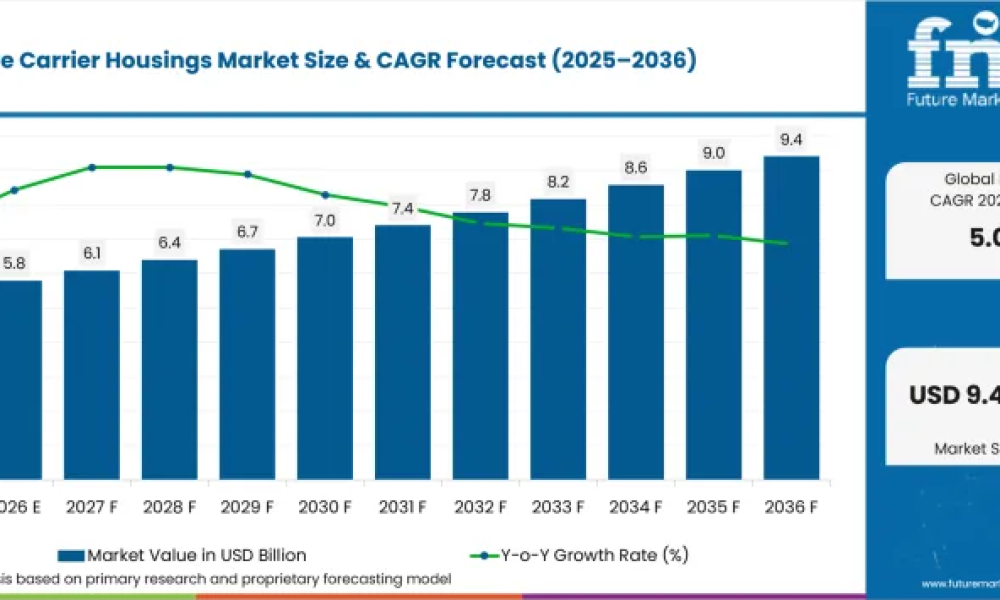
The global automotive carrier housings market is projected to grow from USD 5.8 billion in 2026 to USD 9.4 billion by 2036, registering a CAGR of 5.0% over the forecast period. Demand is supported by vehicle-platform renewal, expanding electric-driveline production, and the need for precision-engineered housings that maintain gear alignment, structural stiffness, and sealing performance.
Carrier housings provide structural support for driveline components, including differential gears, bearings, shafts, and reducer assemblies. Their dimensions and machining accuracy influence gear alignment, lubrication, sealing, and final assembly performance. As automakers introduce new axle, transmission, and electric-reducer platforms, housing suppliers must validate geometry and manufacturing processes before production tooling is released.
Electric vehicle production is adding to demand for reducer housings and related casting, tooling, and machining services. The International Energy Agency recorded more than 20 million electric-car sales in 2025, expanding the vehicle base requiring electric-drive components. At the same time, conventional and hybrid platforms continue to require application-specific housings, creating demand across multiple driveline architectures.
Vehicle production patterns also influence housing specifications. Mexico’s National Institute of Statistics and Geography (INEGI) recorded 1,642,083 light vehicles produced from January to May 2026, with light trucks accounting for 80.0% of output. This production mix supports demand for housings engineered for higher-load applications, while compact electrified platforms place greater emphasis on reducer packaging, weight, and dimensional integration.
What Are the Key Segments in the Automotive Carrier Housings Market?
The market is segmented by housing type, material, vehicle type, manufacturing process, sales channel, and region. Segment demand reflects the need to balance structural performance, manufacturing economics, weight, and compatibility with vehicle-specific driveline systems.
- Differential carrier housings — 32.0% share: Differential carrier housings lead the housing-type segment because they support driven-axle components and help maintain the alignment required for dependable power transmission.
- Cast iron — 38.0% share: Cast iron leads the material segment due to established foundry capabilities, structural stiffness, and its suitability for high-load housing applications.
- Passenger cars — 32.0% share: Passenger cars lead the vehicle-type segment because production volumes sustain demand across multiple driveline and vehicle-platform families.
Manufacturing choices also affect supplier selection. Casting and die casting provide routes for producing complex housing geometries, while machining establishes the precision of bearing bores, sealing faces, and gear interfaces. Forging or hybrid processes may be selected where component design and performance requirements justify alternative manufacturing approaches.
Get detailed market forecasts, competitive benchmarking, and pricing trends:
https://www.futuremarketinsights.com/reports/sample/rep-gb-35127
Which Countries Are Showing the Strongest Growth in the Automotive Carrier Housings Market?
Mexico is projected to record the fastest growth among the profiled countries, with a 6.0% CAGR from 2026 to 2036. Its vehicle manufacturing base and substantial light-truck production create opportunities for suppliers of axle, differential, and other driveline housings. Suppliers that can support platform-specific tooling, precision machining, and production qualification are positioned to address demand from vehicle manufacturers and Tier 1 suppliers.
Brazil is expected to expand at a 5.7% CAGR. Demand is linked to automotive production and the need for reliable driveline components across passenger vehicles and commercial applications. Housing suppliers must balance material performance, manufacturing cost, and compatibility with the relevant axle and transmission architecture.
South Korea is projected to grow at a 5.4% CAGR. Its automotive and electrified-driveline ecosystem supports demand for precision housing components. As vehicle programs incorporate different propulsion systems, suppliers must meet dimensional tolerances and integration requirements across conventional driveline and electric-reducer applications.
Canada is expected to register a 5.1% CAGR. Market development is supported by automotive manufacturing and the continued need for durable, precision-machined components. Housing sourcing decisions are influenced by tooling readiness, production consistency, and the ability to maintain alignment and sealing performance across vehicle programs.
The United States is projected to expand at a 4.7% CAGR. Demand reflects the requirements of established vehicle platforms alongside new electric-driveline programs. Manufacturers evaluate carrier housings based on structural performance, dimensional accuracy, manufacturing repeatability, and the cost of qualifying alternative suppliers.
Germany is expected to record a 4.4% CAGR. Its automotive engineering base supports demand for precision housing components used in conventional, hybrid, and electric drivetrains. Supplier qualification places emphasis on machining accuracy, process control, gear-interface tolerances, and consistency throughout serial production.
Japan is projected to record the lowest growth rate among the profiled countries, at a 4.1% CAGR. Demand continues to depend on the requirements of vehicle and driveline manufacturers seeking dependable housing performance and production quality. Suppliers must demonstrate precise geometry, reliable sealing surfaces, and stable manufacturing processes to qualify for vehicle programs.
How Is the Competitive Landscape Evolving?
The automotive carrier housings market includes established driveline suppliers, component manufacturers, and precision casting and machining specialists. Key participants include American Axle & Manufacturing, Dana, Magna International, GKN Automotive, Linamar, Nemak, Aisin, Schaeffler, JTEKT, and Musashi Seimitsu.
Competition is shaped by the ability to deliver housings that meet vehicle-specific dimensional, structural, and manufacturing requirements. Bearing bores, gear alignment, sealing faces, and machining sequences can affect assembly performance. As a result, changing suppliers may require new fixtures, additional validation, and requalification at the component or driveline level.
Manufacturers compete through casting expertise, precision machining, tooling management, material selection, and the ability to support design changes during vehicle development. Suppliers that coordinate housing geometry with downstream assembly requirements can reduce the risk of production disruption during launch.
Electrification is creating additional design requirements. Electric reducer housings may need to accommodate compact packaging and specific integration constraints, while conventional and hybrid driveline programs continue to require robust axle and differential structures. Suppliers with flexible manufacturing capabilities can serve a broader range of vehicle architectures.
What Does the Analyst Say About the Automotive Carrier Housings Market?
Future Market Insights Principal Consultant Nikhil Kaitwade observes:
“Carrier-housing economics are set by the interfaces that force revalidation: bearing bores, gear alignment, sealing faces and the machining sequence. A low casting quote loses value if the source change requires new fixtures or axle-level proof, while an incumbent can defend margin by carrying geometry changes from tooling release into launch.”
What Is Driving Demand for Automotive Carrier Housings?
Vehicle-platform renewal
New vehicle and driveline programs require housings designed around specific axle, transmission, and reducer configurations. Changes to gear geometry, bearing positions, or sealing interfaces can affect downstream assembly, making early design validation and tooling accuracy important. Suppliers that support engineering changes through production launch can help manufacturers control qualification risk.
Growth in electric drivetrains
Electric vehicles require reducer assemblies and associated structural housings that support electric-drive components. As electric-car sales increase, demand extends to the casting, tooling, and precision machining required to manufacture these components. Packaging and weight considerations can influence material and manufacturing decisions, particularly for compact electric platforms.
Vehicle mix and load requirements
Differences between passenger cars, SUVs, pickups, and light commercial vehicles affect housing dimensions and structural requirements. Higher-load applications can place greater emphasis on stiffness and durability, while compact platforms may prioritize packaging and weight. Suppliers must align the housing design with the intended vehicle’s operating loads and driveline configuration.
Precision manufacturing and quality control
Carrier housings require accurately machined bearing bores, gear interfaces, and sealing surfaces. Manufacturing variation can affect assembly alignment and sealing performance, making process consistency an important purchasing consideration. Foundry capability, machining sequence, fixture design, and quality verification all influence the cost and reliability of production.
Drive Your Business Growth Strategy: Checkout the Report for Key Insights!
https://www.futuremarketinsights.com/checkout/35127
What Are the Key Market Restraints?
High tooling costs and lengthy qualification processes can make supplier changes difficult. A revised housing design or manufacturing source may require new fixtures, dimensional validation, and additional testing to establish that gear alignment and sealing performance remain within requirements. These activities can delay sourcing decisions and increase the cost of introducing alternative suppliers.
Material and manufacturing trade-offs also affect procurement. Cast iron offers established production economics and stiffness, while aluminum and other lightweight materials may be considered where weight and packaging requirements justify them. The preferred solution depends on component loads, design constraints, manufacturing capability, and the vehicle program’s cost targets.
What Opportunities Exist for Automotive Carrier Housing Manufacturers?
Opportunities are emerging in electric reducer housings, lightweight housing designs, and manufacturing processes that combine complex casting geometries with precise machining. Suppliers that can support early engineering validation and accommodate design changes may strengthen their position in new vehicle programs.
There is also scope to improve manufacturing efficiency through coordinated tooling design, process control, and dimensional inspection. OEMs and driveline Tier 1 suppliers can benefit from housing partners that manage geometry changes from initial tooling through serial production. These capabilities can reduce requalification risk and support consistent assembly quality.
How Is the Automotive Carrier Housings Market Segmented?
The market is segmented by Housing Type, Material, Vehicle Type, Manufacturing, Sales Channel, and Region.
- By Housing Type: Differential carrier housings, axle carrier housings, transmission carrier housings, EV reducer housings, and lightweight aluminum housings.
- By Material: Cast iron, aluminum, magnesium alloy, ductile iron, and high-strength steel.
- By Vehicle Type: Passenger cars, SUVs and crossovers, light commercial vehicles, pickup trucks, and electric vehicles.
- By Manufacturing: Casting, die casting, machining, and forging or hybrid manufacturing.
- By Sales Channel: OEM direct, driveline Tier 1 suppliers, aftermarket replacement, and precision foundries.
These segments reflect different design and sourcing priorities. Housing type determines the interfaces and loads the component must accommodate, while material and manufacturing choices influence stiffness, weight, precision, and production cost. Sales channels determine how suppliers engage with vehicle manufacturers, driveline integrators, and replacement markets.
What Is the Outlook for the Automotive Carrier Housings Market?
The automotive carrier housings market is projected to reach USD 9.4 billion by 2036, advancing at a 5.0% CAGR from 2026 to 2036. Demand is supported by vehicle-platform renewal, electric-driveline production, and the continued requirement for precision-engineered axle, differential, transmission, and reducer housings.
Mexico is expected to lead the profiled countries with a 6.0% CAGR, followed by Brazil at 5.7%, while Japan is projected to grow at 4.1%. Across markets, suppliers that combine manufacturing consistency, precision machining, tooling expertise, and support for conventional and electrified drivetrains will be better positioned to meet OEM and Tier 1 sourcing requirements.
About Future Market Insights
Future Market Insights (FMI) provides market research and consulting services, delivering market forecasts, competitive intelligence, and industry analysis to support business planning and strategic decisions across global markets.



