
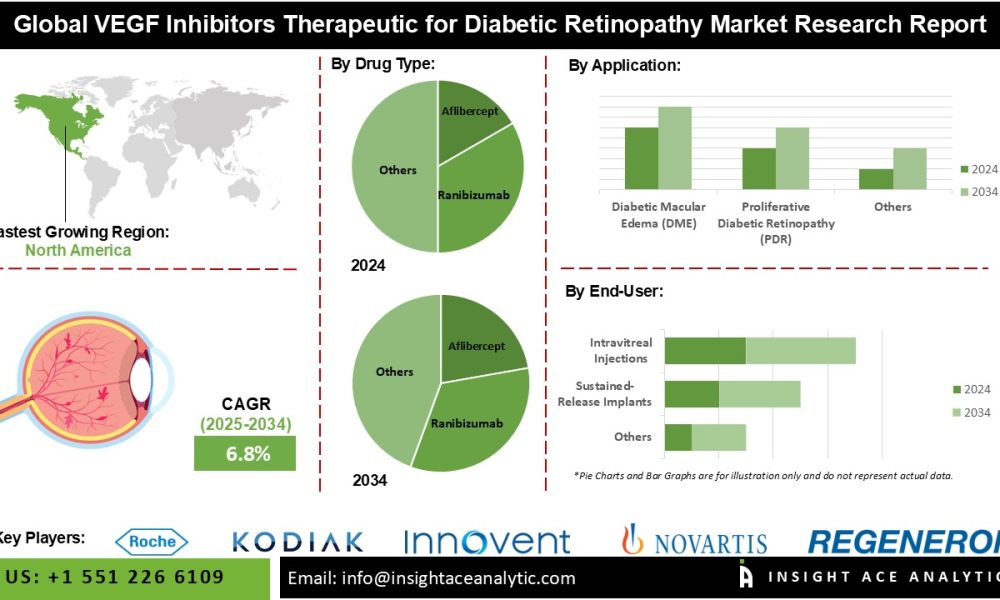
InsightAce Analytic Pvt. Ltd. announces the release of a market assessment report on the “VEGF Inhibitors Therapeutic for Diabetic Retinopathy Market”-, By Drug Type (Aflibercept, Ranibizumab, Bevacizumab, Faricimab, Biosimilars, Pipeline drugs), By Indication (Diabetic Macular Edema (DME), Proliferative. Diabetic Retinopathy (PDR), Non-Proliferative Diabetic Retinopathy (NPDR)), By Delivery Method (Intravitreal Injections, Sustained-Release Implants, Emerging), and Global Forecasts, 2025-2034 And Segment Revenue and Forecast To 2034.”
VEGF Inhibitors Therapeutic for Diabetic Retinopathy Market Size is predicted to expand with a 6.8% CAGR during the forecast period for 2025-2034.
Check this Report Brochure : https://www.insightaceanalytic.com/request-sample/3088
Vascular Endothelial Growth Factor (VEGF) is a signaling protein naturally produced by the body, playing a vital role in stimulating the formation of new blood vessels through angiogenesis. This process is essential for normal physiological functions such as embryonic development, wound healing, and restoring oxygen supply to tissues under hypoxic conditions. However, in diabetic retinopathy (DR), a serious complication of diabetes, chronically high blood sugar levels damage the retinal blood vessels, triggering excessive VEGF production. This leads to the growth of fragile, abnormal blood vessels (neovascularization) on the retina or optic nerve, which are prone to bleeding, causing vitreous hemorrhage, and may result in tractional retinal detachment and severe vision loss.
VEGF inhibitors are administered as intravitreal injections directly into the vitreous humor of the eye. These injections are typically performed quickly in an ophthalmologist’s office under local anesthesia. Treatment usually begins with a “loading dose” of monthly injections, followed by a personalized regimen depending on the patient’s response and ongoing disease activity. Because diabetes continues to drive VEGF production, repeated injections are often necessary to maintain vision and prevent progression of the disease.
Innovations such as long-acting formulations and sustained-release delivery mechanisms are significantly reducing the frequency of intravitreal injections, thereby improving patient compliance and convenience, key challenges in the management of diabetic retinopathy. Additionally, the introduction of biosimilar versions of established anti-VEGF drugs like ranibizumab and aflibercept is intensifying market competition and enhancing treatment accessibility, particularly in emerging economies. The market is also witnessing a shift toward personalized medicine, with growing emphasis on tailoring therapies based on individual patient profiles, including genetic markers and disease progression, to optimize outcomes and minimize side effects.
Ongoing research into combination therapies pairing VEGF inhibitors with corticosteroids or anti-inflammatory agents is showing promise in targeting multiple disease pathways to enhance treatment efficacy. Furthermore, there is an increasing focus on early diagnosis and intervention, especially in the Non-Proliferative Diabetic Retinopathy (NPDR) stage, where early use of VEGF inhibitors can effectively prevent progression and help preserve vision.
List of Prominent Players in the VEGF Inhibitors Therapeutic for Diabetic Retinopathy Market:
Regeneron Pharmaceuticals, Inc.
- Hoffmann-La Roche Ltd.
- Novartis AG
- Bayer AG
- Genentech, Inc. (Roche subsidiary)
- Kodiak Sciences Inc.
- Innovent Biologics, Inc.
- Ashvattha Therapeutics, Inc.
- UNITY Biotechnology, Inc.
- PanOptica, Inc.
- Regenxbio Inc.
- Ocular Therapeutix, Inc.
- Adverum Biotechnologies, Inc
Market Dynamics:
Drivers:
The rising global prevalence of type 1 and type 2 diabetes has led to a significant increase in diabetic retinopathy cases. As patients live longer with diabetes, their risk of developing diabetic retinopathy and diabetic macular edema (DME) also rises. These conditions have become leading causes of vision impairment and blindness among working-age adults. Anti-VEGF drugs such as aflibercept (Eylea), ranibizumab (Lucentis), bevacizumab (Avastin), and faricimab (Vabysmo) have demonstrated high efficacy in reducing macular edema and preventing vision loss. Their ability to improve or stabilize visual acuity has established them as the standard of care. Additionally, growing awareness of diabetic eye complications, supported by national screening initiatives, is enabling earlier diagnosis and intervention, further driving demand for effective therapies like VEGF inhibitors.
Challenges:
Branded VEGF inhibitors such as Eylea (aflibercept) and Lucentis (ranibizumab) are associated with high treatment costs, which pose a significant financial burden on both patients and healthcare systems. This economic challenge is especially pronounced in countries with limited healthcare funding or inadequate insurance infrastructure.
Regional Trends:
North America holds the largest share in the VEGF inhibitors market for diabetic retinopathy. This dominance is attributed to a well-established healthcare system, high awareness levels, and the early adoption of advanced treatments. The region benefits from favorable reimbursement policies and a strong presence of key market players, facilitating widespread access to anti-VEGF therapies. However, However, The Asia-Pacific region is experiencing the fastest growth in the VEGF inhibitors market for diabetic retinopathy. This surge is propelled by the increasing prevalence of diabetes in countries like China, India, and Japan. Improved healthcare infrastructure, rising awareness about diabetic eye diseases, and enhanced access to diagnostic tools contribute to the market’s rapid expansion.
Recent Developments:
- In Jan 2025, Ocular Therapeutix, Inc. Wet age-related macular degeneration (wet AMD) is the leading cause of blindness in the United States, but it doesn’t have to be. The company is dedicated to redefining the retina experience and has described remarkable clinical progress throughout its registrational program for AXPAXLI™ in wet AMD. Additionally, it plans to advance AXPAXLI in non-proliferative diabetic retinopathy (NPDR). In the United States, diabetic retinopathy is the most common cause of blindness among working people, but it doesn’t have to be. They have VEGF as a proven target and anti-VEGFs as established therapy that have been around for decades.
- In Aug 2023, Regeneron Pharmaceuticals, Inc, declared that EYLEA HD (aflibercept) Injection 8 mg has been approved by the U.S. Food and Drug Administration (FDA) to treat patients with diabetic macular edema (DME), diabetic retinopathy (DR), and wet age-related macular degeneration (wAMD). For the first three months across all indications, the recommended dose for EYLEA HD is 8 mg (0.07 mL of 114.3 mg/mL solution) every four weeks (monthly). After that, it should be taken every eight to sixteen weeks (2 to four months) for wAMD and DME and every eight to twelve weeks (2 to three months) for DR.
Segmentation of VEGF Inhibitors Therapeutic for Diabetic Retinopathy Market.
Global VEGF Inhibitors Therapeutic for Diabetic Retinopathy Market – By Drug Type
- Aflibercept (Eylea)
- Ranibizumab (Lucentis)
- Bevacizumab (Avastin, off-label)
- Faricimab (Vabysmo, dual VEGF/Ang-2 inhibitor)
- Biosimilars
- Pipeline drugs
Global VEGF Inhibitors Therapeutic for Diabetic Retinopathy Market – By Indication
Diabetic Macular Edema (DME)
- Proliferative Diabetic Retinopathy (PDR)
- Non-Proliferative Diabetic Retinopathy (NPDR)
Global VEGF Inhibitors Therapeutic for Diabetic Retinopathy Market – By Delivery Method
- Intravitreal Injections
- Sustained-Release Implants
- Emerging
Global VEGF Inhibitors Therapeutic for Diabetic Retinopathy Market – By Region
North America-
- The US
- Canada
Europe-
- Germany
- The UK
- France
- Italy
- Spain
- Rest of Europe
Asia-Pacific-
- China
- Japan
- India
- South Korea
- Southeast Asia
- Rest of Asia Pacific
Latin America-
- Brazil
- Argentina
- Mexico
- Rest of Latin America
Middle East & Africa-
- GCC Countries
- South Africa
- Rest of the Middle East and Africa
About Us:
InsightAce Analytic is a market research and consulting firm that enables clients to make strategic decisions. Our qualitative and quantitative market intelligence solutions inform the need for market and competitive intelligence to expand businesses. We help clients gain competitive advantage by identifying untapped markets, exploring new and competing technologies, segmenting potential markets and repositioning products. expertise is in providing syndicated and custom market intelligence reports with an in-depth analysis with key market insights in a timely and cost-effective manner.




