
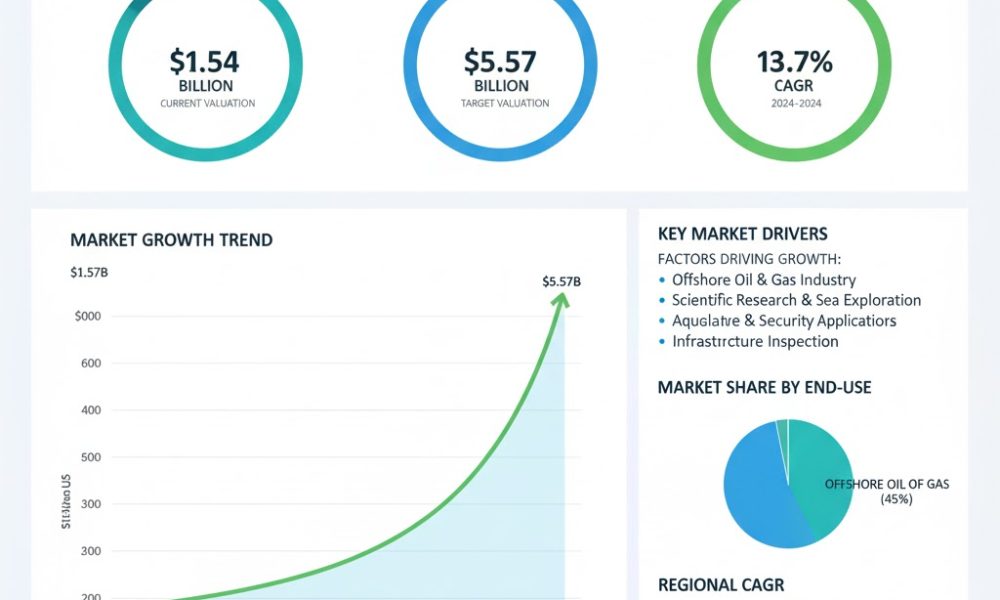
The U.S. underwater robot market is poised for significant growth over the next decade, driven by expanding applications in offshore oil and gas, defense, marine research, and subsea infrastructure inspection. Advancements in autonomous underwater vehicle (AUV) technology, remote operation capabilities, and enhanced sensor integration are transforming subsea operations across multiple industries.
Market Overview and Forecast
The U.S. underwater robot market is estimated at approximately USD 1.25 billion in 2025 and is projected to reach USD 2.3 billion by 2035, reflecting a compound annual growth rate (CAGR) of 6.4% over the forecast period. Growth is driven by rising investments in offshore exploration, naval modernization, environmental monitoring, and subsea data collection.
Underwater robots, including remotely operated vehicles (ROVs) and autonomous underwater vehicles (AUVs), are increasingly deployed for complex tasks such as pipeline inspection, deep-sea exploration, marine biology research, and defense missions. The integration of AI, advanced navigation systems, and high-resolution imaging sensors is improving operational efficiency and mission accuracy.
Key Market Insights at a Glance
| Metric | U.S. Estimate |
|---|---|
| Market Value (2025) | USD 1.25 billion |
| Forecast Value (2035) | USD 2.3 billion |
| CAGR | 6.4% |
| Dominant Vehicle Type | Remotely Operated Vehicles (ROVs) – 57% share |
| Fastest-Growing Segment | Autonomous Underwater Vehicles (AUVs) – 7.2% CAGR |
| Leading Application | Offshore Oil & Gas Inspection (38% share) |
Drivers of Market Growth
Expansion of Offshore Oil & Gas Exploration
Increased investment in offshore energy exploration is fueling demand for underwater robots capable of performing inspection, maintenance, and repair of subsea infrastructure.Defense and Naval Modernization
Autonomous and semi-autonomous underwater robots are integral to modern naval operations, including mine detection, reconnaissance, and surveillance missions.Advancements in Robotics and AI
AI-enabled navigation, obstacle detection, and real-time data processing enhance mission accuracy, reduce human intervention, and allow longer-duration deployments.Marine Research and Environmental Monitoring
Underwater robots are increasingly deployed for ecological studies, deep-sea exploration, and environmental impact assessments, supporting sustainable resource management.Cost Efficiency and Operational Safety
Using underwater robots reduces risks to human divers and decreases operational costs for offshore, defense, and research missions, driving adoption.
Segment Analysis
By Vehicle Type: ROVs currently dominate the market due to their widespread use in inspection and maintenance. AUVs are the fastest-growing segment, benefiting from autonomous capabilities and extended mission endurance.
By Application: Offshore oil & gas inspection leads in revenue, followed by defense, marine research, and subsea infrastructure monitoring.
By End-User: Oil & gas operators, defense agencies, and marine research institutions account for the majority of adoption, while commercial subsea service providers are emerging as significant customers.
Regional Insights
The U.S. is the largest market for underwater robots in North America due to advanced naval capabilities, a mature oil and gas industry, and strong investments in marine research. Coastal regions, including the Gulf of Mexico, California, and the East Coast, are key hubs of underwater robot deployment.
Competitive Landscape
Leading players in the U.S. underwater robot market include:
Oceaneering International, Inc.
Teledyne Technologies Inc.
Bluefin Robotics (a division of General Dynamics)
Saab Seaeye
ECA Group
These companies focus on innovation in autonomous navigation, sensor integration, and mission-specific customization, while also partnering with research institutions and defense organizations to expand market presence.
Market Outlook: Automation, AI, and Multi-Industry Applications
Over the next decade, the U.S. underwater robot market is expected to evolve with:
Increased Autonomy: AUVs will see higher adoption as autonomous navigation, obstacle avoidance, and real-time data analysis improve.
Advanced Sensors and Imaging: Enhanced sonar, lidar, and high-definition cameras will enable precise subsea mapping and inspection.
Integration with AI and IoT: Intelligent data processing, predictive maintenance, and remote monitoring will increase operational efficiency.
Diversification Across Industries: Beyond oil & gas and defense, applications in marine research, renewable energy, and environmental monitoring will drive growth.
“Underwater robotics is transforming how we explore, protect, and maintain the subsea environment. Companies investing in AI, sensor integration, and autonomous capabilities will define market leadership,” said a market analyst.
To access the complete data tables and in-depth insights, request a Discount On The Report here: https://www.factmr.com/connectus/sample?flag=S&rep_id=8214
Have a specific Requirements and Need Assistant on Report Pricing or Limited Budget please contact us – [email protected]
To View Related Report :



