
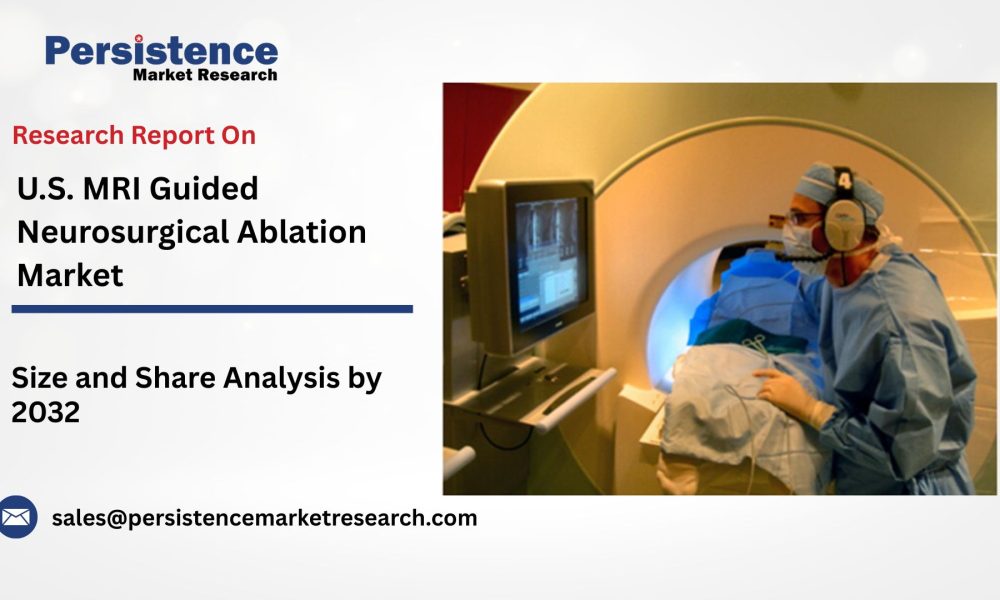
The U.S. MRI-guided neurosurgical ablation market is poised for robust growth over the coming decade. With an estimated market value of US$ 62.1 million in 2025, and projected expansion to US$ 92.2 million by 2032, the sector is expected to grow at a compound annual growth rate (CAGR) of 5.8 % during the forecast window from 2025 to 2032.
This upward trajectory reflects a confluence of clinical demand, technological innovation, regulatory progress, and evolving healthcare reimbursement dynamics. In this article, I examine the market drivers, challenges, product and indication trends, competitive landscape, and key strategic considerations that will shape the U.S. MRI-guided neurosurgical ablation sector.
Market Drivers & Growth Catalysts
- Rising Burden of Neurological Diseases: Brain Tumors, Epilepsy & Movement Disorders
One of the foremost growth drivers is the increasing incidence and prevalence of neurological disorders that require precision intervention. In the U.S., primary brain and central nervous system tumors (malignant and non-malignant) have an age-adjusted incidence of about 25.34 per 100,000 persons. Each year, tens of thousands of new diagnoses occur in regions where surgical resection is challenging or risky. Many lesions are deep-seated or adjacent to functionally critical brain regions, making minimally invasive, image-guided ablation especially attractive.
Similarly, epilepsy affects roughly 1.1 % of U.S. adults (~2.9 million people), many of whom continue to suffer from uncontrolled seizures despite pharmacotherapy. For patients with drug-resistant focal epilepsy, MRI-guided laser ablation (often called laser interstitial thermal therapy, or LITT) provides an alternative with potentially lower morbidity compared to open resection. The stable, sizable patient pool and the persistent unmet need in treatment-resistant cases underpin sustained demand.
Request a Sample: https://www.persistencemarketresearch.com/samples/35661
Movement disorders—such as essential tremor or Parkinson’s disease—also represent growth niches, especially as noninvasive focused ultrasound-based ablation (MRI-guided focused ultrasound, MRgFUS) becomes more clinically accepted.
- Preference for Minimally Invasive, Image-Guided Therapies
MRI-guided ablation techniques (both laser- and ultrasound-based) offer several advantages over conventional open neurosurgery:
- Real-time imaging allows precise targeting and monitoring of thermal effects, reducing collateral damage to healthy tissue
- Smaller incisions or potentially no incision (in the case of focused ultrasound) result in faster recovery, shorter hospital stays, and fewer complications
- In patients with comorbidities or who are poor surgical candidates, minimally invasive options expand the therapeutic window
These benefits align well with broader trends in neurosurgery and oncology, where image-guided, less invasive, safety-optimized methods are increasingly preferred.
- Technological Advances & Regulatory Momentum
Technological innovation is accelerating the capabilities of MRI-guided ablation systems. Key advances include:
- Improved laser fibers, cooling schemes, and thermometry feedback
- More powerful, precise focused ultrasound transducers
- Integration of artificial intelligence (AI) for treatment planning and safety margin optimization
- Compact and MRI-compatible devices tailored for neurosurgical suites
- Workflow and user-interface enhancements to reduce procedure time, improve ease-of-use, and support integration with surgical navigation systems
Regulatory support is also playing a critical role. FDA clearances for systems such as Visualase™ have established clinical legitimacy for neurosurgeons to use MRI-guided ablation in indications such as epilepsy, brain tumors, and radiation necrosis Moreover, recent FDA approval (2025) for Insightec’s staged bilateral focused ultrasound therapy for Parkinson’s disease underscores growing acceptance of noninvasive MRI-guided interventions in movement disorders.
- Improved Insurance Coverage & Reimbursement Policies
A key barrier to adoption historically has been the high cost of MRI-guided ablation and uncertainty around reimbursement. However, recent policy shifts are opening doors:
- Some private insurers, such as Health Care Service Corporation (HCSC), have begun covering MRI-guided LITT for brain tumors and epilepsy.Medicare has expanded local coverage determinations for MRgFUS in essential tremor in multiple states.
- Blue Cross Blue Shield of North Carolina and other payers have updated their policies to include MRgLITT for neurological indications.
- These developments reduce financial risk for hospitals and providers and foster greater adoption in more institutions.
Market Segmentation & Trends
Understanding how the market breaks down by product type, indication, and end user helps clarify where growth is concentrated and where emerging opportunities lie.
Product Type: Laser vs Focused Ultrasound vs Accessories
- MRI-guided laser therapy systems (i.e., LITT) are currently the leading product segment, capturing an estimated ~45.6 % market share in 2025. Factors driving this include strong clinical validation, FDA clearance in key neurological indications, and extensive institutional adoption in neurosurgical centers.
- MRI-guided focused ultrasound (MRgFUS) systems represent the fastest-growing segment due to their noninvasive nature, growing regulatory approvals, and increasing visibility in movement-disorder applicationsAccessories & consumables (e.g. probes, fibers, thermometry sensors, software modules) comprise the remainder. While they are lower-value per unit compared to core systems, growth in installed base and procedure volumes will drive accessory demand.
In future years, focused ultrasound is expected to gain share relative to laser systems, as the noninvasive route becomes more refined and accepted in neurosurgical settings.
By Indication: Brain Tumors, Epilepsy Lead
- Brain tumors are forecast to be the largest indication segment, benefitting from both high incidence and the clinical challenges associated with tumor location, surgical access, and preservation of surrounding neural tissue. The ability to ablate deep-seated or recurrent tumors in eloquent regions positions MRI-guided ablation as a strong adjunct or alternative to open surgery.
- Epilepsy, particularly drug-resistant focal epilepsy, is another leading application. MRI-guided laser ablation has shown efficacy in reducing seizure burden while minimizing morbidity.
- Movement disorders—notably essential tremor and Parkinson’s disease—offer future potential, especially via MRgFUS, which can deliver bilaterally staged, lesion-based therapy noninvasively (as in the 2025 FDA approval).
- Radiation necrosis and other neurologic indications represent additional but smaller niches.
By End User: Hospitals Dominate, Ambulatory & Research as Growth Avenues
- Hospitals represent the dominant end-user segment, accounting for over 50 % of the market in 2025. Their technological infrastructure (MRI suites, neurosurgery departments), high patient volumes, and capacity for capital investment make them natural adopters.
- Ambulatory surgical centers (ASCs) may represent a growing frontier, especially as procedural workflows become more streamlined and cost pressures mount.
- Research institutions and academic neurosurgical centers will continue to adopt and pilot novel techniques, especially for new indications and system advancements.
- Other user types (e.g. specialty clinics) may adopt in niche settings, particularly in partnership with hospitals.
Challenges & Restraints
Despite a promising outlook, the U.S. MRI-guided neurosurgical ablation market faces several headwinds.
Capital & Operational Costs
Installing and maintaining MRI-compatible surgical suites is capital-intensive. Building a fully integrated MRI-guided ablation suite (including scanner, shielding, cooling, and structural modifications) can cost US$ 3–5 million or more. The MRI system itself might cost US$ 1–3 million or beyond, along with the ancillary costs of facility adaptation. Operationally, procedure costs are nontrivial. For example, in epilepsy, the median cost of MRgLITT (including disposables, imaging, hospital stay, professional fees) has been reported at ~US$ 21,800, with variability across settings. These high costs restrict adoption to larger institutions and limit scalability in resource-constrained environments.
Limited Access in Smaller, Rural, or Community Hospitals
Smaller hospitals and community-based centers often lack the capital resources, MRI infrastructure, or neurosurgical expertise required to adopt these sophisticated systems. This geographic and institutional divide may perpetuate disparities in access, with advanced therapies concentrated at major academic and tertiary centers.
Reimbursement Uncertainties & Fragmentation
While insurance coverage is improving, reimbursement processes remain complex and variable by state, payer, and indication. In some cases, providers may be reluctant to invest until reimbursement policies are well-established and stable. The need to negotiate local coverage determinations or obtain prior authorization can slow adoption.
Clinical Evidence, Learning Curve & Treatment Guidelines
Although accumulating clinical data supports MRI-guided ablation, long-term outcomes and head-to-head trials comparing to conventional neurosurgery remain limited for many indications. Surgeons must acquire new skills and validate workflows. Integration into treatment guidelines is ongoing. These factors may slow adoption, especially among conservative practitioners.
Competitive Landscape & Strategic Moves
The U.S. MRI-guided neurosurgical ablation market is competitive, with both incumbent medical-device giants and nimble innovators vying for share. Key players include Medtronic, Insightec, Monteris Medical, Philips Healthcare, GE Healthcare, Siemens Healthineers, Profound Medica, ClearPoint Neuro, Elekta, Boston Scientific, and others. Notable Recent Developments
- In June 2025, Medtronic obtained FDA 510(k) clearance for its Visualase™ V2 MRI-Guided Laser Ablation System, enhancing real-time guidance for ablating brain tumors, epileptic foci, and other neural targets
- In July 2025, Insightec secured FDA approval for its staged bilateral focused ultrasound therapy in Parkinson’s disease, enabling bilateral MRI-guided ablation over staged sessions.
- In January 2025, adjustments in reimbursement rates for MRI-guided ablation (e.g. TULSA procedure) were implemented at the federal or state level to standardize coverage and facilitate broader use.
Strategic Imperatives
To succeed in this evolving market, companies must focus on:
- System differentiation: innovations in imaging speed, thermometry, safety control, AI-aided planning, and user interface.
- Affordability and modular design: offering scalable or modular systems that reduce upfront cost and integrate with existing MRI infrastructure.
- Clinical partnerships & evidence generation: collaborating with academic neurosurgical centers to publish outcomes, runs trials, and validate the long-term safety and efficacy of ablation modalities.
- Reimbursement strategy: working with payers to secure favorable coverage, demonstrating cost-effectiveness, and facilitating adoption across multiple states.
- Training & workflow support: offering surgeon training, simulation platforms, and streamlined procedural workflows to lower the learning curve and promote institutional adoption.
- Geographic reach & service models: developing service, maintenance, and support networks across the U.S., including in less penetrated regions.
Forecast Insights & Market Projection
Given the growth assumptions, the market’s increase from US$ 62.1 million in 2025 to US$ 92.2 million in 2032 reflects sustained expansion at 5.8 % CAGR.
- Early years (2025–2028): growth is likely to be driven by installations in leading academic centers and early adopters, expansion of indications (e.g. epilepsy, brain tumors), and gradual payer acceptance.
- Mid period (2028–2030): as more clinical evidence accumulates and reimbursement steadies, adoption may accelerate into secondary hospitals and certain ASCs.
- Later phase (2030–2032): the market should see greater diffusion, with mid-tier institutions investing in MRI-guided ablation infrastructure, and focused ultrasound gaining share against laser systems as noninvasive approaches mature.
While laser-based systems are expected to maintain leadership initially, focused ultrasound is projected to grow faster, gradually carving out a larger share over time. Similarly, the brain tumor and epilepsy segments are likely to remain core demand drivers, although movement-disorder applications may become more prominent.
The installed base growth will also drive ancillary revenue (consumables, maintenance, software upgrades), which may represent higher-margin streams for OEMs.
Key Takeaways & Outlook
- The U.S. MRI-guided neurosurgical ablation market is on a steady growth trajectory: US$ 62.1 million in 2025 → US$ 92.2 million by 2032 with CAGR 5.8 %.
- Growth is underpinned by rising neurologic disease burden (brain tumors, epilepsy, movement disorders), preference for minimally invasive therapies, and advancing imaging and ablation technologies.
- MRI-guided laser systems currently dominate, but focused ultrasound is the fastest-growing segment.
- Hospitals remain the primary end-user, though ambulatory centers and academic institutions offer growth potential.
- Key challenges include high capital and operational costs, limited access in smaller hospitals, variable reimbursement, and the need for more long-term clinical evidence.
- Strategic priorities for industry players include cost reduction, system differentiation, reimbursement alignment, training, and evidence generation.
Overall, the U.S. MRI-guided neurosurgical ablation market presents a promising, dynamic landscape. Success in this space will depend on balancing innovation with affordability, building evidence-based credibility, and navigating the complex healthcare reimbursement environment.
Explore the Latest Trending Research Reports:




