
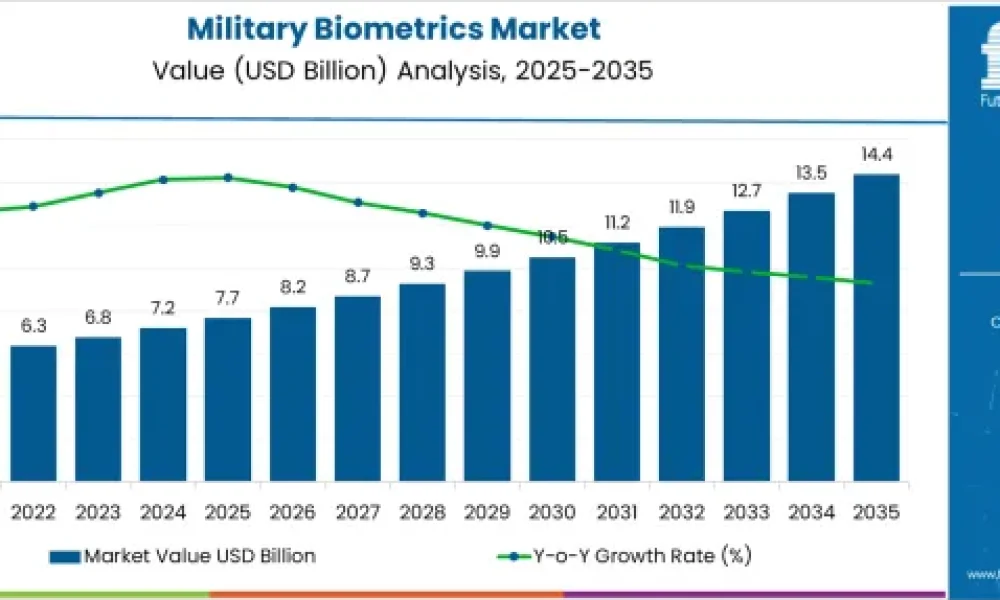
The global Military Biometrics Market is entering a high-growth phase as defense forces worldwide accelerate investments in secure identity verification, surveillance enhancement, and next-generation authentication systems. Valued at USD 7.7 billion in 2025, the market is projected to reach USD 14.4 billion by 2035, advancing at a CAGR of 6.5%, according to the latest industry analysis.
The rapid expansion is driven by rising geopolitical tensions, modernization of defense infrastructure, and increased demand for fast, field-ready biometric authentication. As asymmetric warfare, border infiltration, and cyber-physical threats intensify, military agencies are prioritizing multi-layered biometric solutions for operational security and battlefield intelligence.
Hardware Remains the Backbone of Military Biometric Deployment
The hardware segment dominates the market with a commanding 59.1% share in 2025, underscoring the reliance on robust, rugged, and portable biometric devices. These include fingerprint scanners, facial imaging systems, iris sensors, and handheld verification terminals engineered for harsh combat environments.
Defense organizations are increasingly procuring systems that support multi-modal capabilities, low-latency data processing, and seamless integration with command-and-control networks. Advancements in miniaturization, power efficiency, and ruggedization continue to elevate the performance and field utility of biometric hardware.
Subscribe for Year-Round Insights → Stay ahead with quarterly and annual data updates
https://www.futuremarketinsights.com/reports/sample/rep-gb-22836
Fingerprint Recognition Leads Technology Adoption with 34.7% Share
Fingerprint recognition remains the most widely deployed biometric modality, accounting for 34.7% of market share. Its maturity, reliability, and cost-effectiveness make it indispensable for base access control, troop movement tracking, battlefield verification, and detainee management.
Enhancements in live-finger detection, improved sensor resolution, and spoof-resistant materials are further strengthening its adoption across mission-critical military applications, even as facial and iris recognition gain traction.
Defense Forces Account for 41.3% of End-Use Demand
The defense forces segment holds 41.3% of the total market in 2025, driven by large-scale deployments across border security, field missions, secure installations, and logistics operations. Governments worldwide are integrating multi-modal biometric frameworks to mitigate insider threats, strengthen surveillance infrastructure, and enhance situational awareness during operations.
As militaries transition toward digital transformation and AI-enabled identity management, demand for real-time, interoperable biometric systems is expected to grow significantly.
Key Market Drivers: Security, Modernization, and Battlefield Integration
- Heightened Need for Secure Access Control
Rising risks of espionage and infiltration are propelling defense agencies to adopt biometric-based access systems for high-security facilities. Multi-layered authentication—combining fingerprint, iris, and facial recognition—is becoming standard across NATO and allied nations.
- Expansion of Border Security and Perimeter Defense
Military biometric checkpoints are increasingly deployed at borders, naval bases, and conflict zones to authenticate individuals in real time. Countries facing porous borders—from Asia to the Middle East—are leading adopters of multimodal biometric surveillance.
- Integration with Tactical and Field Systems
Portable and wearable biometrics are enabling frontline soldiers to perform rapid identity checks during missions. Interoperable systems now link tactical units with command centers, enhancing intelligence flow and operational speed.
- Strategic Investments and AI-Driven Authentication
Defense contractors are investing heavily in AI-enhanced biometrics, next-gen algorithms, and cyber-hardened platforms. Mergers, acquisitions, and defense partnerships are accelerating the deployment of scalable, high-accuracy solutions.
Global Growth Accelerates: China and India Lead Expansion
Between 2025 and 2035, high-growth countries are reshaping the market landscape:
- China: 8.8% CAGR, driven by AI-backed surveillance and border defense upgrades
- India: 8.1% CAGR, supported by Digital Border Management and modernization of forward bases
- Germany: 7.5% CAGR, aligned with NATO security enhancements
- France: 6.8% CAGR, driven by multi-modal deployments in rapid-response forces
- UK: 6.2% CAGR, focused on secure base infrastructure
- USA: 5.5% CAGR, driven by next-gen AI biometric integration for battlefield operations
The report includes detailed insights across 40+ countries, highlighting growing defense expenditures, evolving procurement trends, and increasing adoption of multimodal biometrics.
Personalize Your Experience: Ask for Customization to Meet Your Requirements
https://www.futuremarketinsights.com/customization-available/rep-gb-22836
United States: Modernization Accelerates Post-2025
The U.S. market’s CAGR rose from 4.6% (2020–2024) to 5.5% (2025–2035) due to expanded adoption of AI-powered biometric systems for naval bases, air command centers, and homeland security.
Key milestones:
- 58% of defense biometric systems integrated with AI by 2027
- 41% growth in facial recognition deployments by 2029
- 33% increase in federal funding for biometric modernization by 2028
Competitive Landscape: Global Leaders Redefine Security Standards
The market is moderately concentrated, led by companies specializing in multimodal authentication, rugged hardware, and AI-driven biometrics. Key players include:
Aware, BioEnable Technologies, Cognitec Systems, Dermalog Identification Systems, Fulcrum Biometrics, HID Global, IDEMIA, Leidos, M2SYS Technology, Microsoft, NEC Corporation, Neurotechnology, Safran, Securiport, Smiths Group, and Thales
Recent developments include Safran’s acquisition of Preligens (September 2024), strengthening its AI-based military surveillance capabilities.
These companies are enhancing systems with improved accuracy, faster processing, cloud-based analytics, and stronger cybersecurity—solidifying their leadership in global defense security modernization.
Why Choose FMI: Empowering Decisions that Drive Real-World Outcomes:
https://www.futuremarketinsights.com/why-fmi
About Future Market Insights (FMI)
Future Market Insights, Inc. (FMI) is an ESOMAR-certified, ISO 9001:2015 market research and consulting organization, trusted by Fortune 500 clients and global enterprises. With operations in the U.S., UK, India, and Dubai, FMI provides data-backed insights and strategic intelligence across 30+ industries and 1200 markets worldwide.



