
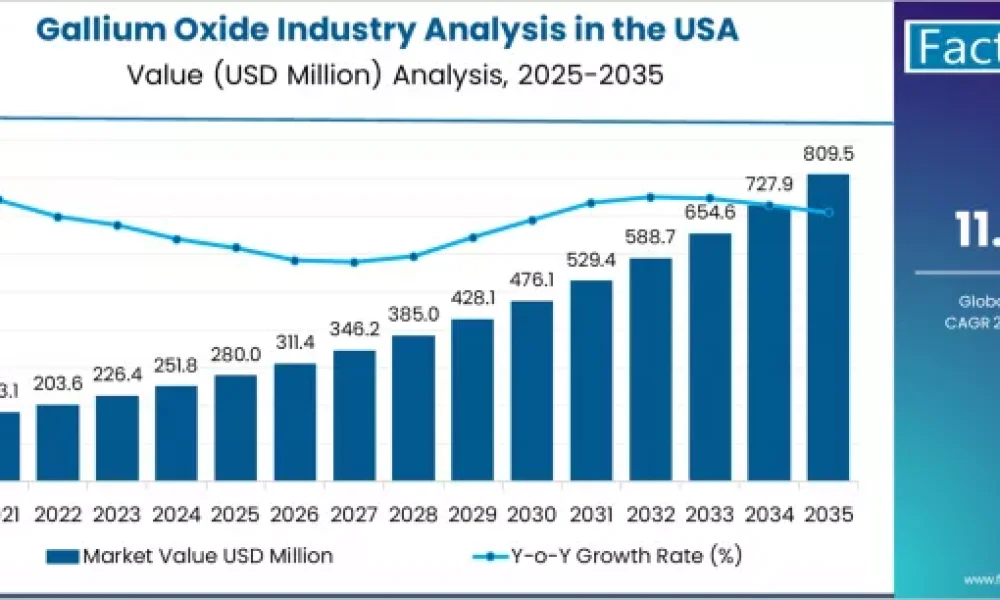
The U.S. gallium oxide industry is poised for rapid growth from 2025 to 2035, driven by surging demand in power electronics, semiconductor innovation, and next-generation energy and telecommunications infrastructure. Gallium oxide (Ga₂O₃), an ultra-wide bandgap semiconductor material, is increasingly recognized for its superior thermal stability, high breakdown voltage, and efficiency advantages over conventional materials. This report provides a comprehensive outlook on market size, growth drivers, regional dynamics, technology trends, and strategic implications for stakeholders.
Market Size and Growth
The U.S. gallium oxide market is projected to expand from approximately USD 280 million in 2025 to around USD 810 million by 2035, reflecting a robust compound annual growth rate (CAGR) of 11.2%. Powders and substrates dominate the market, accounting for 54% of total demand, while power electronics applications represent the largest segment, capturing 46% of market share. Growth is expected across key regions including the West, South, Midwest, and Northeast, with the Western U.S. leading in consumption due to advanced semiconductor infrastructure and technology-driven demographics.
To access the complete data tables and in-depth insights, request a Discount On The Report here: https://www.factmr.com/connectus/sample?flag=S&rep_id=11951
Key Growth Drivers
- Semiconductor Innovation:Gallium oxide powders and substrates are essential for modern semiconductor manufacturing, enabling higher efficiency, thermal management, and reliability in advanced electronic devices. Increased investment in semiconductor fabs and R&D is driving consistent demand.
- Power Electronics Expansion:The rise of electric vehicles, renewable energy integration, and advanced power systems has fueled demand for gallium oxide-based devices. Its superior Baliga’s figure of merit and ultra-wide bandgap properties allow devices to operate efficiently under high voltage and temperature stress.
- Technological Advancements:Advanced crystal growth technologies, epitaxial wafer production, and enhanced performance standards are improving material quality, ensuring reliability, and enabling scalable production. These innovations support integration into 5G networks, high-performance RF devices, and energy-efficient systems.
- Government and Industry Support:Validation from institutions such as the U.S. Department of Energy and ongoing investments in semiconductor and electronics infrastructure have accelerated adoption, positioning the U.S. as a global leader in gallium oxide utilization.
Regional Insights
The Western U.S. holds a leading position in gallium oxide demand due to concentrated semiconductor facilities and technology hubs. The South and Midwest also exhibit strong growth potential, driven by emerging semiconductor clusters and adoption of electric vehicle and renewable energy technologies. The Northeast supports research and lab-based applications, complementing national semiconductor and electronics initiatives.
Technology Trends and Competition
The U.S. market is characterized by a mix of established and specialized players, including Sumitomo Metal Mining, Materion, II-VI, Kyma Technologies, and Kojundo Chemical. Key trends include:
- High-purity powders and substrates for semiconductor and optoelectronic applications.
- Integration of gallium oxide in power electronics and energy-efficient devices.
- Adoption of advanced crystal growth and performance-validation technologies.
- Expansion of premium-grade Ga₂O₃ platforms for next-generation electronic devices.
Challenges
Despite strong growth, the market faces challenges such as supply chain optimization, high production costs, and stringent quality standards. Manufacturers must navigate complex material handling requirements and ensure consistency across high-performance applications.
Strategic Implications
For manufacturers: Invest in R&D for high-purity Ga₂O₃ materials, expand production capabilities, and explore collaborations with semiconductor and power electronics companies to meet growing demand.
For end-users and electronics developers: Leverage gallium oxide to enhance device performance, energy efficiency, and thermal management, particularly for electric vehicles and 5G infrastructure.
For investors: The sector offers high-growth potential with strong technological adoption, providing opportunities in both production and application of advanced semiconductor materials.
Outlook Summary
From 2025 to 2035, the U.S. gallium oxide industry is expected to experience rapid expansion, driven by semiconductor innovation, power electronics demand, and advanced material technologies. While challenges in production and supply chain management persist, gallium oxide remains a cornerstone for next-generation electronics, energy-efficient systems, and high-performance power applications, offering substantial opportunities for manufacturers, developers, and investors committed to technological leadership.
Purchase Full Report for Detailed Insights
For access to full forecasts, regional breakouts, company share analysis, and emerging trend assessments, you can purchase the complete report here: https://www.factmr.com/checkout/11951
Have a specific Requirements and Need Assistant on Report Pricing or Limited Budget please contact us – [email protected]
About Fact.MR
Fact.MR is a global market research and consulting firm, trusted by Fortune 500 companies and emerging businesses for reliable insights and strategic intelligence. With a presence across the U.S., UK, India, and Dubai, we deliver data-driven research and tailored consulting solutions across 30+ industries and 1,000+ markets. Backed by deep expertise and advanced analytics, Fact.MR helps organizations uncover opportunities, reduce risks, and make informed decisions for sustainable growth.



