
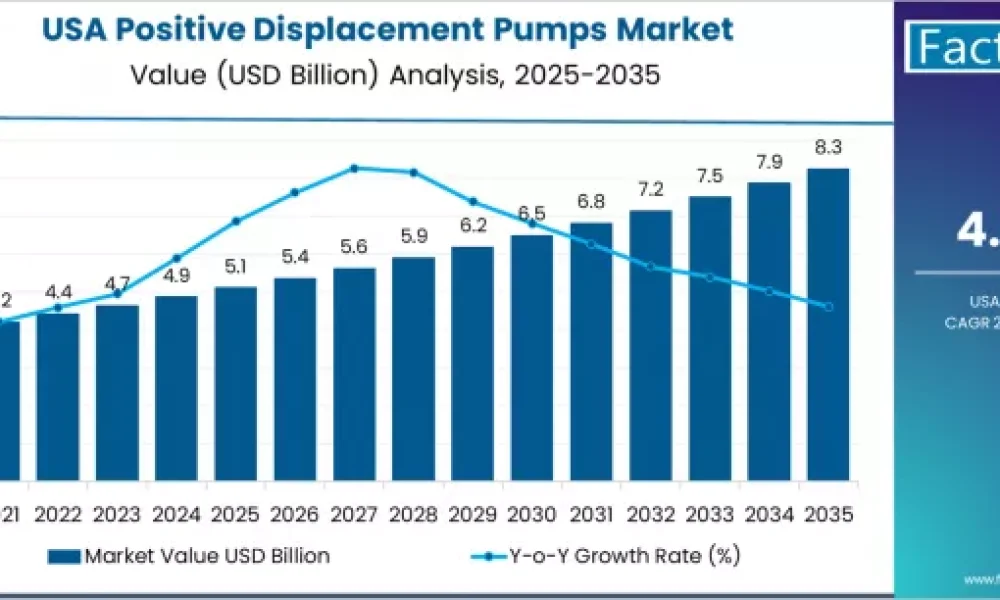
A new analysis of the U.S. positive displacement pump market indicates steady growth through 2035, underpinned by industrial modernization, infrastructure expansion, and rising adoption of smart and energy-efficient technologies. Data-driven projections show consistent mid-single-digit growth across multiple end-use sectors, offering actionable insights for manufacturers, distributors, and industrial operators.
Market Overview
The U.S. positive displacement pump market was valued at approximately USD 2.75 billion in 2024, with forecasts indicating a compound annual growth rate (CAGR) of 4.5%–5% from 2025 through 2035. By 2035, the market is projected to exceed USD 4.4 billion, driven by replacement cycles in mature industrial sectors, expansion in water and wastewater infrastructure, and increasing demand for precision pumping in process industries.
To access the complete data tables and in-depth insights, request a Discount On The Report here: https://www.factmr.com/connectus/sample?flag=S&rep_id=12452
Market composition shows:
Rotary pumps: 45% of current installations, primarily in oil, gas, and chemical applications
Reciprocating pumps: 35%, focused on high-pressure transfer and metering in petrochemical plants
Metering and specialty pumps: 20%, dominated by food & beverage, pharmaceuticals, and municipal water projects
Key Drivers
1. Oil, Gas, and Petrochemical Industries
Approximately 35% of positive displacement pump demand in the U.S. comes from the energy sector. Aging refinery and midstream assets are driving replacement cycles, while volumetric accuracy and high-pressure capabilities remain critical. Forecasts suggest annual replacement volumes of 5,000–6,000 units across North American refineries through 2030.
2. Municipal Water & Wastewater
U.S. water treatment infrastructure is undergoing a projected 7% annual capital expansion through 2030. Positive displacement pumps for chemical dosing, sludge handling, and metering account for 20%–25% of municipal installations, translating into an estimated 2,500–3,000 new units annually in medium-to-large treatment plants.
3. Food & Beverage, Pharma, Specialty Chemicals
These sectors currently drive 15% of overall U.S. pump demand, with adoption rates growing 6% annually due to hygienic requirements and low-shear pumping needs. Progressive cavity, lobe, and gear pumps dominate these applications, with installed capacities rising in line with U.S. specialty chemical production, which is projected to expand 4% per year over the next decade.
4. Digital and Smart Pump Adoption
Smart pump integration—including sensors, predictive maintenance, and IoT connectivity—is expected to grow 12% CAGR through 2035. Adoption is particularly strong in energy-intensive facilities, where lifecycle cost reductions of 10%–15% can be achieved through predictive analytics and condition monitoring. By 2035, digital-enabled positive displacement pumps may constitute 40% of new installations.
Market Outlook
The U.S. positive displacement pump market will evolve along two primary tracks:
Replacement & Retrofit
Accounts for ~65% of demand through 2030
Driven by industrial reliability upgrades, energy efficiency mandates, and regulatory compliance
Expected annual retrofit units: 6,000–7,000
New-Build & Expansion Projects
Accounts for ~35% of demand
Driven by water infrastructure, specialty chemical facilities, biofuels, and food-processing expansions
Projected units: 3,000–3,500 annually, with 6% annual growth
Pricing and Supply Trends
Raw material fluctuations are expected to impact base pump pricing by 3%–5% annually
Automation components and IoT integration add 10%–15% to capital costs initially, but reduce operational costs by 10%–15% over the lifecycle
Digital and modular pump solutions are gaining market share, increasing aftermarket revenue potential by 20%–25% over 10 years
Strategic Insights
Prioritize Smart Retrofits and Predictive Maintenance
40% of future demand is projected for digital-enabled pumps
Subscription-based monitoring services can increase recurring revenue by up to 25%
Develop Hygienic, Modular Designs
Food, beverage, and pharma sectors show 6%–8% annual growth in demand for CIP/SIP-capable pumps
Target Municipal and Industrial Water Projects
Skid-mounted, turnkey chemical dosing systems can capture 2,500–3,000 units/year
Enhance Supply-Chain Resilience
Regional sourcing and component redundancy can reduce lead times by 20%–30%, protecting margins in inflationary markets
Conclusion
The U.S. positive displacement pump market is entering a period of steady, data-driven growth. Replacement and retrofit cycles in energy and industrial sectors, combined with smart pump adoption and municipal infrastructure expansion, position the industry for mid-single-digit CAGR growth through 2035. Manufacturers who integrate digital capabilities, modular design, and strategic supply-chain resilience will be best positioned to capture market share and maximize recurring revenue streams.
Have a specific Requirements and Need Assistant on Report Pricing or Limited Budget please contact us – [email protected]
To View Related Report :
Demand Analysers Market https://www.factmr.com/report/972/demand-analysers-market
Demand and Trend Analysis of Air Purifiers in Middle East & Africa https://www.factmr.com/report/demand-and-trend-analysis-of-air-purifier-in-middle-east-and-africa
Demand and Trend Analysis of Air Purifiers in Europe https://www.factmr.com/report/europe-air-purifier-market
Demand and Trend Analysis of Air Purifiers in Latin America https://www.factmr.com/report/demand-and-trend-analysis-of-air-purifier-in-latin-america
“



