
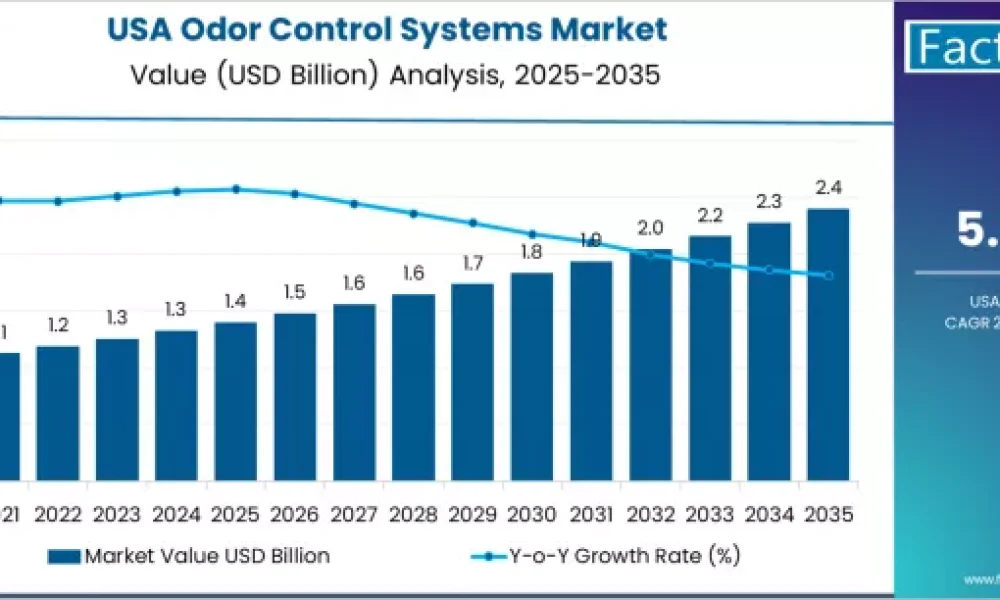
The U.S. market for odor control systems is projected to experience sustained growth over the next decade, driven by increasing regulatory pressure, expansion of municipal and industrial wastewater infrastructure, and adoption of advanced technologies. Market estimates indicate that in 2024, the U.S. odor control system market was valued at $831 million. Analysts forecast a compound annual growth rate (CAGR) of 5.3% from 2025 to 2035, projecting the market to reach $1.45 billion by 2035.
This growth reflects an increased focus on operational efficiency, regulatory compliance, and environmental responsibility across wastewater treatment plants (WWTPs), food and beverage processing, landfill management, and chemical production.
Market Drivers
1. Regulatory Pressure
Odor regulations in the U.S. have intensified across multiple states. As of 2025:
Over 38 states have enforceable odor emission limits for WWTPs and landfills.
Community complaints have risen 14% year-over-year on average in urban areas, driving capital investment in odor mitigation.
Average fines for non-compliance have reached $25,000–$75,000 per incident, creating financial incentives for advanced control systems.
These regulations are prompting municipalities and industrial operators to replace legacy chemical masking systems with engineered solutions such as biofilters, activated carbon units, wet and dry scrubbers, and catalytic oxidizers.
To access the complete data tables and in-depth insights, request a Discount On The Report here: https://www.factmr.com/connectus/sample?flag=S&rep_id=12442
2. Infrastructure Expansion
The U.S. wastewater and biosolids treatment sector is experiencing significant infrastructure growth:
More than 1,200 WWTPs are slated for upgrades or capacity expansion between 2025–2035.
Estimated capital expenditure on odor control equipment is expected to reach $420 million by 2030 for municipal projects alone.
Industrial sectors such as food processing, rendering, and chemicals are projected to contribute $320–$350 million to the odor control market over the same period.
Infrastructure expansion is driven by aging assets (average plant age in the U.S.: 45 years), increased urbanization, and the need for higher capacity to handle growing wastewater volumes.
3. Industrial Growth
Industrial adoption is growing faster than municipal demand in several segments:
The food and beverage sector is projected to account for 18% of total U.S. odor control demand by 2030, up from 12% in 2024.
Chemical and rendering industries collectively contribute an estimated 15–17% of market share.
Industrial facilities increasingly adopt hybrid odor control systems to address complex emissions, with biofilters and carbon adsorption systems showing annual adoption growth of 6–7%.
Technology Trends
Activated Carbon Adsorption
Remains the leading technology, accounting for 38% of market share in 2024.
Growth driven by efficacy in removing volatile organic compounds (VOCs).
Average lifespan of modern carbon units has increased by 20%, reducing operational costs.
Biofiltration
Fastest-growing technology with projected CAGR of 6.2%.
Preferred for biodegradable odorous compounds.
Hybrid biofilter-carbon systems are gaining traction for enhanced performance.
Scrubbers & Catalytic Systems
Wet and dry scrubbers collectively represent 22% of total demand.
Catalytic oxidation units are increasingly used in heavy industrial applications due to long-term cost savings and footprint efficiency.
Digital Integration
Remote monitoring and predictive maintenance adoption is projected to grow 10% annually through 2035.
Continuous emission monitoring enables facilities to reduce odor complaints by an estimated 25–30%.
Market Segmentation & Forecast
| Segment | 2024 Market Value | 2035 Market Value | CAGR (2025–2035) |
|---|---|---|---|
| Municipal WWTPs | $350 million | $620 million | 5.2% |
| Landfills & Waste Transfer | $160 million | $290 million | 5.1% |
| Industrial (Food & Beverage) | $100 million | $260 million | 7.0% |
| Chemical & Other Industries | $120 million | $280 million | 6.3% |
| Total U.S. Market | $831 million | $1.45 billion | 5.3% |
Competitive Landscape
The U.S. market remains moderately consolidated:
Top 10 suppliers account for approximately 60% of revenue.
Leading firms include global engineering and chemical technology providers alongside regional specialists.
Competitive strategies focus on service contracts, lifecycle media replacement, and hybrid technology offerings.
Increasing M&A activity is expected as companies integrate digital monitoring and predictive maintenance into their product portfolios.
Investment & Procurement Insights
Lifecycle Cost Focus: Facilities increasingly evaluate total cost of ownership, including media replacement, energy consumption, and maintenance.
Service Agreements: Remote monitoring and performance-based service contracts are becoming standard, providing recurring revenue opportunities for suppliers.
Retrofit Opportunities: A large installed base of legacy systems (~30% of units older than 15 years) provides significant retrofit potential for modular, compact systems.
Risks and Market Considerations
Regional permitting delays could slow municipal deployment in certain areas.
Economic fluctuations may impact industrial capital expenditure cycles.
Technology adoption depends on site-specific emission profiles and available budgets.
Despite these uncertainties, market momentum is expected to remain positive, with annual growth exceeding 5% through 2035.
Conclusion
The U.S. odor control system market is entering a decade of measured but sustained growth. Municipal modernization, industrial compliance, and digital innovation are driving demand for advanced biofiltration, activated carbon, and hybrid solutions. By 2035, total market size is projected to surpass $1.45 billion, with industrial adoption growing faster than municipal demand, particularly in the food, chemical, and rendering sectors.
Advanced monitoring, predictive maintenance, and lifecycle-focused procurement strategies will differentiate leaders in this increasingly sophisticated market. For municipalities and industrial operators, investing in high-efficiency, digitally enabled odor control systems is no longer optional—it is a regulatory and operational imperative.
Have a specific Requirements and Need Assistant on Report Pricing or Limited Budget please contact us – [email protected]
To View Related Report :
Demand Analysers Market https://www.factmr.com/report/972/demand-analysers-market
Demand and Trend Analysis of Air Purifiers in Middle East & Africa https://www.factmr.com/report/demand-and-trend-analysis-of-air-purifier-in-middle-east-and-africa
Demand and Trend Analysis of Air Purifiers in Europe https://www.factmr.com/report/europe-air-purifier-market
Demand and Trend Analysis of Air Purifiers in Latin America https://www.factmr.com/report/demand-and-trend-analysis-of-air-purifier-in-latin-america
“



