
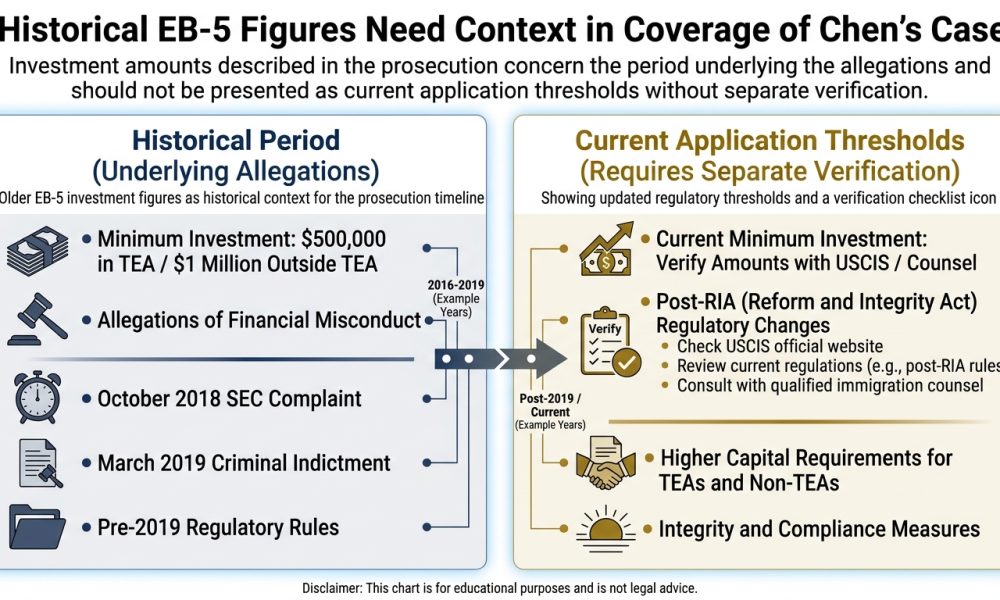
Federal prosecution records describe investment thresholds that applied years before today’s EB-5 requirements, making accurate dates, financial definitions and distinctions between investor capital and alleged commissions essential to understanding the case.
WASHINGTON, November 12, 2026 — The federal prosecution of former California immigration attorney Danhong “Jean” Chen has highlighted a reporting challenge involving the EB-5 Immigrant Investor Program, where historical investment requirements differ substantially from the amounts currently required of foreign nationals seeking permanent residence in the United States.
Federal prosecutors described an immigration fraud investigation involving more than 100 foreign investors, approximately $52 million invested in qualifying projects, and financial activity dating back to a period when certain applicants could qualify with considerably smaller capital commitments than those required today.
The figures provide important context for understanding the allegations against Chen and her former husband and business partner, Jianyun “Tony” Ye. Still, they should not be presented as current application thresholds or treated as interchangeable measures of investment capital, commissions, and criminal proceeds.
Under the EB-5 rules applicable in November 2026, the standard minimum qualifying investment is $1,050,000, while certain investments in targeted employment areas or qualifying infrastructure projects require at least $800,000, reflecting changes enacted long after much of the conduct described in the Chen prosecution.
The Chen Investigation Concerned Earlier Investment Rules
The Justice Department’s March 2019 announcement described alleged conduct involving EB-5 investors represented by Chen’s law firm, including investment arrangements and immigration submissions tied to activities occurring in prior years rather than applications governed by today’s statutory framework.
During the relevant historical period, the general EB-5 investment requirement was $1 million, while qualifying investments in designated targeted employment areas could satisfy the program’s capital requirement with $500,000, provided the applicant met additional immigration and job-creation conditions.
Those thresholds help explain the investment transactions described in the original federal allegations. Still, they cannot serve as current pricing guidance because Congress and the Department of Homeland Security later changed the applicable capital requirements.
This distinction matters for international readers comparing older prosecutions with current citizenship and residence programs, since a historical minimum may look attractive without reflecting the legal rules or administrative costs governing a new application.
Prosecutors Identified Approximately $52 Million in Investments
The March 2019 indictment announcement stated that clients represented by the Law Offices of Jean D. Chen invested approximately $52 million in projects associated with the EB-5 program, reflecting the investment activity connected to the government’s investigation.
That figure referred to aggregate investments by clients, not the amount that Chen personally received, the financial loss suffered by each investor, or the minimum contribution required from one applicant seeking immigration benefits.
Treating the $52 million figure as criminal proceeds would therefore misrepresent the published allegation, just as dividing it by the number of investors would not establish any particular participant’s exact contribution or legal eligibility.
The amount is best understood as historical transaction context, illustrating the commercial scale of the representation while leaving questions about particular applications, project qualifications and alleged wrongdoing to the evidence examined through separate proceedings.
SEC Alleged More Than $10 Million in Undisclosed Commissions
The Securities and Exchange Commission filed a civil complaint in October 2018 alleging that Chen, Ye and associated parties received more than $10 million in undisclosed commissions from securities transactions recommended to immigration clients seeking permanent residence through the EB-5 program.
As Bloomberg Law reported in October 2018, federal regulators accused Chen and Ye of acting as unregistered brokers while obtaining substantial compensation from investment recommendations, creating alleged conflicts between their professional responsibilities and financial interests.
The commission allegations represented a separate strand of proceedings from the later criminal indictment, and the reported commission amount should not be confused with the total funds clients invested or the criminal penalties eventually imposed.
Understanding the difference requires identifying whose money each figure describes, whether the amount represents capital or compensation, and whether the government presented it as an allegation, a documented investment total, or an established judicial finding.
The EB-5 Program Links Capital Investment With Job Creation
Congress established the EB-5 immigrant investor classification to encourage investment in American businesses, with eligibility generally tied to qualifying capital, lawful funding sources,s and the creation of at least 10 full-time positions for eligible workers.
Applicants may invest through qualifying regional center projects or pursue permitted standalone investments. However, each route carries requirements involving project documentation, eligible employment, and the applicant’s relationship with the enterprise receiving the capital.
The program offers a potential route to lawful permanent residence rather than an immediate grant of American citizenship, so characterizing an EB-5 contribution as simply purchasing a United States passport is misleading.
Eligibility also depends on more than meeting a published capital threshold, since immigration authorities examine legal requirements concerning the investment, the source and deployment of funds and the qualifying economic activity associated with the application.
2019 Regulations Introduced Higher Investment Requirements
The Department of Homeland Security adopted regulations that took effect November 21, 2019, raising the standard minimum investment from $1 million to $1.8 million and the reduced targeted employment area requirement from $500,000 to $900,000.
Those increases occurred after the principal period of conduct described in the Chen indictment, so neither the $900,000 reduced requirement nor the $1.8 million standard requirement should automatically apply retrospectively to the earlier investor transactions.
The regulation also changed how targeted employment areas were designated, illustrating why historical reporting needs to consider both the applicable capital amount and the legal criteria determining whether a particular investment qualified for a reduced threshold.
However, the 2019 regulatory framework did not remain permanently in effect, making accounts that describe its higher requirements as universal or current equally misleading without acknowledging the subsequent court decision and congressional legislation.
A 2021 Court Decision Changed the Rules Again
In June 2021, a federal court vacated the 2019 EB-5 modernization regulation, reinstating the earlier investment requirements until Congress established a revised statutory framework the following year.
The temporary return to the previous thresholds illustrates why a historical EB-5 figure cannot be evaluated solely by comparing its numerical value with another published figure, since filing dates and legal developments determine which rules apply.
Investors whose petitions were submitted during different periods may consequently face distinct regulatory histories, requiring careful examination of the applicable filing circumstances rather than broad statements that one historical requirement governed every application.
This intermediate regulatory period also shows why articles about enforcement cases should avoid using a single, timeless definition of the program, especially when the underlying allegations span several years of legislative and administrative change.
Congress Established New Thresholds in March 2022
The EB-5 Reform and Integrity Act of 2022 established a standard minimum investment of $1,050,000 and a reduced threshold of $800,000 for qualifying targeted employment area or infrastructure investments, replacing the earlier capital framework.
The current federal statute governing employment-based immigrant investor visas reflects these amounts and provides periodic inflation adjustments beginning January 1, 2027, making the timing of a future application especially important.
As of November 12, 2026, these are the applicable statutory investment thresholds, and an individual considering a new EB-5 filing should not rely on the $500,000 amount described in the historical Chen prosecution.
The scheduled adjustment mechanism also means future thresholds may change, while the amount required for an individual petition can depend on its filing date and the legally applicable provisions governing that application.
The Reduced Threshold Requires a Qualifying Investment
The $800,000 reduced investment requirement is not available simply because an applicant chooses a less expensive project, since the investment must meet the statutory conditions for targeted employment areas or qualifying infrastructure developments.
Targeted employment areas generally involve designated rural locations or areas meeting specified unemployment criteria, while qualifying infrastructure projects are subject to additional legal definitions and requirements administered through the federal immigration framework.
A project advertised as economically disadvantaged does not necessarily meet the applicable legal definition, so official eligibility and project documentation matter more than informal claims that a location qualifies for the reduced investment amount.
The same distinction applied historically, when the $500,000 requirement depended on an eligible investment location, so neither the old nor the current reduced threshold should be presented as universally available.
Historical Commission Figures Are Not Application Fees
The SEC allegations involving more than $10 million in undisclosed commissions concerned compensation allegedly received through investment solicitation, which differs from the minimum capital commitment required by immigration law and the legitimate administrative expenses associated with applications.
A qualifying EB-5 investment is intended to satisfy statutory capital requirements. At the same time, legal fees, project administration charges, and other professional expenses can add costs whose nature and amount depend on the arrangement.
Because the Chen allegations involved undisclosed compensation and ownership relationships, the case illustrates why investors should understand who receives each payment and whether an intermediary has a financial interest in a recommended project.
A headline combining the $52 million investment total with the $10 million commission allegation without explanation could also create confusion, since those numbers describe different financial relationships and were reported in different enforcement contexts.
Regional Centers Add Another Layer of Financial Relationships
Regional centers facilitate qualifying EB-5 investment activity through a regulated program structure. Still, their participation does not mean every associated project or financial intermediary receives a blanket government guarantee on investment performance.
The SEC alleged that Chen and Ye secretly controlled Golden State Regional Center while recommending its investment projects to clients without adequately disclosing their ownership interests, raising questions about conflicts and investor decision-making.
These allegations involved the commercial relationships underlying investment recommendations, rather than a determination that the regional center designation itself guaranteed approval of individual petitions or established the absence of financial misconduct.
For current applicants, a regional center’s official designation and a project’s regulatory status should be distinguished from assurances concerning financial returns, immigration approval and the legality of compensation received by outside intermediaries.
Investor Protection and Immigration Approval Are Different Decisions
Securities regulators examine matters including investment disclosures and potentially unlawful brokerage activity. At the same time, immigration officers assess whether applications meet the statutory requirements for the immigration benefit a foreign investor requests.
A project may encounter financial difficulties despite legitimate immigration submissions, just as a financially successful investment would not necessarily cure false statements, ineligible funding, or other deficiencies in an individual immigration application.
The Chen investigation demonstrates why the two systems can overlap when alleged misconduct affects both the investment arrangements and the information submitted to immigration authorities. At the same time, each agency retains separate legal responsibilities.
Readers should therefore avoid treating an SEC complaint as automatic proof that every associated immigration petition was fraudulent, since liability and eligibility must be determined using the evidence and legal standards relevant to each proceeding.
Criminal Charges Introduced Separate Allegations in 2019
Federal prosecutors obtained a 14-count indictment against Chen and Ye in March 2019, alleging visa fraud and related offenses involving documents submitted to United States Citizenship and Immigration Services on behalf of foreign investor clients.
The indictment described purportedly false signatures and misleading representations involving regional center ownership and investment arrangements, placing the accuracy of immigration submissions at the center of allegations distinct from the SEC’s earlier civil enforcement complaint.
The Justice Department reported that Chen’s law office represented clients who collectively invested about $52 million. Still, it did not describe that entire sum as fraudulent proceeds or the amount the defendants personally received.
Understanding the case requires separating the historical investments from the allegedly false documents, since an investor’s contribution to a project does not itself establish whether the accompanying immigration application contained a material misrepresentation.
Subsequent Criminal Outcomes Changed the Reporting Context
Chen was extradited from the Kyrgyz Republic in March 2025 and later pleaded guilty in November 2025 to visa fraud and obstruction-related offenses, moving the criminal proceedings beyond the allegations contained in the original indictment.
On January 27, 2026, she received a sentence of 30 months in federal prison, two years of supervised release and a $20,000 fine, according to the SEC Office of Inspector General’s published investigative summary.
Those criminal outcomes are now part of the established record. Still, they should not transform every financial allegation in the separate 2018 SEC complaint into a criminal conviction concerning the precise commission amounts reported by regulators.
This distinction remains essential because a current article must acknowledge the guilty plea and sentence while accurately attributing disputed financial claims to the authorities that originally advanced them.
Investors Must Understand the Lawful Source of Capital
Current EB-5 applications require documentation establishing the lawful source and path of invested capital, making financial transparency important even when the applicant has sufficient assets to satisfy the applicable minimum contribution.
Funds can come from legitimate business earnings, property transactions, investments, or other recognized sources. Still, applicants must provide appropriate evidence explaining their circumstances and the transactions linking the original assets to the qualifying investment.
The Chen allegations provide context for financial scrutiny involving intermediaries. However, those accusations should not be interpreted as proof that the investors themselves obtained their capital unlawfully or knowingly participated in misleading government submissions.
Distinguishing the applicant’s source of wealth from an adviser’s compensation arrangements is especially important because each issue concerns different individuals, documentary evidence and legal obligations within a complex immigration investment transaction.
Legal Fees and Administrative Costs Require Separate Examination
An EB-5 investor’s total financial commitment can exceed the statutory investment threshold because project administration, professional representation, government filing charges, and other authorized expenses may be incurred in connection with an application.
Those additional expenses should be identified separately rather than incorporated into an advertised minimum investment figure without explanation, particularly when an intermediary receives compensation that could affect the independence of its project recommendations.
The SEC allegations demonstrate the potential significance of undisclosed compensation, but not every fee paid to an immigration lawyer or investment administrator constitutes improper brokerage activity or a prohibited conflict of interest.
The legal characterization depends on the services performed, the compensation arrangement, and applicable regulatory requirements, so accurate reporting should distinguish legitimate professional charges from the specific misconduct alleged in the Chen civil complaint.
Project Risk Does Not Disappear With Immigration Eligibility
An investment meeting EB-5 capital requirements remains subject to financial and operational risks, and satisfying a statutory amount does not by itself guarantee successful project performance, repayment of capital, or approval of permanent residence. This distinction matters for historical enforcement coverage because a large aggregate investment total may show commercial success without indicating whether each project met expectations or whether each participating investor ultimately obtained immigration benefits.
The Chen prosecution addressed alleged misrepresentations and obstruction, so it is inappropriate to convert the published $52 million investment figure into an unsupported conclusion about realized investment losses or the outcome of each investor’s petition.
Reliable articles should identify the particular financial issue being discussed, whether initial capital commitments, project proceeds, administrative compensation, or confirmed victim losses, rather than treating all amounts as equivalent indicators of wrongdoing.
Historical Cases Cannot Substitute for Current Program Guidance
An investor reading about Chen’s activities between 2014 and 2017 might encounter the historical $500,000 threshold in contemporary accounts of the prosecution. Still, that amount no longer represents the reduced requirement for new EB-5 petitions filed under today’s law.
Likewise, articles from the period following November 2019 may describe $900,000 or $1.8 million thresholds, figures that reflected a specific regulatory period rather than the statutory amounts now applicable following the 2022 reform legislation.
Publication dates therefore matter as much as numerical accuracy, since a correctly quoted historical figure can become misleading when placed beside present-day immigration guidance without explaining the different legal periods to which the amounts relate.
For new applicants, the appropriate reference is the law and official guidance in effect at the time of filing, together with a careful assessment of the proposed project and the investor’s particular circumstances.
Passport Security and Immigration Investment Are Separate Issues
The Chen case principally concerns investment-related financial allegations and fraudulent immigration submissions, rather than evidence that counterfeit passport books were manufactured or that technical security features of legitimate electronic passports were defeated.
As Amicus International Consulting’s explanation of modern passport security describes, physical document examination and electronic authentication can help establish credential integrity. Still, neither determines whether an underlying investment complied with securities rules or an immigration petition contained truthful financial information.
An authentic government-issued document and a compliant investment application therefore require different kinds of verification, making it important to avoid confusing passport authenticity with the validity of the financial representations supporting an immigration benefit.
The wider lesson is that identity integrity, immigration eligibility and financial transparency each depend on appropriate records and legal standards, even when the same applicant interacts with all three systems during an international relocation.
The Chen Case Illustrates Why Financial Reporting Needs Precision
The historical EB-5 figures described in the Chen prosecution should be understood within the investment rules governing the underlying transactions. In contrast, the alleged commissions, aggregate client investments and eventual criminal penalties must remain clearly distinguished.
Contemporary reporting should therefore explain that the program’s earlier $500,000 and $1 million requirements were followed by regulatory changes in 2019 and a new statutory framework in 2022, establishing today’s $800,000 and $1,050,000 thresholds.
The current amounts are scheduled for inflation adjustment beginning January 1, 2027, reinforcing why applicants should verify the law applicable to their filing rather than relying on historical enforcement announcements, promotional materials, or investment figures published during earlier regulatory periods.
Ultimately, the Chen case shows how accurate chronology and clear financial definitions strengthen immigration reporting, helping readers understand the actual allegations without confusing historical investment requirements, disputed professional compensation, and the standards governing lawful EB-5 applications today.




