
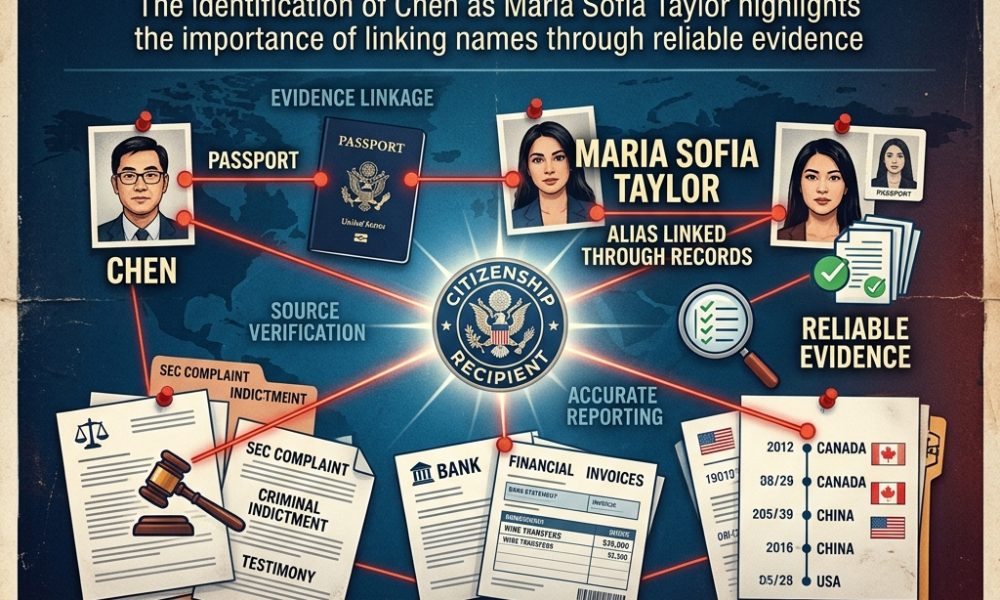
Federal records identify Danhong “Jean” Chen as Maria Sofia Taylor, while investigative reporting raises questions about how citizenship authorities, courts and journalists verify the identities of international passport holders.
WASHINGTON, November 12, 2026 — Identifying former California immigration attorney Danhong “Jean” Chen as Maria Sofia Taylor has highlighted a major challenge in international citizenship reporting, where multiple names can complicate efforts to connect government-issued passports, court proceedings and personal histories.
American prosecutors publicly connected the two names following Chen’s Extradition from the Kyrgyz Republic in March 2025, while an earlier international investigation into Dominica’s citizenship-by-investment program had examined her reported acquisition of Caribbean nationality and related travel documents.
The case illustrates why investigators and journalists must establish identity through reliable documentary evidence rather than assumptions about unfamiliar names, particularly when the same individual appears in immigration applications, securities proceedings, criminal court records and foreign citizenship documentation.
It also draws an important distinction between a lawful name change, an officially recognized alternative name, and an identity allegedly used to conceal personal history, because multiple names alone do not establish that a passport was counterfeit or fraudulently issued.
Federal Prosecutors Connect Chen With Maria Sofia Taylor
The U.S. Department of Justice’s March 7, 2025, Extradition announcement explicitly identified Danhong “Jean” Chen as also known as Maria Sofia Taylor, establishing an official connection between the two identities in the federal criminal proceedings.
The announcement described Chen as a former California immigration attorney accused of participating in an EB-5 visa fraud scheme involving more than 100 foreign investors, following a federal indictment returned against her and former husband Jianyun “Tony” Ye in March 2019.
This government Identification provides a stronger evidentiary foundation than simply finding similar photographs or matching names in unrelated databases, because prosecutors placed both names in the same documented case involving a specifically identified defendant.
Nevertheless, the official use of an alternative name does not independently explain how it was legally established, what supporting records were presented to foreign authorities, or whether the name appeared consistently across every citizenship application and travel document.
Dominica Passport Reporting Introduced the Identity Question
An October 2023 Le Monde investigation into Dominica’s citizenship-by-investment program reported that Chen obtained Dominican citizenship and used travel documents bearing the name Maria Sofia Taylor after becoming the subject of American financial enforcement scrutiny.
The newspaper’s investigation examined thousands of people associated with Dominica’s citizenship program, using published nationality records and supporting information to investigate whether recipients had professional, financial or criminal histories relevant to official screening.
Its account highlighted the gap between Chen’s established professional identity in California and the different name appearing in reporting about her Dominican passport, raising questions that require careful distinction between documented facts and unresolved administrative details.
The reporting also illustrates why responsible investigations should identify their evidentiary foundation and explain any remaining uncertainty, rather than treating a name appearing in a passport record as conclusive proof of how that identity was created.
The Timeline Contains an Important Documentary Difference
The chronology requires particular care because Le Monde reported that Chen obtained Dominican citizenship shortly before leaving the United States in October 2018, while a federal court’s July 2025 detention decision referenced a Dominican passport issued in January 2019 under the name Maria Sofia Taylor.
These accounts may not describe the same administrative event, since citizenship acquisition and passport issuance can occur on different dates. Still, the publicly available descriptions do not fully reconcile the timing of the passport reportedly used during Chen’s departure.
The 2019 federal charging announcement also stated that Chen became a naturalized Dominican citizen in October 2018, supporting a distinction between the reported acquisition of nationality and the later passport date described in the court record.
Until journalists independently examine the underlying nationality and passport issuance records, they should preserve those differences rather than assert that a January 2019 passport was necessarily the document presented during an October 2018 journey.
Citizenship and Passport Issuance Are Separate Legal Events
Citizenship establishes a legal relationship between an individual and a sovereign state. At the same time, a passport ordinarily provides government-issued documentation of nationality and identity for authorized travel, making the dates of naturalization and document issuance independently significant.
An individual may become a citizen before receiving a passport, renew an existing passport after acquiring nationality, or obtain replacement documentation following administrative changes, so different dates in official records do not automatically indicate wrongdoing.
In Chen’s case, determining precisely when the alternative name became legally recognized would require more than a contemporary news report, because the relevant evidence could include civil-status records, nationality certificates, passport applications and other government-held documentation.
Available American records show that authorities associated Chen with Maria Sofia Taylor. Still, they do not publicly provide the complete Dominican application file needed to determine how authorities reviewed the name during the original citizenship process.
A Name Used in Court Does Not Establish Its Legal Origin
Courts and prosecutors may describe a person using legal names, previously used names, nicknames, or aliases to ensure that judicial proceedings identify the correct defendant, particularly when investigators encounter different identifying information across national jurisdictions.
The designation of an alias within criminal proceedings is therefore an important Identification fact. Still, it does not by itself demonstrate that an alternative name originated through unlawful document manufacturing or an unauthorized change to government records.
Likewise, different names on genuine government documents may require explanation without proving the documents themselves were counterfeit, since lawful administrative changes and nationality-specific naming conventions can produce legitimate differences.
The Chen case raises separate questions about the circumstances of her reported Dominican documentation. Still, those questions should be answered through reliable records and applicable law, not assumptions that every alternative identity is automatically fictitious.
Civil Securities Proceedings Established the Initial Public Context
The Securities and Exchange Commission filed a civil enforcement complaint in October 2018 alleging that Chen and associated defendants had violated federal securities laws through undisclosed investment commissions and other activities connected with the EB-5 Immigrant Investor Program.
Federal investigators subsequently developed separate criminal allegations involving allegedly fraudulent immigration submissions and obstruction, creating a procedural history in which Chen’s professional background, financial relationships and travel records became relevant to different government authorities.
These proceedings matter to identity reporting because an individual’s name may appear in securities complaints, professional registration files, immigration records and criminal court documents, each created for different administrative or legal purposes.
Connecting those records requires more than discovering matching names, particularly when an investigation involves foreign citizenship, alternate personal identifiers and disputed conduct spanning several years before a criminal conviction.
The March 2019 Indictment Added Criminal Allegations
A federal grand jury returned a 14-count indictment against Chen and Ye in March 2019, alleging visa fraud and related crimes involving immigration applications associated with foreign investors seeking permanent residence through qualifying American investment projects.
The indictment followed the October 2018 SEC complaint and Chen’s reported departure from the United States, making accurate chronology essential to explaining when the criminal charges became public and how authorities later pursued the defendant internationally.
The criminal allegations concerned allegedly false information supplied in immigration proceedings, which differs from establishing whether every passport Chen possessed was counterfeit or whether a foreign citizenship authority unlawfully issued a particular credential.
Journalists should therefore avoid converting an immigration fraud indictment into a claim that every document associated with the defendant was forged, unless independent evidence and applicable judicial findings establish the specific allegation.
International Investigations Depend on Reliable Identity Matching
When a person appears in records from several jurisdictions, investigators may encounter different spellings, transliterations, family names, and official documents, creating challenges that are especially significant in cases involving international travel and naturalization.
Reliable Identification requires evaluation of authoritative records and other lawfully available evidence, while recognizing that a name alone may be shared by unrelated individuals whose financial activities or criminal histories have no connection.
The Chen proceedings provide an example of stronger attribution because American prosecutors explicitly identified Maria Sofia Taylor as another name associated with Chen, rather than merely suggesting a relationship based on circumstantial similarities.
Even that Identification does not answer every administrative question, so it is necessary to distinguish the government’s recognition of an alternative name from conclusions about how the name originally entered another country’s records.
Passport Authenticity and Identity Accuracy Are Different Questions
A passport may be physically genuine, issued by a recognized government, and equipped with valid security features. At the same time,e questions remain about the accuracy or completeness of the information supplied during its original application.
Conversely, a counterfeit passport may reproduce a person’s real biographical details without being manufactured or authorized by the responsible government, showing why authentic document production and truthful enrollment require separate examinations.
These distinctions matter for reporting on Chen because the available evidence concerns the association of two names and reported foreign nationality, not an established technical finding that the Dominican passport was a manufactured counterfeit.
The underlying concern instead involves whether relevant identity information was accurately disclosed and assessed, questions that cannot be resolved solely by inspecting the document’s appearance or confirming that an alternative name appeared in court.
Electronic Passport Security Provides Another Verification Layer
Modern electronic passports may contain digitally signed information that compatible inspection systems authenticate using trusted issuing-authority certificates, allowing qualified personnel to assess whether protected identity data originated from a recognized government.
As Amicus International Consulting’s guide to modern passport security explains, physical examination, electronic authentication, and biometric comparison provide complementary safeguards. Still, none independently proves that every statement made during an earlier citizenship application was accurate.
A successfully authenticated passport can therefore remain relevant to a separate investigation concerning identity history. At the same time, an unusual name or unfamiliar nationality record cannot, on its own, establish that a genuine document failed electronic authentication.
The distinction helps prevent technical exaggeration because passport security features verify particular aspects of document integrity. In contrast, questions concerning personal history, professional conduct and the legality of naturalization require additional authoritative evidence.
Biometric Comparisons Can Assist With Identity Continuity
Biometric comparisons may help authorities determine whether records bearing different names concern the same person, particularly when reliable reference information and properly authorized identity verification procedures are available.
However, facial similarities alone do not constitute a complete legal identity history, and automated comparisons can produce uncertain results that require qualified review before authorities make consequential findings.
In cases involving alternative names, biometric evidence should be considered alongside reliable documents and official records, ensuring that identity matching does not substitute for proving the legal origin of a particular name.
The responsible approach recognizes that identifying the same individual across records and establishing whether any representation was unlawful are separate questions, each requiring evidence appropriate to its particular purpose.
Dominica’s Screening Process Became a Public Accountability Issue
The Le Monde investigation raised broader concerns about citizenship-by-investment screening in Dominica, examining whether applicants with significant adverse histories received nationality despite government procedures intended to identify criminal, financial and reputational risks.
Chen’s reported citizenship became relevant to that inquiry because her American professional history and subsequent legal proceedings raised questions about what information Dominican officials could have found while assessing her application.
Nevertheless, the public reporting does not provide a complete Dominican screening file or establish what every responsible official knew, making definitive conclusions about intentional misconduct by citizenship authorities unsupported without additional records.
The same caution applies to the alternative name, because determining whether Maria Sofia Taylor was disclosed, independently documented, or accepted under applicable procedures requires evidence beyond later American Identification of the two names.
Adverse Information Changes Over Time
Citizenship authorities may approve an application before a regulatory complaint becomes public, while later criminal charges or convictions can substantially change the information available for reviewing an applicant’s background.
In Chen’s case, the October 2018 SEC action preceded the March 2019 criminal indictment, while her Extradition occurred in March 2025 and subsequent criminal proceedings established additional outcomes.
These developments should be connected chronologically rather than presented as information necessarily available during the original nationality decision, because retrospective knowledge does not establish the contents of an earlier official screening report.
Investigators may appropriately examine whether reliable warning signs existed before approval. Still, they must identify those signs and establish their availability, rather than presuming that every later allegation could have been discovered beforehand.
Extradition Confirmed the Continuing Federal Proceedings
Chen was detained in the Kyrgyz Republic in April 2024 and extradited to the United States in March 2025, allowing federal authorities to resume proceedings associated with the outstanding indictment returned several years earlier.
American prosecutors described the transfer as the first Extradition from the Kyrgyz Republic to the United States on federal criminal charges, illustrating international cooperation despite the defendant’s extended period outside American jurisdiction.
The case also shows why foreign citizenship or holding another passport should not be treated as automatic Protection from Extradition, since such decisions depend on applicable law and cooperation between relevant governments.
For reporting purposes, the important facts involve the documented transfer and the authorities’ Identification of Chen, rather than speculation about every passport presented during her earlier international movements.
Later Criminal Convictions Changed the Legal Record
Chen pleaded guilty in November 2025 to visa fraud and obstruction-related offenses, and a federal judge subsequently imposed a 30-month prison sentence in January 2026, providing established outcomes beyond the original allegations.
Those developments should appear in contemporary reporting because describing Chen solely as a person accused of criminal wrongdoing would omit the subsequent guilty plea and sentencing information available by November 2026.
At the same time, the convictions should not be expanded into claims about every unproven allegation concerning foreign passport issuance, since the admitted offenses and findings have specific legal boundaries.
Accurate reporting should identify the criminal outcome while keeping separate questions about the administrative history of Chen’s Dominican citizenship and the legal basis for the name appearing on her foreign travel documentation.
Legal Name Changes Must Not Be Confused With Fraud
Individuals may change their names for marriage, personal reasons, cultural integration, or other lawful purposes, and governments can recognize those changes through established procedures without creating an entirely new or fictitious person.
Dual citizens may also encounter variations between national naming systems, including different surname conventions and transliteration practices, making it important to examine official records before interpreting inconsistencies as evidence of deception.
A foreign passport under a different name therefore requires careful explanation in a reported criminal case. Still, it cannot, on its own, establish that every lawful name-change applicant or person holding multiple nationalities presents a security concern.
Journalists Need Strong Evidence Before Linking Identities
When investigating citizenship recipients, journalists should prioritize official court filings, verified government records and appropriately corroborated reporting, particularly when a published name differs from the identity associated with earlier professional or financial history.
A name appearing in a citizenship list may lack birth dates or other distinguishing information, creating risks that unrelated people will be mistakenly associated with criminal proceedings merely because they share similar identifying details.
The connection between Chen and Maria Sofia Taylor is unusually well supported because federal prosecutors expressly identified the relationship, but that does not eliminate the need to separately verify contested chronology and document-specific assertions.
Citizenship Lists Require Careful Interpretation
Government nationality publications may identify newly naturalized citizens without providing the detailed biographical history needed to distinguish people with similar names, leaving investigators dependent on additional sources when examining individual recipients.
An official list can confirm that a name was published. Still, it does not necessarily reveal which documents supported approval, whether the applicant held other nationalities, or how the issuing government evaluated potentially adverse information.
For journalists examining citizenship-by-investment programs, these limitations make corroboration essential before linking a published entry to a particular person whose activities have attracted criminal, regulatory or professional scrutiny elsewhere.
Cross-Border Records Present Practical Challenges
Court filings, immigration records, corporate registrations and citizenship records may use different naming conventions, making consistent Identification difficult when the same individual has lived or conducted business across several countries.
The problem becomes more complicated when records cover different time periods, since an individual’s legally recognized name or citizenship status may change without earlier documents being incorrect when they were originally issued.
A defensible investigation should therefore distinguish the identity information valid at each relevant date from later administrative changes, ensuring that a discrepancy is not treated as criminal deception without evidence of its legal significance.
Financial and Criminal Histories Must Be Attributed Correctly
The SEC’s October 2018 civil complaint alleged investment-related misconduct, while the subsequent federal criminal case concerned visa fraud and obstruction, demonstrating that separate proceedings can identify the same person while addressing different alleged conduct.
When alternative names appear in such investigations, reporters must ensure that financial allegations and criminal outcomes are attributed to the correct individual without treating every contested civil claim as a proven criminal offense.
The Chen record provides enough official evidence to connect the names for reporting purposes, but the distinction between established convictions and unresolved questions concerning foreign administrative records remains necessary.
Passport Issuance Records Would Clarify the Remaining Questions
A complete accounting of Chen’s Dominican documentation would require reliable records establishing citizenship approval, the legal basis for the name Maria Sofia Taylor, and the issuance dates of relevant travel documents.
Those records could help explain the apparent chronological difference between reporting about an October 2018 departure and the January 2019 passport date discussed in a later federal court decision.
Until that information is independently reconciled, the strongest reporting identifies what each source says, notes the difference, and avoids confidently assigning an earlier journey to a specific passport whose issuance date remains disputed.
International Cooperation Depends on Accurate Identity Information
The Extradition proceedings demonstrate why accurate identity matching matters when authorities in different countries seek to locate and transfer someone facing outstanding criminal charges, especially where official records contain more than one name.
Effective cooperation requires reliable evidence that the person detained abroad matches the individual identified in judicial proceedings, while protecting unrelated people from mistaken associations based on incomplete or misleading information.
The Chen case illustrates that international enforcement can proceed despite alternative names. Still, it does not establish that foreign citizenship itself was invalid or that every associated travel credential was technically fraudulent.
Multiple Names Demand Precision, Not Automatic Suspicion
The case demonstrates that responsible passport and citizenship reporting must distinguish identity continuity, legal name recognition, document authenticity, and criminal responsibility, because each raises different questions requiring different kinds of proof.
American government statements establish the connection between Danhong “Jean” Chen and Maria Sofia Taylor. At the same time, investigative reporting and court records leave important questions concerning the precise timing and administrative history of her Dominican passport.
Ultimately, accurate reporting on international citizenship recipients depends on verifiable identity links, careful chronology, and restraint when interpreting incomplete records, ensuring that legitimate name changes remain distinguishable from documented wrongdoing and allegations requiring further evidence.




