
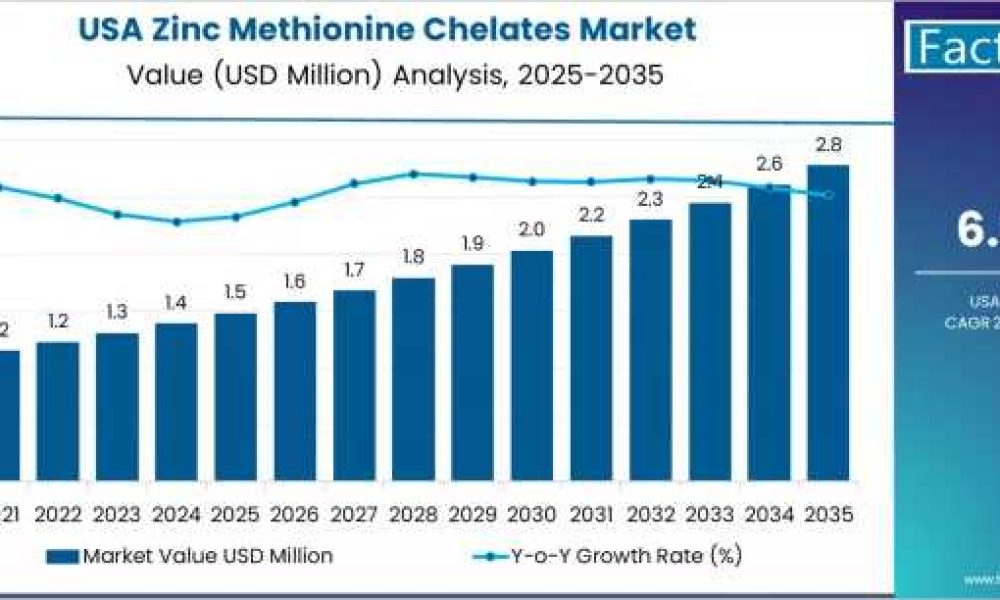
The U.S. market for zinc methionine chelates is positioned for a decade of solid expansion as the livestock nutrition sector accelerates its transition toward higher-efficiency, environmentally aligned mineral strategies. Market modeling indicates that domestic demand will rise from an estimated USD 1.48 million in 2025 to approximately USD 2.70 million by 2035, representing a projected compound annual growth rate (CAGR) of about 6.5%. This growth reflects the increasing emphasis on mineral bioavailability, precision feeding, and sustainability across U.S. animal agriculture.
Key Takeaways
U.S. zinc methionine chelate demand is forecast to grow steadily through 2035, driven by productivity benefits, regulatory pressure to reduce mineral excretion, and a broad shift toward organic trace minerals.
Global chelated mineral markets are also expanding at mid- to high-single-digit CAGRs, reinforcing momentum within the U.S. industry.
Poultry and swine operations account for the largest share of domestic use, driven by feed-conversion improvements, robust immune performance, and overall production efficiency.
Powder and granule formulations remain the predominant form factor, although premixes and liquid delivery systems are growing in adoption.
To access the complete data tables and in-depth insights, request a Discount On The Report here: https://www.factmr.com/connectus/sample?flag=S&rep_id=12460
Market Drivers
1. Superior Bioavailability and Performance Gains
Zinc methionine chelates continue to attract attention because of their higher bioavailability compared with conventional inorganic zinc sources such as zinc sulfate or zinc oxide. Nutritional trials across multiple species show enhanced absorption and retention of zinc when delivered in chelated form. In practical terms, this translates into measurable improvements in growth rates, immune response, structural integrity of tissues, and reproductive outcomes.
This has become especially important as feed formulators adopt cost-benefit models that track mineral utilization more precisely. Even though organic chelates typically carry higher upfront cost, improved biological efficiency allows for reduced inclusion rates while maintaining or improving performance outcomes. The result is a more predictable return on investment for producers.
2. Sustainability and Environmental Compliance
Environmental considerations are now core to the purchasing decisions of large-scale livestock operations. Over-supplementation of minerals has long contributed to increased zinc excretion in manure, elevating nutrient-loading risks in soil and water systems. U.S. states continue to introduce tighter guidelines on nutrient discharge, making nutritional accuracy a regulatory imperative.
Zinc methionine chelates allow producers to meet performance and health requirements using lower total quantities of supplemental zinc. This reduces fecal output, helps maintain regulatory compliance, and aligns with sustainability goals demanded by processors, retailers, and increasingly, consumers.
3. Growth of Precision Feeding and Data-Enabled Nutrition
The integration of data analytics, automated feeding systems, and on-farm monitoring has transformed how nutritionists evaluate mineral performance. Precision feeding platforms quantify minute changes in growth, feed conversion, and mineral balance, making it easier to justify higher-value ingredients like chelated minerals.
Within these systems, zinc methionine chelates are valued for providing consistent mineral uptake across diverse feed ingredients and management environments. Their use supports precision-nutrition strategies that target optimal mineral status rather than simply meeting minimum inclusion thresholds.
4. Evolving Supply Chains and Standardized Mineral Delivery
The feed industry has seen increasing emphasis on ingredient consistency, traceability, and performance predictability. Chelated minerals help reduce variability inherent in inorganic mineral salts, resulting in more uniform nutrient delivery across flocks and herds.
Feed manufacturers and integrators are therefore incorporating more organic mineral sources into premixes and complete feeds to strengthen consistency. As supply chains modernize and move toward validated, high-efficiency additives, zinc methionine chelates gain a strategic position within mineral formulations.
Segment and Formulation Outlook
Poultry and Swine Remain the Core Growth Engines
Poultry and swine producers account for the majority of zinc methionine chelate use in the U.S., together representing the dominant share of demand. In poultry, benefits include improved meat quality, stronger immune response, and enhanced structural integrity of feathers and skin. In swine, chelates play a key role in skeletal development, reproduction, and robustness during health challenges.
These performance outcomes align with the economic pressures faced by both sectors, where feed-conversion improvements and health stability directly influence profitability.
Ruminant and Specialty Segments Expanding
Beef, dairy, and small ruminant producers are increasingly adopting chelated zinc solutions, though from a smaller baseline. Growth in these segments is driven by reproductive efficiency improvements, hoof health, somatic cell reduction strategies in dairy, and enhanced resilience against environmental stressors.
Formulation Trends
Powder and granule forms remain the most widely used, given their efficiency in premix manufacturing and ease of inclusion in feed mills. Liquid chelated zinc products are gaining traction in operations focusing on precision dosing, nursery systems, or automated feeding setups. Microencapsulation technologies may further support stability and targeted intestinal release over the next decade.
Risks and Market Constraints
Although the market outlook is strong, several headwinds remain:
1. Cost Sensitivity
Zinc methionine chelates are more expensive than inorganic zinc sources. While performance data often justify the higher cost, adoption in price-sensitive commodity systems may be slower without clear ROI documentation.
2. Variability in On-Farm Response
Performance improvements may vary based on management quality, baseline mineral status, and herd or flock health conditions. This variability underscores the need for tailored feeding programs and locally validated data.
3. Competitive Pressure from Other Organic Zinc Sources
As organic mineral markets grow, producers may compare zinc methionine chelates with other organic complexes such as proteinate or polysaccharide forms. Product differentiation and field trials will remain essential for market positioning.
Industry Perspective
Industry analysts note that the U.S. is entering a new era of mineral efficiency, where the focus is shifting from maximum inclusion to maximum utilization. Zinc methionine chelates fit this trend by providing a balance of biological efficiency, environmental responsibility, and economic value.
“The next decade will reward nutrition strategies that can simultaneously support productivity and sustainability,” one analyst said. “Zinc methionine chelates are positioned to be integral to that evolution.”
Have a specific Requirements and Need Assistant on Report Pricing or Limited Budget please contact us – [email protected]
To View Related Report :
Demand for Inorganic Color Pigments in UK https://www.factmr.com/report/united-kingdom-inorganic-color-pigments-market
Demand for Amine Oxides in USA https://www.factmr.com/report/united-states-amine-oxides-market
Demand for Engineering Thermoplastic in USA https://www.factmr.com/report/united-states-engineering-thermoplastic-market
Demand for Desalination Chemicals in UK https://www.factmr.com/report/united-kingdom-desalination-chemicals-market
“



