
Bonded magnets are permanent magnets created by combining magnetic powders, such as ferrite or rare-earth alloys, with a binding agent and forming them via injection molding, compression bonding, or extrusion. Compared to traditional sintered magnets, bonded magnets offer advantages such as lighter weight, complex geometries, flexibility, reduced waste, and cost-effective manufacturability.
These magnets are increasingly used across sectors like automotive, consumer electronics, medical devices, industrial automation, and sensors/actuators. The demand for low-weight, high-efficiency, and compact magnetic components—especially in electric vehicles, aerospace, defense, electronics, and robotics—positions the U.S. bonded magnet market for significant growth between 2025 and 2035.
Current Market Status
In 2025, the U.S. bonded magnet market is estimated at approximately USD 954 million. Globally, bonded magnets constitute a growing segment of the permanent magnet market, with increasing adoption in industries emphasizing miniaturization, energy efficiency, and sustainability.
Forecast 2025–2035
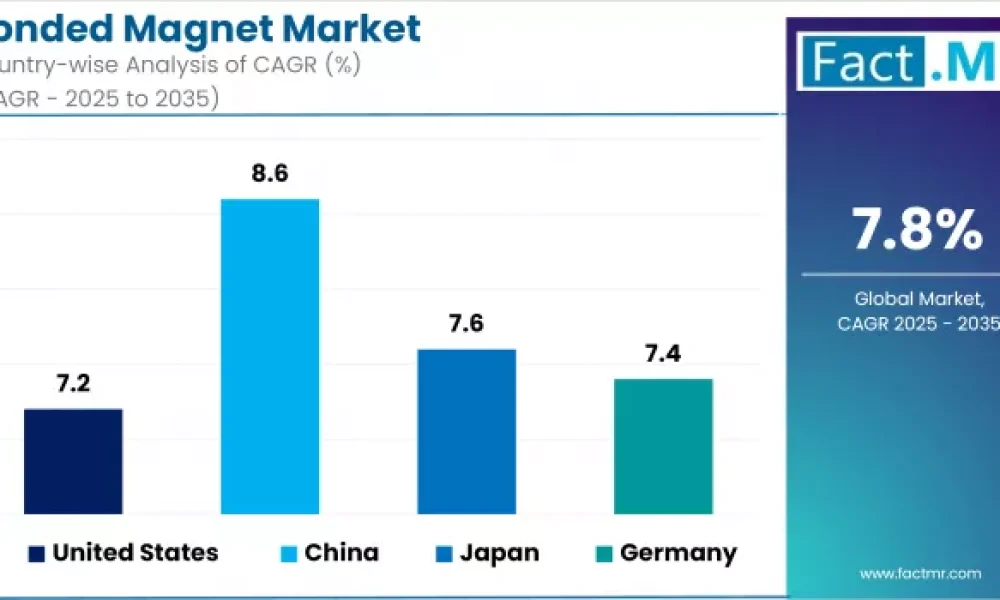
The U.S. bonded magnet industry is projected to grow at a compound annual growth rate (CAGR) of 3.9% over the next decade. Under this growth rate, starting from USD 954 million in 2025, the market could reach around USD 1.43–1.45 billion by 2035.
Considering accelerating demand across multiple high-growth sectors, the market may exceed USD 1.5–1.6 billion by 2035 under a more bullish scenario. Bonded magnets are expected to capture an increasing share of the overall permanent magnet market, particularly in applications prioritizing lightweight, flexible, and cost-effective solutions.
To access the complete data tables and in-depth insights, request a Discount On The Report here: https://www.factmr.com/connectus/sample?flag=S&rep_id=7176
Key Growth Drivers
1. Electrification and EV Adoption
The shift toward electric vehicles is a primary driver for permanent magnets, including bonded magnets. High-performance magnets are critical for electric motors, actuators, and sensors. The automotive sector is expected to represent a substantial share of bonded magnet demand, especially in electric vehicles and auxiliary systems.
2. Miniaturization in Electronics and Automation
Compact devices such as smartphones, wearables, medical equipment, and industrial sensors require small, powerful, and cost-effective magnets. Advances in manufacturing technologies, including injection molding and compression bonding, enable the production of complex geometries, which supports wider adoption.
3. Demand in Aerospace, Defense, Medical, and Renewable Energy
Bonded magnets are increasingly used in aerospace and defense applications, medical devices, and renewable energy equipment. Their reliability, lightweight properties, and adaptability make them suitable for high-precision and high-performance applications, including actuators and sensors in robotics and industrial automation.
4. Sustainable and Efficient Manufacturing
The market is seeing increased adoption of ferrite-bonded and rare-earth-free variants, helping reduce reliance on limited or volatile supply chains. Hybrid systems combining magnetic powders with polymers or composites are gaining traction due to their thermal stability, corrosion resistance, and reduced environmental impact.
Challenges and Risks
Despite positive growth prospects, several challenges could affect the market:
Raw Material Volatility: Fluctuations in prices of magnetic powders, especially rare-earth elements, can impact production costs.
Competition: Sintered magnets and emerging magnet-free technologies may limit bonded magnet penetration in high-performance applications.
Performance Limitations: In high-demand applications, bonded magnets may lag behind sintered magnets in terms of magnetic strength, thermal stability, and demagnetization resistance.
Regulatory and Environmental Constraints: Tightening regulations on rare-earth usage and composite waste may increase compliance costs and operational complexity.
Market Outlook 2035
By 2035, the U.S. bonded magnet market is likely to:
Reach USD 1.4–1.5 billion, representing steady growth from 2025.
Gain increasing share in sectors such as automotive (EV motors, sensors), electronics, medical devices, aerospace, and industrial automation.
Shift material composition toward ferrite-bonded and rare-earth-free composites, with some continued use of rare-earth magnets where high performance is critical.
Benefit from advanced manufacturing techniques, including injection molding, compression bonding, and hybrid composite fabrication, enabling high-precision, customized magnet shapes.
Strategic Implications
Manufacturers and Suppliers: Investing in advanced bonded magnet production, including hybrid composites and sustainable materials, will help capture growth in key sectors. R&D to optimize magnetic performance and shape flexibility is essential.
Automotive and EV Companies: Exploring bonded magnets for lighter, flexible components in EV motors, sensors, and auxiliary systems can create competitive advantages.
Electronics Manufacturers: Adopting bonded magnets in miniaturized devices supports product innovation and differentiation.
Policymakers: Supporting domestic production, recycling, and environmentally friendly magnet technologies can strengthen supply chains and promote sustainability.
Investors: Companies in bonded magnet production or advanced magnetic materials offer attractive growth opportunities due to the expansion of high-demand applications.
Why 2025–2035 Is Critical
The 2025 baseline of roughly USD 954 million indicates a market that is still emerging relative to the overall permanent magnet industry. Over the next decade, growth will be driven by electrification, automation, miniaturization, sustainability, and supply-chain rebalancing—all aligning with the advantages of bonded magnets.
Technological advances, including hybrid materials and precision processing, combined with increasing adoption in automotive, electronics, medical, and industrial sectors, may position bonded magnets as a mainstream segment within the U.S. magnetic materials market rather than a niche.
Conclusion
The U.S. bonded magnet market is poised for steady growth from USD 954 million in 2025 to approximately USD 1.4–1.5 billion by 2035. Growth drivers include EV adoption, miniaturization of electronics, expansion in medical and aerospace applications, and advances in manufacturing technology. While challenges such as material supply volatility and competition remain, early investment in production capabilities, material innovation, and strategic integration with high-growth applications can yield significant benefits.
2025–2035 represents a pivotal decade in which bonded magnets could transform from a supplementary segment into a key pillar of the U.S. magnetic materials industry.
Have a specific Requirements and Need Assistant on Report Pricing or Limited Budget please contact us – [email protected]
To View Related Report : Magnetic Materials Market https://www.factmr.com/report/magnetic-materials-market
Magnetorheological Fluids Market https://www.factmr.com/report/magnetorheological-fluids-market
Magnetic Alloys Market https://www.factmr.com/report/1820/magnetic-alloys-market
Magneto-Rheological Fluids (MRF) Market https://www.factmr.com/report/magneto-rheological-fluids-mrf-market



