
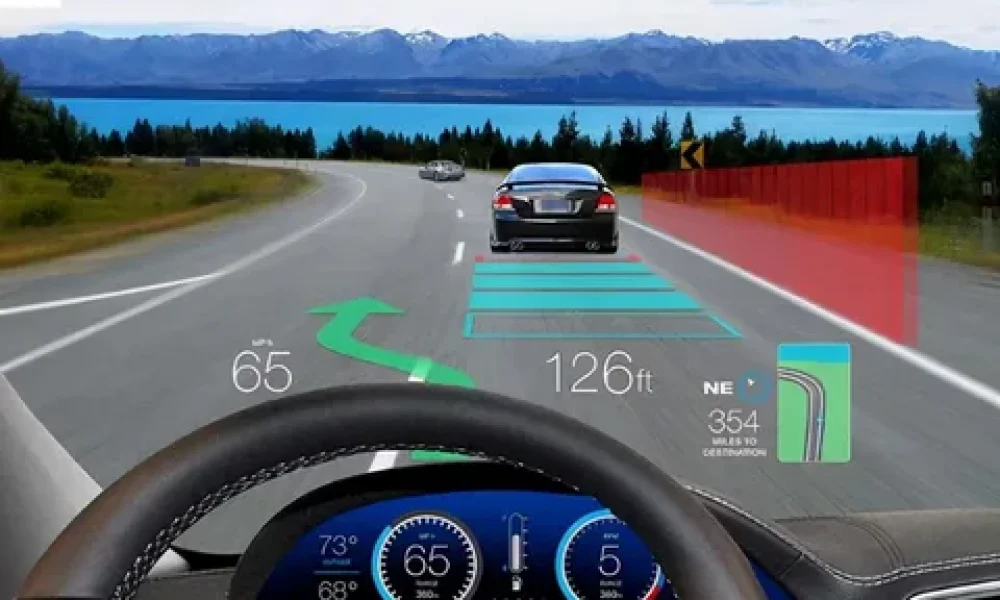
The global automotive head-up display (HUD) market is poised for transformative growth, expanding from an estimated USD 1,892.1 million in 2025 to USD 9,251.7 million by 2035 at an impressive CAGR of 17.2%, driven by increasing demand for enhanced driver safety, immersive in-vehicle experiences, and cockpit digitalization.
HUDs, which project critical driving data directly onto the driver’s line of sight, are rapidly transitioning from luxury vehicle exclusivity to broader adoption in mid-size sedans, SUVs, and electric vehicles. This trend is fueled by the rising integration of augmented reality (AR) HUDs, which overlay navigation guidance, hazard alerts, and ADAS (Advanced Driver Assistance Systems) notifications, creating safer and more intuitive driving experiences.
Technological Trends Driving Market Expansion
The HUD market is primarily categorized into windshield HUDs and combiner HUDs, with technology segments spanning conventional 2D systems, 3D displays, and AR-based HUDs. AR HUDs, in particular, are transforming driver interaction by projecting real-time hazard warnings and navigation cues directly over physical road elements, leveraging sensors, cameras, and LiDAR technology. Premium automakers such as Mercedes-Benz, BMW, and Hyundai have already deployed AR HUDs in flagship models, with rapid adoption expected in mid-tier EVs and connected vehicles as component costs decline.
Conventional HUDs remain a dominant force, offering reliable speed, fuel, navigation, and warning displays. These systems have gained traction in Europe and Asia, especially in mid-size vehicles, while the aftermarket segment has grown steadily, providing cost-effective plug-and-play solutions via OBD-II ports for regions such as Latin America and Asia-Pacific.
Subscribe for Year-Round Insights → Stay ahead with quarterly and annual data updates
https://www.futuremarketinsights.com/reports/sample/rep-gb-784
Sales Channel Dynamics
OEM Segment: OEM-installed HUDs are becoming a significant differentiator in premium, luxury, and electric vehicles. With windscreen-based displays preferred for their enhanced brightness and seamless integration with ADAS and infotainment systems, nearly 18% of luxury vehicles globally featured HUDs in 2023—a number expected to double over the next five years. Collaborations with suppliers like Continental, Nippon Seiki, and Denso are accelerating the development of compact, wide-field HUD systems suitable for digital cockpits.
Aftermarket Segment: Cost-effective HUDs continue to penetrate mid-size sedans, crossovers, and commercial vehicles. These systems, ranging from basic speed displays to mid-level GPS and RPM projections, are particularly popular in emerging markets such as India, Southeast Asia, and Eastern Europe. E-commerce platforms, including Amazon and Alibaba, are boosting accessibility to retrofit HUD kits equipped with solar power, adjustable brightness, and voice alerts.
Regional Market Insights
North America: HUD adoption is rapidly increasing in EVs and premium SUVs, driven by AR navigation and ADAS integration. OEMs such as Ford, GM, and Tesla are pioneering camera-guided, LiDAR-integrated systems, while the aftermarket sees rising popularity of 2D combiner displays.
Europe: Europe leads HUD integration in luxury and SUV segments, with German automakers driving AR HUD adoption. Regulatory frameworks, including Euro NCAP, are encouraging OEMs to embed HUDs into ADAS frameworks, reinforcing driver safety.
Asia-Pacific: Markets in China, Japan, and South Korea are witnessing fast adoption of both OEM and aftermarket HUDs, supported by government initiatives promoting smart mobility and urban safety technologies. Entry-level 2D HUDs dominate India and ASEAN markets, while premium AR HUDs are gaining ground in EV and high-end ICE vehicles.
Rest of the World: Latin America, the Middle East, and Africa are seeing initial HUD penetration primarily in luxury and imported vehicles. UAE and Saudi Arabia are emerging as key markets for AR HUD-equipped SUVs.
Challenges and Opportunities
HUD adoption faces challenges including optical calibration, windshield compatibility, and cost constraints, particularly for mid-segment vehicles. Misalignment issues and integration complexities with AR overlays require stringent calibration and adaptive projection systems.
However, AR HUDs present substantial opportunities. By overlaying dynamic road information and traffic warnings, they enhance driver cognition and reduce distraction. Emerging 3D HUD technologies leveraging holographic optics, stereoscopic imaging, and eye-tracking systems offer immersive, depth-aware displays that enhance urban driving safety. Additionally, the aftermarket segment continues to grow through affordable DIY kits, mobile integration, and Bluetooth-enabled HUD units.
Personalize Your Experience: Ask for Customization to Meet Your Requirements!
https://www.futuremarketinsights.com/customization-available/rep-gb-784
Competitive Landscape
Key players in the HUD market include Nippon Seiki Co., Ltd. (16–20% market share), Continental AG (13–17%), Denso Corporation (10–13%), Panasonic Automotive Systems (7–10%), and Visteon Corporation (5–8%). Other notable contributors include Bosch Mobility Solutions, Yazaki, Pioneer, Garmin, HUDWAY, WayRay, JVC Kenwood, Thales Group, and Harman International (Samsung). These companies are innovating across AR, 3D, and conventional HUD technologies to address OEM and aftermarket demands globally.
Future Outlook (2025–2035)
Between 2025 and 2035, the automotive HUD market is expected to experience unprecedented growth, driven by AR adoption, miniaturization, autonomous mobility advancements, and regulatory encouragement for smart displays. OEMs will remain at the forefront, integrating HUDs into electric, connected, and semi-autonomous vehicles. Meanwhile, declining costs and DIY aftermarket solutions will make HUDs accessible to mid-segment and commercial vehicles, further expanding global penetration.
By 2035, HUDs are set to become an essential vehicle safety and infotainment feature, transforming the driver experience with interactive, immersive, and real-time road guidance.
About Future Market Insights (FMI)
Future Market Insights, Inc. (FMI) is an ESOMAR-certified, ISO 9001:2015 market research and consulting organization, trusted by Fortune 500 clients and global enterprises. With operations in the U.S., UK, India, and Dubai, FMI provides data-backed insights and strategic intelligence across 30+ industries and 1200 markets worldwide.
Why Choose FMI: Empowering Decisions that Drive Real-World Outcomes:
https://www.futuremarketinsights.com/why-fmi



