
The global tennis equipment market is experiencing steady growth as participation in tennis continues to rise across recreational and professional segments. Tennis has gained popularity as a fitness-oriented sport that combines physical activity with social engagement. Increasing awareness about healthy lifestyles and the expansion of sports infrastructure are encouraging more individuals to adopt tennis. Equipment such as racquets, balls, apparel, and accessories play a crucial role in enhancing player performance and overall experience, driving consistent demand across various consumer groups.
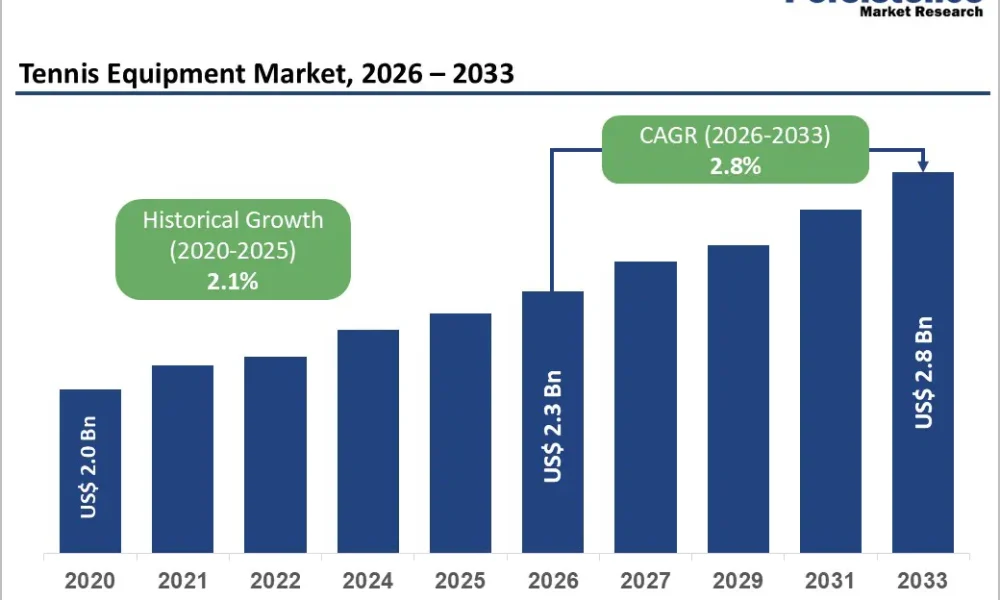
According to Persistence Market Research, the global tennis equipment market is likely to be valued at US$ 2.3 billion in 2026 and is expected to reach US$ 2.8 billion by 2033, growing at a CAGR of 2.8% during the forecast period from 2026 to 2033. Growth is supported by increasing investments in sports development programs and the rising influence of international tennis tournaments. Racquets remain the leading product segment due to their essential role in gameplay, while North America leads the market owing to its well-established tennis culture, strong retail presence, and high participation rates.
Download Your Free Sample & Explore Key Insights : https://www.persistencemarketresearch.com/samples/33983
Key Highlights from the Report
➤ The tennis equipment market is projected to grow from US$ 2.3 billion in 2026 to US$ 2.8 billion by 2033.
➤ Rising global participation in recreational and professional tennis is boosting equipment demand.
➤ Technological advancements in racquet design are improving performance and attracting players.
➤ Increasing popularity of tennis among youth is supporting long-term market growth.
➤ Expansion of sports clubs and training academies is strengthening equipment sales globally.
➤ Growing influence of international tennis tournaments is enhancing product visibility and demand.
Market Segmentation
The tennis equipment market is segmented based on product type, end-user, and distribution channel. Product categories include racquets, balls, strings, apparel, and accessories. Among these, racquets dominate the market due to their indispensable role in the sport and frequent replacement cycles driven by wear and technological upgrades. Tennis balls also represent a significant segment due to their high consumption rate in both practice and professional matches. Apparel and accessories are gaining traction as players seek comfort, performance enhancement, and style during gameplay.
From an end-user perspective, the market is divided into professional players, recreational users, and institutions such as sports academies and clubs. Recreational users account for a large share due to the growing popularity of tennis as a leisure activity. Distribution channels include specialty sports stores, online retail platforms, and general retail outlets. Online channels are gaining momentum due to convenience, product variety, and competitive pricing, while specialty stores continue to attract serious players seeking expert guidance and premium equipment.
Get Personalized Data – Request Customization Today : https://www.persistencemarketresearch.com/request-customization/33983
Regional Insights
North America holds a leading position in the tennis equipment market, driven by a strong sports culture and high participation rates. The region benefits from well-developed infrastructure, including tennis clubs, academies, and public courts. The presence of major tournaments and established brands further supports market growth. Consumers in the United States and Canada are also more inclined toward premium equipment, which contributes to higher revenue generation in the region.
Europe represents another significant market, supported by a long-standing tradition of tennis and the popularity of major tournaments. Countries such as France, the United Kingdom, and Germany have a strong base of both professional and amateur players. Meanwhile, the Asia-Pacific region is emerging as a growth hotspot due to increasing urbanization, rising disposable incomes, and growing interest in sports among younger populations. Investments in sports infrastructure and training programs are further driving market expansion in this region.
Market Drivers
One of the key drivers of the tennis equipment market is the increasing global participation in sports and fitness activities. As individuals become more health-conscious, tennis is gaining recognition as a sport that offers both physical and mental benefits. Governments and sports organizations are also promoting tennis through initiatives and programs aimed at encouraging youth participation. This has led to a steady increase in the number of players, thereby driving demand for equipment such as racquets, balls, and apparel.
Another significant driver is the continuous innovation in tennis equipment technology. Manufacturers are focusing on developing lightweight, durable, and high-performance products to enhance player experience. Advanced materials such as carbon fiber and graphite are being used to improve racquet strength and flexibility. These innovations not only attract professional players but also appeal to recreational users seeking better performance, thereby contributing to market growth.
Market Restraints
Despite steady growth, the tennis equipment market faces challenges such as the high cost of premium equipment. Professional-grade racquets, apparel, and accessories can be expensive, limiting their accessibility to a broader consumer base. This can particularly affect adoption in price-sensitive markets where consumers may opt for lower-cost alternatives or other sports activities.
Another restraint is the competition from other sports and recreational activities. With a wide range of fitness options available, consumers may choose alternative sports that require less equipment or lower initial investment. Additionally, limited access to tennis courts in certain regions can restrict participation and, consequently, the demand for tennis equipment.
Market Opportunities
The tennis equipment market presents significant opportunities through the expansion of emerging markets. Countries in Asia-Pacific and Latin America are witnessing increased interest in tennis due to rising disposable incomes and growing exposure to international sports events. Investments in sports infrastructure and the establishment of training academies are expected to create new growth avenues for equipment manufacturers.
Another promising opportunity lies in the growing demand for eco-friendly and sustainable products. Consumers are becoming more environmentally conscious and are seeking equipment made from recyclable and sustainable materials. Manufacturers that focus on sustainability and innovation are likely to gain a competitive edge in the market while attracting a new segment of environmentally aware consumers.
Secure Your Full Report – Proceed to Checkout : https://www.persistencemarketresearch.com/checkout/33983
Company Insights
Key players operating in the tennis equipment market include:
- Amer Sports Corporation
- Head N.V.
- Dunlop Sports Co. Ltd.
- Tecnifibre
- Oliver Sports & Squash GmbH
- Harrow Sports Inc.
- Babolat
- Yonex Co. Ltd.
- Prince Global Sports LLC
- Wilson Sporting Goods
- Nanjing Spark Shot Technology Co., Ltd.
- VINEX TECHNOLOGIES
- Volkl Tennis
- DONIC
Recent Developments
- June 2024: Wilson Sporting Goods launched a new range of performance-enhancing tennis racquets designed for advanced players.
- October 2023: Babolat introduced updated tennis strings focusing on durability and improved control for professional athletes.
Future Opportunities and Growth Prospects
The future of the tennis equipment market is expected to be shaped by increasing participation, technological innovation, and expanding global reach. As more individuals embrace tennis as a recreational and professional sport, demand for high-quality equipment will continue to rise. Manufacturers are likely to focus on product innovation, lightweight materials, and enhanced performance features to meet evolving consumer expectations.
Additionally, the growth of emerging markets and the rising popularity of tennis among younger demographics will create new opportunities for industry players. Strategic partnerships, investments in sports infrastructure, and the introduction of sustainable products will play a crucial role in driving long-term growth and ensuring the continued expansion of the tennis equipment market.




