
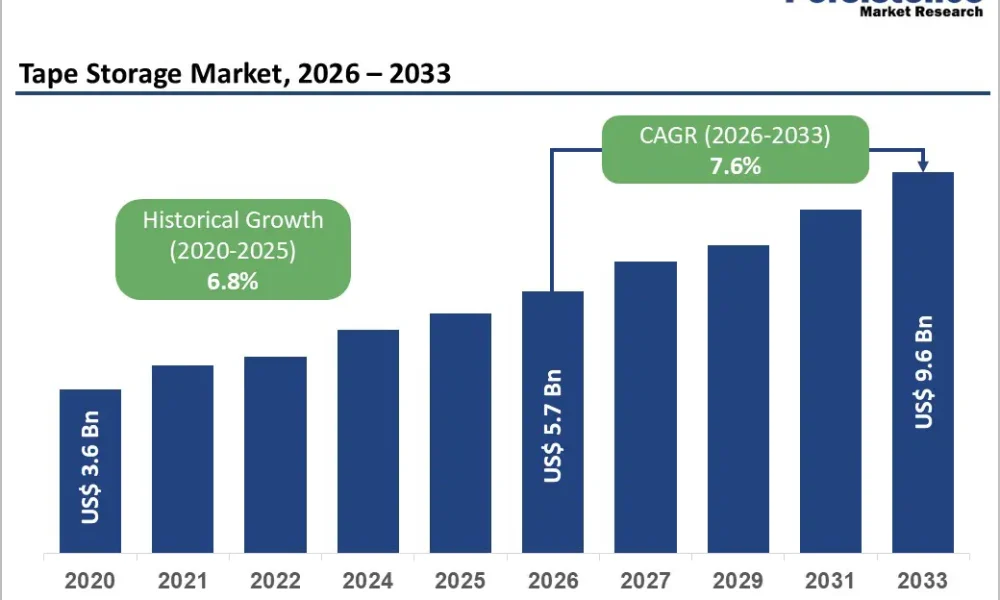
The global tape storage market is witnessing steady growth as organizations generate massive volumes of data and seek cost-efficient long-term storage solutions. The market is expected to be valued at US$5.7 billion in 2026 and is projected to reach US$9.6 billion by 2033, expanding at a CAGR of 7.6% between 2026 and 2033.
Tape storage technology, once considered legacy infrastructure, is now experiencing renewed demand due to its unique advantages in data archiving, cybersecurity protection, and long-term cost efficiency. As global data generation surpasses 100 zettabytes annually, organizations require scalable storage solutions capable of securely preserving data for decades. Tape storage provides reliable offline storage that protects against cyber threats such as ransomware while offering a lower cost per terabyte compared to disk and cloud alternatives.
The combination of regulatory compliance requirements, increasing cybersecurity risks, and the expansion of hyperscale data centers is driving the continued relevance and growth of tape storage systems across enterprises, governments, and cloud service providers.
Key Industry Highlights
The tape storage market is characterized by technological innovation, expanding data storage needs, and strong adoption in enterprise IT environments.
Leading Technology Segment
The LTO-8 (Linear Tape-Open 8) technology dominates the market with 18.5% market share, benefiting from widespread infrastructure compatibility and mature manufacturing ecosystems. With native storage capacity of approximately 12TB per cartridge, LTO-8 delivers reliable performance and cost-effective archiving for enterprise environments.
Meanwhile, DDS-4 technology is emerging as the fastest-growing segment with a CAGR of 9%. Its affordability and accessibility make it particularly attractive to mid-sized businesses and emerging markets that require cost-effective storage solutions.
Dominant Capacity Range
Tape cartridges with 10TB to 50TB capacity account for 47.2% of market share, reflecting alignment with LTO-8 and LTO-9 technologies that provide balanced storage density and operational efficiency.
However, above-50TB cartridges represent the fastest-growing segment with an expected CAGR of 16%, driven by hyperscale data center demand and high-capacity technologies such as the IBM TS1170 50TB cartridge.
Primary Application Sector
Data centers dominate the market with 36.5% share, as cloud providers and hyperscalers integrate tape storage into multi-tier storage architectures for long-term archival purposes.
Enterprises represent the fastest-growing segment, expanding at 11% CAGR. Rising cybersecurity concerns and regulatory compliance requirements are encouraging organizations to adopt offline backup systems, particularly tape-based solutions that support robust disaster recovery strategies.
Regional Market Leadership
North America leads the global tape storage market with approximately 35% share, driven by strong adoption among financial institutions, government agencies, and large enterprises.
Europe holds about 26% market share, supported by strict data privacy regulations and compliance requirements.
Meanwhile, Asia Pacific is the fastest-growing regional market with a CAGR of 13%, expected to expand from 22% share today to nearly 28% by 2033 due to rapid digital transformation and data center expansion.
Market Drivers
Rising Ransomware Threats and Air-Gapped Backup Adoption
One of the most powerful drivers of the tape storage market is the increasing threat of ransomware attacks. Cybercrime incidents have surged globally, with ransomware attacks increasing by nearly 48% year-over-year and causing estimated damages exceeding US$34 billion by 2025.
Tape storage provides a crucial advantage in cybersecurity: air-gapped offline backup. Unlike disk or cloud storage systems that remain connected to networks, tape systems are physically isolated when not in use. This prevents ransomware from spreading across backup infrastructure or encrypting stored data.
As a result, organizations are increasingly implementing the 3-2-1 backup strategy, which recommends maintaining:
- Three copies of data
- Two different storage media
- One offsite backup location
Tape storage plays a critical role in fulfilling this strategy, ensuring secure offline backups that cannot be compromised by network-based attacks.
Cyber insurance companies are also encouraging organizations to adopt tape-based backup systems by offering 10–15% premium reductions for verified air-gapped backup infrastructures.
Superior Total Cost of Ownership
Another major advantage of tape storage is its low cost per terabyte, which significantly undercuts alternative storage technologies.
Typical storage costs include:
- Tape storage: US$8–15 per TB
- Disk-based storage: US$25–40 per TB
- Cloud storage: US$50–100+ per TB
For organizations storing petabytes or even exabytes of archival data, these cost differences translate into substantial savings.
Tape storage also offers impressive energy efficiency. Unlike disk arrays that require continuous power to maintain operation, tape systems consume minimal energy while data is stored. Enterprises adopting tape-based cold storage report 85% lower energy consumption and 40–60% reduction in infrastructure power costs.
These economic and environmental advantages are particularly attractive for hyperscale data centers managing enormous volumes of archival data.
Market Restraints
Competition from Cloud Storage Platforms
Despite its advantages, tape storage faces growing competition from cloud storage platforms. Cloud providers such as Amazon, Google, and Microsoft offer scalable storage services that eliminate the need for organizations to manage physical infrastructure.
Services like cloud archival storage appeal to organizations seeking flexible capacity, rapid scalability, and reduced upfront capital investment.
Additionally, the perception that tape storage is outdated technology can discourage adoption among newer technology companies that prioritize cloud-native architectures.
High Equipment Acquisition Costs
Deploying tape storage infrastructure requires significant capital investment. Large-scale tape library systems can cost anywhere between US$100,000 and US$2 million, depending on automation levels and storage capacity.
Another challenge is vendor dependency. A large portion of the tape drive manufacturing ecosystem is controlled by a small number of suppliers, including IBM, while cartridge manufacturing is dominated by companies such as Sony and Fujifilm.
These supply chain concentrations can create procurement risks and longer lead times for enterprise deployments.
Additionally, tape systems require specialized technical expertise to manage libraries, cartridges, and backup workflows, increasing operational complexity.
Elevate your business strategy with comprehensive market data. Request a sample report now: https://www.persistencemarketresearch.com/samples/14725
Emerging Market Opportunities
Hybrid Tape-Cloud Storage Architectures
One of the most promising opportunities in the tape storage market is the development of hybrid storage architectures that combine tape storage with cloud services.
In these architectures, organizations store frequently accessed data on high-performance systems such as cloud or disk storage, while archiving rarely accessed data on tape. Automated data lifecycle management platforms move data between storage tiers based on access patterns and compliance requirements.
This approach allows organizations to balance performance, cost efficiency, and long-term data preservation.
Industry projections indicate that hybrid tape-cloud deployments may represent 35% of enterprise backup installations by 2033, creating a multi-billion-dollar market opportunity.
Next-Generation High-Capacity Tape Technologies
Technological innovation continues to expand the capabilities of tape storage systems. New tape generations such as LTO-9 and LTO-10 deliver significantly higher storage capacities.
For example:
- LTO-9 provides 18TB native capacity per cartridge
- LTO-10 is expected to deliver 36TB native capacity
These advancements enable organizations to store larger datasets using fewer cartridges, improving operational efficiency and reducing storage footprint.
Research breakthroughs are also pushing the boundaries of tape technology. Laboratory demonstrations by Fujifilm have achieved 580TB raw tape capacity, indicating a strong technological roadmap for future storage innovation.
Category-Wise Market Analysis
Technology Type Insights
The LTO-8 format remains widely adopted due to its balance of capacity, reliability, and backward compatibility. Enterprise environments benefit from standardized infrastructure supported by major storage vendors including Hewlett Packard Enterprise and Quantum Corporation.
Meanwhile, DDS-4 technology continues to gain traction in cost-sensitive markets where organizations prioritize affordability over high storage density.
Storage Capacity Insights
The 10TB–50TB cartridge segment dominates due to compatibility with widely deployed enterprise tape libraries.
However, the above-50TB capacity segment is rapidly expanding due to increasing adoption by hyperscale data centers and cloud service providers requiring massive long-term archival storage.
Ultra-high-capacity cartridges are expected to become the next growth engine in the market as data volumes continue to grow exponentially.
End-Use Industry Insights
Data centers represent the largest end-use segment, accounting for 36.5% of market share. Hyperscale cloud operators deploy tape storage to reduce the cost of storing large archival datasets.
Major cloud providers including Amazon, Google, and Microsoft incorporate tape-based storage systems within their archival infrastructure.
Enterprise organizations are emerging as the fastest-growing end-use segment due to increasing cybersecurity concerns, regulatory data retention requirements, and disaster recovery planning.
Regional Market Insights
North America
North America dominates the global tape storage market due to the strong presence of financial institutions, government agencies, and hyperscale cloud providers.
The United States accounts for the majority of regional demand, with enterprises investing heavily in secure data archiving systems to meet compliance regulations and cybersecurity requirements.
Europe
Europe represents the second-largest regional market. Strict data privacy regulations, including GDPR compliance requirements, encourage organizations to maintain secure long-term data storage systems.
Countries such as Germany, the United Kingdom, and France are major adopters of tape-based archival systems.
Asia Pacific
Asia Pacific is the fastest-growing region due to rapid digital transformation, expansion of cloud infrastructure, and increasing enterprise IT investments.
Countries including China, India, and Southeast Asian nations are witnessing strong demand for large-scale data storage solutions as businesses generate increasing volumes of digital data.
Competitive Landscape
The global tape storage market is moderately consolidated, with a few major suppliers controlling approximately 70% of global market share.
Key players in the industry include:
- IBM
- Quantum Corporation
- Hewlett Packard Enterprise
- Fujifilm
- Sony
- Dell
- Lenovo
- Oracle
- Seagate Technology
These companies are focusing on expanding storage capacity, improving automation in tape libraries, and integrating tape solutions with cloud-based storage architectures.
Conclusion
The tape storage market continues to demonstrate strong resilience and relevance in the modern data economy. Despite competition from cloud storage platforms, tape technology remains a critical component of long-term data archiving and cybersecurity infrastructure.
With projected revenues reaching US$9.6 billion by 2033, the market is benefiting from rising data volumes, increasing ransomware threats, and the need for cost-efficient storage solutions.
Future growth will likely be driven by high-capacity tape technologies, hybrid cloud-tape storage architectures, and growing enterprise adoption of air-gapped backup systems. As organizations prioritize data security, sustainability, and cost efficiency, tape storage is expected to remain a vital element of global data management strategies.
Related Reports:




