
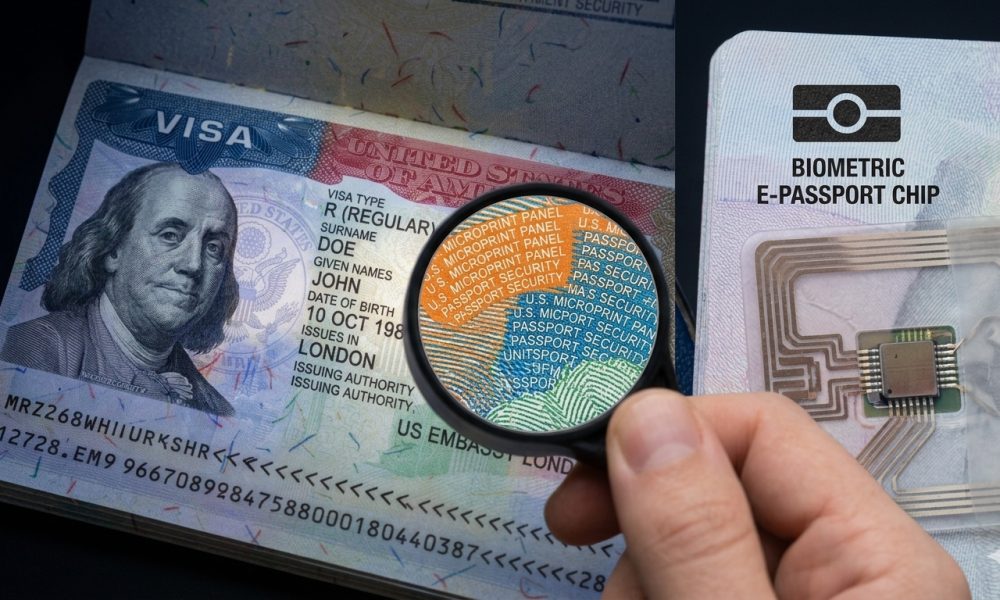
Optically variable features change appearance as documents tilt, helping inspectors distinguish genuine security elements from flat reproductions.
Washington, DC, October 3, 2026 — Modern passports use holograms and other optically variable security features because these elements change appearance when the document is tilted, rotated, or viewed from different angles, giving inspectors dynamic characteristics that ordinary printing and flat photographic reproduction cannot easily imitate.
Unlike static artwork that remains visually unchanged under normal viewing conditions, properly manufactured optical security devices can display movement, color changes, Image transitions, or shifting patterns, allowing trained officers to determine whether a document behaves as expected during physical examination.
These features contribute to a broader layered security system in which visual inspection, specialized materials, biometric information, machine-readable data, and electronic Authentication work together to help authorities identify counterfeit, altered, or otherwise suspicious travel documents.
Holograms Introduce Movement Into Document Inspection
A conventional printed Image usually looks the same from any angle. In contrast, an optically variable feature can reveal different colors, symbols, images, or apparent movement as an examiner changes the passport’s orientation.
This changing response gives inspectors information that a single photograph or ordinary photocopy cannot fully capture, because the security characteristic depends on the interaction between light, viewing angle, and precisely manufactured optical structures.
During examination, an officer can tilt the passport slowly and observe whether expected patterns move smoothly, whether specific images appear at predetermined angles, and whether the feature maintains the sharpness and visual behavior associated with genuine document production.
A counterfeit reproduction may imitate a hologram’s appearance from one angle while remaining flat, showing incorrect movement or inconsistent reflections when examined dynamically.
The broader international framework for secure machine-readable travel documents is maintained through the International Civil Aviation Organization’s travel document program, which supports interoperable standards for passports used across international borders.
Optical Security Features Are Difficult to Capture With Ordinary Printing
Desktop printers, commercial photocopiers and conventional scanners are designed primarily to reproduce static colors and images, meaning they cannot normally recreate the complex optical structures that produce genuine holographic or diffractive effects.
A high-resolution photograph may capture what a security element looks like at one moment. Still, it does not preserve the controlled movement, depth, color transitions, or changing imagery that appear when the original feature is tilted.
This limitation makes optically variable devices useful against straightforward reproduction because counterfeiters must replicate physical behavior rather than merely reproduce a visible graphic with approximately similar colors and dimensions.
Inspectors can therefore evaluate whether the security feature changes correctly across several viewing angles, looking for transitions that should occur smoothly rather than appearing as printed simulations or reflective stickers.
The distinction becomes especially important when a suspicious document contains a visually convincing reproduction that appears plausible in a photograph but fails immediately once an examiner moves the passport under ordinary inspection lighting.
Holographic Effects Can Contain Multiple Images
Sophisticated optical features can show different symbols, portraits, numbers, or patterns depending on the angle from which an inspector views the passport, allowing several pieces of visual information to occupy a relatively small area.
One viewing position may reveal a national emblem. At the same time, another may display a secondary portrait, document symbol, or geometric pattern that appears only after the passport has been rotated or tilted.
Because these effects depend on precise optical engineering, a convincing imitation must reproduce not only individual images but also the exact sequence, angle, and quality of the transitions between them.
Incorrect timing, blurred transitions, or missing visual elements can therefore become useful indicators during document examination, particularly when inspectors have access to reliable reference examples for the passport series being inspected.
These dynamic characteristics give optical security features an advantage over simpler static graphics because the inspector can evaluate how the feature behaves rather than merely asking whether something resembling a hologram appears to be present.
Kinegrams and Related Devices Add Controlled Motion
Some secure travel documents use diffractive optical devices commonly referred to as kinegrams or related technologies, which can create apparent movement, changing structures and Image transformations as the document is viewed from different directions.
These elements may display lines that appear to rotate, symbols that expand or contract, or patterns that move across the feature when the passport is tilted through a controlled range.
The resulting motion comes from microscopic optical structures rather than conventional animation, so the feature requires specialized manufacturing equipment and carefully designed materials that ordinary printing cannot readily reproduce.
An imitation might reflect light brightly and appear holographic at first glance, but fail to produce the expected directional movement or display a repetitive rainbow effect inconsistent with the genuine device.
Professional inspection therefore emphasizes observing the feature’s behavior across multiple angles rather than relying on a single static view under one lighting condition.
Color Shifts Provide Another Optical Clue
Optically variable inks and related materials can change apparent color as the viewing angle changes, giving authorities another dynamic characteristic that can support examination of passport pages and personalized information.
A feature might appear green from one angle and shift toward another color as the document is tilted, with the transition occurring predictably because of the material’s engineered optical properties.
Flat printed imitations may reproduce one of those colors but generally cannot recreate the same controlled transition without using comparable specialized materials and manufacturing processes.
Inspectors can therefore compare the starting color, transition range, and final appearance against known authentic examples, particularly when a security element should behave consistently across passports from the same generation.
This technique becomes even more effective when color-shifting features are positioned near photographs, document numbers or other personalized information that counterfeiters may attempt to alter.
Optical Features Can Protect the Portrait Area
The passport holder’s photograph is one of the most important targets for document manipulation, so governments often place holographic or optically variable protections directly over or around the portrait area.
A transparent optical feature can overlap the photograph while remaining visible under particular viewing conditions, creating a relationship between the portrait and surrounding security structure that becomes difficult to preserve after substitution.
If someone attempts to replace the photograph or modify the data page, the optical element may become damaged, misaligned, or interrupted, leaving evidence that the personalized area no longer matches the original construction.
Inspectors can observe whether the holographic feature moves continuously across the portrait, whether boundaries align properly, and whether optical details remain sharp where they interact with personalized information.
Travelers seeking a broader explanation of these overlapping protections can review the Amicus International Consulting guide to passport security and modern counterfeit detection.
Secondary Portraits Can Appear Within Optical Elements
Some passports include additional images of the holder inside holographic or variable optical features, creating another independent representation that can be compared with the primary photograph.
These secondary portraits may appear only at particular angles, so an examiner can deliberately tilt the document to see whether the expected Image appears and whether it matches the main portrait.
Unauthorized photograph substitution becomes more difficult when several independent representations must remain consistent, particularly when each Image is created using a different manufacturing technique.
A counterfeit document that changes only the principal photograph may therefore reveal itself because an embedded secondary Image continues to display the original holder or presents noticeably different facial characteristics.
This redundancy strengthens identity Protection by ensuring the passport does not depend entirely on one visible portrait that could become the focus of alteration.
Optical Features Can Interact With Laser Personalization
Modern polycarbonate passport pages often combine holographic effects with laser engraving, allowing personalized text, portraits, and optical structures to overlap or sit adjacent to one another on the identity page.
This integration adds security because each component must remain correctly aligned with the others so that unauthorized manipulation can disrupt the relationships established during controlled manufacturing.
An altered name, portrait, or document number may interfere with an optical pattern, produce unusual gaps, or create depth differences that become visible when the page is examined from different angles.
Inspectors can therefore evaluate not only whether the hologram appears genuine but also whether it interacts properly with the surrounding laser-personalized information and the page’s physical structure.
The resulting examination becomes more powerful because several independent technologies reinforce one another rather than functioning as isolated security features.
Light Direction Matters During Examination
Optical security features are designed to respond to light, so proper inspection often requires moving the passport, the light source, or both until the expected visual effects become clearly visible.
An examiner looking at a passport from only one fixed angle may miss important transitions that become obvious when the document is slowly tilted under ordinary white light.
For this reason, document examination techniques often involve deliberate movement, allowing the inspector to observe whether colors shift, images change, and dynamic patterns behave consistently throughout the viewing sequence.
A counterfeit sticker may appear convincing when stationary but reveal abrupt reflections, uneven movement, or missing imagery once lighting and angle begin to change. This basic dynamic examination makes holographic features particularly practical because they can often be assessed quickly without specialized electronic equipment.
Holograms Are Not Proof of Authenticity by Themselves
Although holograms are valuable security components, their presence alone does not establish that a passport is genuine because counterfeiters can apply reflective foils, commercially available holographic materials, or simulated optical designs to fraudulent documents.
Professional inspection therefore asks whether the feature behaves correctly, appears in the proper location, matches the expected design, and remains consistent with the passport’s other physical and digital elements.
A document containing a convincing hologram may still be suspicious if its security paper, laser personalization, machine-readable zone, electronic chip or page construction shows significant inconsistencies.
Likewise, damage to an authentic holographic feature does not automatically prove fraud because legitimate passports can suffer wear, scratching, heat exposure,e or other deterioration during years of regular use.
The strongest conclusion comes from examining several independent characteristics and determining whether they collectively support the same document history and identity.
Flat Reproductions Often Fail During Movement
One of the simplest differences between genuine optical security and flat reproduction becomes visible when the passport is moved, because static printed imitations cannot generate true depth or controlled angular change.
A scanner can capture visible patterns accurately at high resolution. At the same time, le a commercial printer can reproduce those patterns with impressive detail, yet neither process automatically recreates the underlying optical structure responsible for movement.
This means a copied security feature may look credible in a digital Image while failing instantly when examined in person under changing angles and lighting conditions.
Authorities benefit from this distinction because physical inspection can reveal weaknesses that might not appear when evaluating only photographs or scanned document files.
Modern document Authentication therefore still relies on direct examination, even as increasingly sophisticated digital verification technologies become common at airports and border checkpoints.
Magnification Can Reveal Manufacturing Differences
Inspectors may also examine optical security features under magnification, looking for fine structures, edge quality, and manufacturing characteristics that differ from printed simulations or low-quality reflective materials.
A genuine feature can contain extremely detailed microstructures that maintain consistent sharpness, while a copied version may show pixelation, printed dots, irregular edges, or other signs of digital reproduction.
Magnification becomes particularly useful when a counterfeit uses a visually similar reflective material whose general appearance seems convincing to the unaided eye.
By combining magnified examination with movement and lighting changes, document specialists can assess both static manufacturing details and dynamic optical behavior.
These complementary techniques improve reliability because a sophisticated imitation must remain convincing across several independent forms of inspection, not just one viewing condition.
Databases Cannot Replace Physical Optical Checks.
Electronic databases can tell authorities whether a passport number has been reported lost, stolen, canceled, or otherwise associated with administrative concerns. Still, those systems cannot independently determine whether every physical security element on the booklet is genuine.
A fraudulent document might contain biographical information copied from a legitimate passport while presenting a counterfeit data page whose optical security features fail close examination.
Conversely, a genuine passport may contain authentic holographic features but still require further review because electronic systems identify a separate immigration or identity issue.
This distinction illustrates why modern border security combines document inspection with database queries rather than expecting either method to answer every Authentication question independently.
Physical and digital verification serve different functions, and combining them creates a stronger overall assessment of both document integrity and traveler identity.
Optical Features Complement Electronic Passport Security
The electronic chip inside a biometric passport provides another independent layer of Protection by storing standardized data that participating governments can authenticate through cryptographic processes.
Successful chip Authentication helps establish that electronically stored information has not been improperly altered, while holographic and optical examination helps determine whether the physical identity page displays expected manufacturing characteristics.
The ICAO Public Key Directory helps participating authorities validate the digital signatures associated with electronic passport data, strengthening the electronic side of this layered security model.
Neither mechanism replaces the other because a passport may still require physical examination after successful electronic Authentication, especially when authorities suspect alteration, substitution, or structural damage.
Modern passport security becomes most effective when the physical booklet, electronic chip, machine-readable information and traveler’s identity all produce results that remain mutually consistent.
Movement Creates Information That Static Images Cannot Preserve
The security value of holograms ultimately comes from their ability to reveal information through movement, allowing a passport to display characteristics that an ordinary photograph or photocopy cannot fully represent.
This dynamic behavior helps inspectors distinguish original optical structures from flat reproductions while also allowing them to identify misalignment, damaged overlays, or improperly substituted personalized information.
When combined with laser engraving, security paper, ultraviolet features, and electronic Authentication, optically variable elements become part of a much larger network of mutually reinforcing protections.
Their purpose is not to make counterfeiting theoretically impossible, but to increase the number of independent technical challenges fraudulent documents must overcome to survive professional inspection.
For legitimate travelers, these shifting images and changing colors may appear decorative. Still, their controlled movement represents a carefully engineered security layer designed to help authorities evaluate whether a passport remains physically consistent with genuine government production.




