
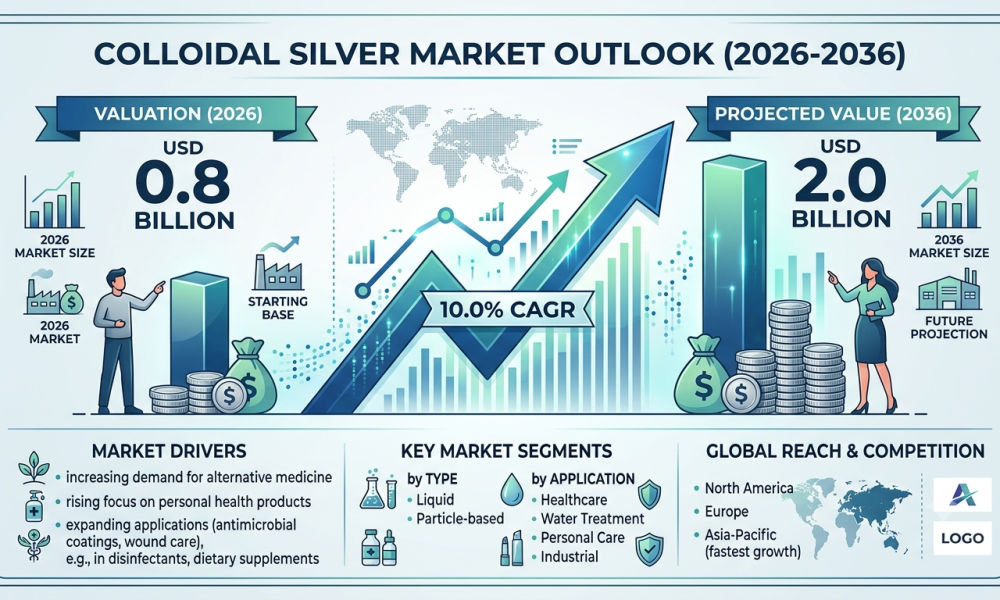
The global colloidal silver market is projected to grow from USD 0.8 billion in 2026 to USD 2.0 billion by 2036, registering a 10.0% CAGR during the forecast period. Demand is supported by growing applications of silver particles in antimicrobial materials, wound-related products, coatings, engineered formulations, and other qualified technical applications. Buyers are increasingly focusing on particle size, stability, product format, and documentation that match the intended end use.
Particle characterization is becoming an important consideration for formulators purchasing colloidal silver. The behavior of silver particles can vary depending on particle size, carrier, concentration, and the final formulation. Powder remains the leading form because it allows formulators to control silver loading and select the downstream carrier closer to production. At the same time, regulatory requirements and safety considerations are shaping the use of colloidal silver across healthcare, cosmetics, dietary supplements, pharmaceutical products, and other applications.
Get detailed market forecasts, competitive benchmarking, and pricing trends: https://www.futuremarketinsights.com/reports/sample/rep-gb-7283
Global Segment Leaders
- Form – Powder: 52.0% in 2026. Powder provides formulators with a concentrated silver input that can be weighed into coatings, composites, or later dispersion systems while allowing downstream buyers greater control over the final carrier.
- Particle Size – 21–50 nm: 23.0% in 2026. This particle-size band remains the leading category as buyers increasingly specify particle dimensions alongside silver concentration when sourcing materials for defined formulations.
- End Use – Healthcare: 29.0% in 2026. Healthcare represents the leading end-use category, supported by qualified applications involving antimicrobial wound-care materials, medical devices, and related silver-containing products.
Country-Level Performance
Japan is projected to record the fastest growth among the profiled countries, with an 11.0% CAGR from 2026 to 2036. Growth is supported by structured healthcare applications for antimicrobial wound-dressing and protection materials, with Japan’s PMDA listing such products under a Class III device category.
The United States is forecast to grow at a 10.0% CAGR through 2036. The market benefits from research activity and the availability of specialty suppliers offering size-defined silver particles. Technical applications continue to require control of particle characteristics and finished-product performance.
Singapore is expected to expand at a 9.0% CAGR. Its topical-antiseptic framework places emphasis on ingredient quality, antimicrobial effectiveness testing, claims, and labeling, creating a defined qualification pathway for applicable silver formulations.
The United Kingdom is projected to register an 8.0% CAGR through 2036. Nanomaterial notification requirements make particle characteristics, exposure information, and toxicological data important considerations for applicable cosmetic products. The country’s 2026 safety workplan also includes micronised silver for assessment.
Canada is forecast to grow at a 7.0% CAGR, with authorized natural health product pathways supporting specific qualified products. Health Canada’s database lists Sovereign Silver under an active Natural Product Number, although authorization remains product-specific.
Germany is projected to expand at a 6.0% CAGR. EU regulatory requirements remain important for cosmetic applications, with colloidal silver in nanoform prohibited in cosmetics under Commission Regulation (EU) 2024/858.
South Korea is expected to grow at a 5.0% CAGR, while Spain is projected to record a 4.0% CAGR from 2026 to 2036. Both markets require suppliers and product developers to account for applicable regulatory requirements and distinguish research, industrial, healthcare, and consumer applications.
Regional Context
Japan, the United States, and Singapore represent the higher-growth group among the profiled markets, with CAGRs of 11.0%, 10.0%, and 9.0%, respectively. Their market development is linked to healthcare qualification, research activity, specialty material supply, and applications requiring controlled silver-particle characteristics.
The United Kingdom and Canada form a middle-growth group, with CAGRs of 8.0% and 7.0%, respectively. Product authorization, nanomaterial requirements, safety documentation, and intended-use considerations remain important factors for commercialization.
Germany, South Korea, and Spain record CAGRs ranging from 6.0% to 4.0%. Regulatory boundaries are particularly relevant in cosmetics and pharmaceutical applications, increasing the importance of clearly defining particle form, intended use, supporting safety data, and permissible product claims.
The full report covers North America, Latin America, Western Europe, Eastern Europe, East Asia, South Asia and Pacific, and the Middle East and Africa, with eight countries profiled individually.
Access full Report in PDF Format@ https://www.futuremarketinsights.com/reports/brochure/rep-gb-7283
Competitive Landscape
The competitive landscape includes American Biotech Labs, Sovereign Silver, Purest Colloids Inc., Silver Biotics, Natural Path Silver Wings, Alfa Aesar (Thermo Fisher Scientific), and nanoComposix. The market includes consumer silver formulation specialists as well as research-grade nanomaterial and chemical suppliers. Competition is shaped by particle-size control, product format, application-specific documentation, supply consistency, and the ability to meet regulatory requirements for the intended use.
Recent developments highlight the growing importance of controlled silver-particle formats. In February 2025, a patent publication assigned to American Silver LLC described anhydrous silver-particle compositions that can be reconstituted with water. Such dry formats can allow buyers to manage silver loading and final dispersion closer to the point of formulation.
Research-grade suppliers are also providing size-defined silver materials with batch characterization, allowing technical buyers to specify particle size and evaluate stability and performance in their own carrier systems. This is particularly relevant as formulators increasingly evaluate silver based on measurable particle characteristics rather than concentration alone.
Analyst Perspective
“Particle size has commercial value only when a supplier can reproduce it in the finished formulation and document safety for the intended route. No wound-dressing result establishes the safety of an oral product.”
— Nandini Roy Choudhury, Principal Consultant, Future Market Insights
About Future Market Insights (FMI)
Future Market Insights, Inc. (ESOMAR certified, recipient of the Stevie Award, and a member of the Greater New York Chamber of Commerce) offers profound insights into the driving factors that are boosting demand in the market. FMI stands as the leading global provider of market intelligence, advisory services, consulting, and events for the Packaging, Food and Beverage, Consumer Technology, Healthcare, Industrial, and Chemicals markets. With a vast team of over 400 analysts worldwide, FMI provides global, regional, and local expertise on diverse domains and industry trends across more than 110 countries.



