
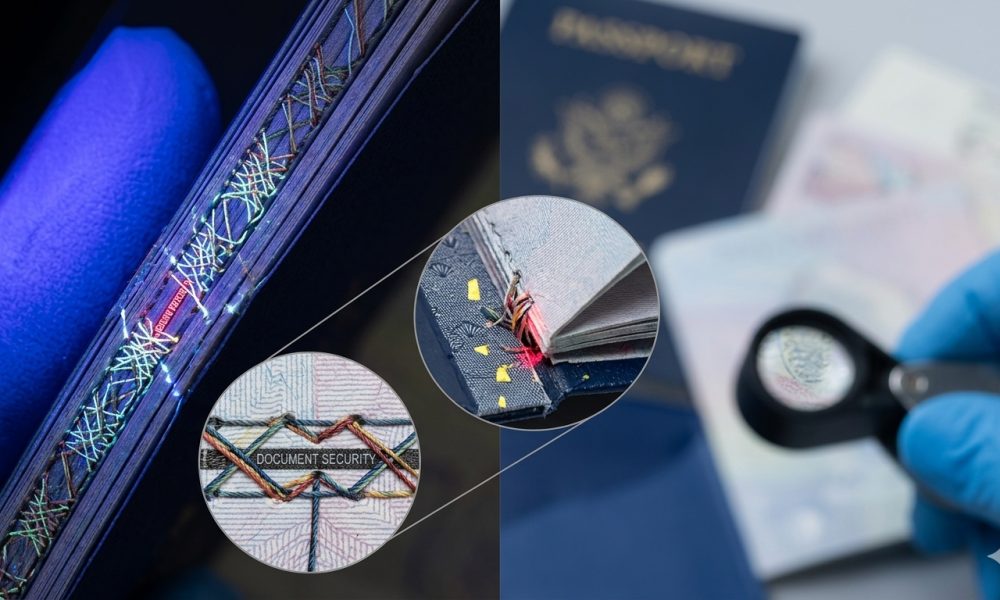
Security stitching and booklet construction offer clues when someone tries to remove, replace, or rearrange passport pages.
Washington, DC, October 3, 2026 — Passport security depends not only on the identity page, biometric chip, and printed security features, but also on how the booklet is physically assembled, stitched, and aligned during controlled manufacturing.
Security binding helps authorities determine whether a passport has remained structurally intact because removing, replacing or rearranging pages can disturb stitching patterns, folded sheets, page alignment and other construction details that are difficult to recreate perfectly after the booklet leaves production.
These physical clues provide inspectors with another independent source of evidence, allowing them to identify suspicious manipulation even when individual passport pages initially appear visually convincing under ordinary lighting and casual examination.
Passport Booklets Are Engineered as Complete Security Documents
A modern passport is manufactured as a coordinated booklet rather than as a loose collection of independent pages, meaning the relationship between neighboring sheets, stitching, page numbering, and internal design elements can contribute directly to document security.
Manufacturers carefully assemble folded sheets, security paper, and identity components in predetermined sequences, creating structural relationships that trained inspectors can examine to determine whether the passport remains consistent with its original production method.
Because several pages may belong to the same folded sheet, removing one page can physically affect another page elsewhere in the booklet, making apparently isolated tampering more difficult than simply cutting out and replacing a single sheet.
This construction provides authorities with important forensic clues because unexpected tears, uneven page edges, unusual folds, or disturbed stitching can indicate that someone has interfered with the booklet after issuance.
The International Civil Aviation Organization’s travel document framework maintains broader standards for machine-readable travel documents, supporting internationally interoperable passport construction and inspection practices.
Security Stitching Creates a Structural Reference Point
Many passports use distinctive stitching patterns to bind the booklet together, creating a visible and tactile feature that can reveal whether pages have been removed, loosened, or reinserted.
Inspectors can examine thread placement, spacing, tension, color, and continuity, comparing those characteristics against known examples from the same passport series or issuing authority.
When a booklet has been opened and resewn, even careful reconstruction may produce differences involving stitch length, knot placement, thread tension or alignment that become noticeable during close examination.
Replacement thread may also react differently under ultraviolet light, show a slightly different texture, or fail to match the original material used during official passport production.
These differences are not necessarily conclusive on their own, but they can become highly significant when combined with unusual page alignment, disturbed paper fibers, or inconsistencies elsewhere in the document.
Folded Sheets Make Page Substitution More Difficult
Passport booklets are often made from sheets that are folded and then bound through the center, meaning two or more page positions may be physically connected as part of the same piece of material.
An attempt to remove one page can therefore damage the corresponding part of the folded sheet, creating structural evidence that extends beyond the specific page someone intended to alter.
Inspectors may notice uneven trimming, missing material, abnormal page thickness, or changes in how the affected sheet sits within the rest of the booklet.
This interconnected construction makes page replacement considerably more complicated because a substitute must reproduce not only the visible page design but also the physical geometry of the original folded structure.
Even when a replacement appears convincing from the front, subtle differences in folding, edge position, or material response can reveal that the page was not part of the original manufactured booklet.
Page Alignment Provides Another Tamper Indicator
Genuine passport pages are assembled within tightly controlled manufacturing tolerances, so page edges, margins, printed borders, and security designs maintain consistent alignment throughout the booklet.
When a page has been removed and replaced, it may sit slightly higher, lower, or farther from the binding than neighboring pages, creating differences that become more apparent when viewed from the side.
Inspectors may also compare printed features near the binding edge because misalignment between adjacent pages can indicate that one sheet entered the booklet through a different production or reconstruction process.
A substituted page may show the correct design but still fail to match the exact dimensions, curvature, or edge position expected from the original passport series.
These small structural inconsistencies often matter because professional document examination focuses on relationships between multiple features rather than waiting for one obvious sign of counterfeiting.
Continuous Designs Can Expose Replaced Pages
Many passport designs use artwork, Background patterns, or security lines that continue across facing pages, creating visual relationships that should remain consistent when the booklet is opened flat.
If someone replaces one page, these cross-page elements may no longer align perfectly, creating breaks in lines, mismatched patterns, or changes in color density that attract closer inspection.
This technique is particularly effective because the replacement must match the neighboring page precisely rather than merely resembling a generic example of the same passport design.
Cross-page artwork can also interact with ultraviolet features, page numbers, or perforations, giving inspectors multiple overlapping ways to evaluate whether the booklet remains structurally coherent.
Travelers interested in understanding how these physical features interact with broader document-security systems can review the Amicus International Consulting guide to modern passport security and counterfeit detection.
Page Numbering Helps Preserve Booklet Integrity
Numbering systems provide another useful structural reference because legitimate passport pages should appear in the correct sequence and display consistent typography, placement, and manufacturing characteristics.
A missing or duplicated number can immediately suggest that a page has been removed, while a number printed differently from surrounding pages may indicate an attempted substitution.
Some passports also incorporate page numbers into perforations, laser features or other security elements that are difficult to reproduce accurately with ordinary printing equipment.
Inspectors may therefore examine not only whether the numbers are sequential but also whether they were created through the correct production technique and remain properly aligned within the booklet.
These numbering checks become especially valuable when combined with stitching and page alignment because each feature reinforces the others and makes successful reconstruction considerably more difficult.
Binding Damage Can Be Distinguished From Normal Wear
Passports naturally experience bending, pressure, humidity, and repeated opening during years of travel, meaning inspectors must distinguish legitimate wear from damage associated with deliberate tampering.
Ordinary use may soften the spine or slightly curl page edges. Still, deliberate page removal can create more localized evidence such as torn fibers, cut stitching, or unusual separation around a specific sheet.
Experienced examiners consider whether damage fits the document’s overall age and travel history, rather than judging one physical defect in isolation.
A heavily used passport may legitimately show widespread wear, while a single pristine page inside an otherwise worn booklet could raise questions if its condition differs significantly from surrounding material.
Context therefore remains essential because passport Authentication relies on evaluating patterns of evidence rather than assuming that every damaged booklet has been manipulated.
Ultraviolet Examination Can Reveal Binding Irregularities
Some passports use stitching materials or page features that respond predictably under ultraviolet illumination, giving inspectors another way to evaluate whether the booklet has been reconstructed.
A replacement thread may fluoresce differently from the original, while disturbed paper fibers near the binding can become easier to see under specialized lighting.
Ultraviolet examination may also reveal whether security artwork near the center fold remains continuous across pages or has been interrupted by physical alteration.
When several anomalies appear in the same region, such as mismatched thread fluorescence, damaged fibers, and misaligned printing, the combined evidence may justify more detailed secondary inspection.
This illustrates why physical examination remains important even in electronic border environments where biometric chips and automated database systems receive much of the technological attention.
Binding Works Together With Security Paper
Passport binding becomes more effective when combined with specialized security paper because a replacement page must match not only the design but also the underlying material characteristics of the surrounding booklet.
Watermarks, embedded fibers, ultraviolet-reactive elements, and paper texture can expose a substituted page even when the binding has been carefully reconstructed.
A counterfeit sheet may therefore fail at multiple levels, displaying incorrect paper properties while also sitting differently within the booklet or disrupting expected stitching patterns.
Authorities gain stronger evidence when these independent observations point toward the same conclusion, which is why layered document Protection remains central to modern passport design.
Resources such as the European Union’s Public Register of Authentic Identity and Travel Documents Online provide reference information that can help trained users understand the security features associated with many genuine travel documents.
The Identity Page Can Also Affect Booklet Structure
In passports that use a rigid polycarbonate identity page, the relationship between that page and the rest of the booklet can create additional structural characteristics for inspectors to examine.
The identity component must be securely integrated with surrounding paper pages, and unauthorized attempts to remove or replace it may disturb hinges, binding material, or adjacent sheets.
Because the data page often contains the most valuable identity information, counterfeiters may focus their efforts there, making structural examination around that section particularly important.
Inspectors can compare the page attachment, thickness, and movement against known authentic examples, looking for evidence that the component has been removed and reinserted.
A sophisticated visual reproduction may therefore still fail if the physical integration between the identity page and booklet does not match the original manufacturing process.
Missing Pages Can Carry Security Significance
A missing visa page may have practical explanations. Still, unexplained removal can raise questions because pages may contain immigration stamps, visas, or other evidence tied to the passport holder’s travel history.
Authorities may examine whether removal appears accidental or deliberate and whether neighboring sheets show damage consistent with extraction.
Because passport pages are often connected through folded construction, removing one section can affect multiple page positions and create irregularities that are difficult to conceal completely.
Inspectors may also compare database information, entry records, or visas with the remaining booklet to determine whether missing material has broader significance.
These checks illustrate how physical passport examination can intersect with administrative and electronic information without either system replacing the other.
Electronic Authentication Does Not Replace Structural Inspection
A functioning electronic chip can provide valuable information about passport data and cryptographic authenticity. Still, it does not automatically establish that every physical page within the booklet remains original and untouched.
Someone assessing document integrity must therefore consider electronic and physical evidence independently before deciding whether the passport presents a coherent and trustworthy record.
A chip may authenticate successfully while the booklet still contains suspicious page manipulation, just as an intact booklet may require further examination if electronic checks produce unexpected results.
This distinction explains why trained officers still inspect stitching, paper, and page construction even as automated border systems become more sophisticated.
The strongest verification process combines booklet examination, chip Authentication, biometric comparison, machine-readable data, and relevant government records into one layered assessment.
Structural Inconsistency Often Reveals Tampering
Passport manipulation often shows up through inconsistencies rather than one dramatic defect, especially when someone has tried to reconstruct the document carefully.
A slightly misaligned page, unusual stitch pattern, or difference in edge wear may seem insignificant on its own but becomes much more important when several irregularities occur together.
Professional inspection therefore looks for relationships between features, asking whether paper, printing, stitching, page numbering and electronic data all support the same document history.
This approach makes successful tampering difficult because an attacker must preserve many independent characteristics simultaneously rather than simply reproducing the visible appearance of one page.
Modern passport binding supports that security architecture by making the booklet’s physical structure part of the Authentication process.
The Entire Passport Functions as a Security System
The importance of binding demonstrates why a passport should never be viewed merely as an identity photograph attached to a collection of travel pages.
Every major component, from paper and stitching to laser personalization and electronic cryptography, contributes evidence that authorities can use to assess whether the document remains genuine and structurally intact.
Security stitching and controlled booklet construction are particularly valuable because they help reveal attempts to manipulate areas of the passport that might otherwise receive less attention than the primary identity page.
When these physical protections operate alongside electronic Authentication and biometric comparison, authorities gain multiple independent opportunities to identify alterations before accepting a suspicious document.
The modern passport therefore functions as an integrated security system whose binding, pages, identity information, and digital components collectively help protect both the document itself and the identity of the legitimate traveler.




