
The bumper beam market is gaining momentum as global automotive manufacturers increasingly focus on improving vehicle safety while reducing overall vehicle weight. Bumper beams serve as a critical structural component within the vehicle’s bumper system, designed to absorb and distribute crash energy during collisions. The growing emphasis on passenger safety, stringent crash test regulations, and the increasing number of vehicles produced globally are accelerating demand for advanced bumper beam solutions. Automotive manufacturers are prioritizing materials that offer strength without significantly increasing vehicle mass, pushing innovation in aluminum and high-strength steel bumper beams.
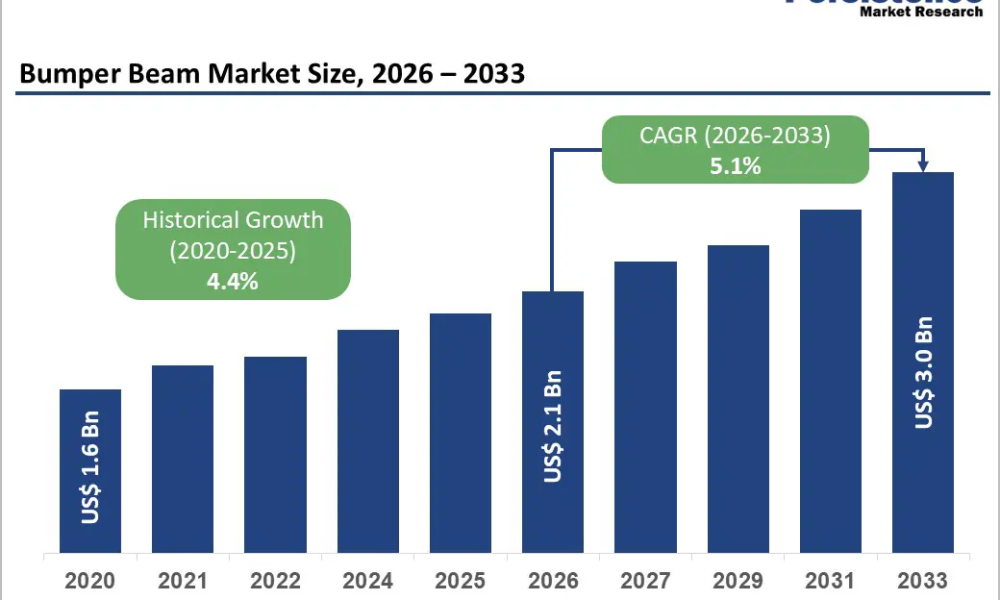
According to industry analysis referenced from Persistence Market Research, the global bumper beam market size is likely to be valued at US$2.1 billion in 2026 and is expected to reach US$3.0 billion by 2033, growing at a CAGR of 5.1% during the forecast period from 2026 to 2033. Market growth is being driven by increasing global vehicle production, stricter crash and passive safety regulations, and mounting pressure for lightweighting to meet fuel efficiency standards and support the transition to electric vehicles. Among product types, aluminum bumper beams are emerging as a leading segment due to their excellent strength-to-weight ratio. Geographically, Asia Pacific is anticipated to remain the dominant market due to large-scale automobile manufacturing and expanding vehicle ownership across emerging economies.
Get Your FREE Sample Report Instantly Click Now: https://www.persistencemarketresearch.com/request-customization/34086
Company Insights
Key players operating in the bumper beam market include:
- Magna International Inc.
- Benteler International AG
- Gestamp
- OPmobility
- Minth Group
- Hyundai Mobis
- Shape Corp.
- Kirchhoff Automotive
- Sungwoo Hitech
- Futaba Industrial Co., Ltd.
- AISIN Corporation
- thyssenkrupp AG
- Metalsa
- Toyoda Gosei Co., Ltd.
- CIE Automotive
Key Highlights from the Report
➤ The bumper beam market is projected to grow from US$2.1 billion in 2026 to US$3.0 billion by 2033 at a CAGR of 5.1%.
➤ Increasing global vehicle production is strengthening demand for advanced bumper beam systems in passenger and commercial vehicles.
➤ Strict crash safety regulations worldwide are encouraging automakers to adopt high-strength bumper beam structures.
➤ Lightweight materials such as aluminum and high-strength steel are becoming the preferred solutions in modern bumper beam manufacturing.
➤ The transition toward electric vehicles is creating new opportunities for lightweight bumper beam designs.
➤ Asia Pacific continues to lead the market due to strong automotive production and growing vehicle ownership.
Market Segmentation
By Material Type
- Steel
- Aluminum
- Composite/Plastic
By Position
- Front Bumper Beam
- Rear Bumper Beam
By Manufacturing Process
- Roll Forming
- Hot Stamping
- Extrusion
By Sales Channel
- OEM
- Aftermarket
By Region
- North America
- Europe
- East Asia
- South Asia & Oceania
- Middle East & Africa
- Latin America
Customize This Report for Your Exact Requirements: https://www.persistencemarketresearch.com/request-customization/34086
Regional Insights
Asia Pacific holds a prominent position in the bumper beam market due to the presence of major automotive manufacturing hubs and rising vehicle production. Countries in this region continue to witness strong growth in passenger vehicle demand, driven by urbanization, expanding middle-class populations, and increasing mobility needs. Automakers operating in Asia Pacific are focusing on improving safety features while optimizing vehicle weight to meet fuel efficiency and emission targets. As a result, demand for lightweight bumper beam solutions continues to rise across both domestic and export-oriented vehicle production.
North America and Europe also represent significant markets for bumper beam systems due to well-established automotive industries and strict vehicle safety regulations. These regions have been early adopters of advanced materials and structural safety technologies. Automotive manufacturers in these markets are investing heavily in research and development to produce stronger, lighter, and more energy-absorbing bumper beams. In addition, the rapid transition toward electric mobility in these regions is encouraging the integration of advanced lightweight components within vehicle structures.
Market Drivers
One of the major drivers of the bumper beam market is the increasing emphasis on vehicle safety and crashworthiness. Governments and regulatory bodies across the world have introduced stringent crash safety standards to reduce fatalities and injuries during accidents. Bumper beams play a crucial role in absorbing and distributing collision forces, thereby protecting passengers and minimizing structural damage to the vehicle. As crash test standards become more demanding, automotive manufacturers are upgrading bumper beam designs to improve performance under impact conditions.
Another key driver is the rising demand for lightweight vehicles aimed at improving fuel efficiency and reducing emissions. Automotive manufacturers are under constant pressure to meet stricter environmental regulations while maintaining vehicle performance and safety. Lightweight materials such as aluminum and high-strength steel allow manufacturers to reduce overall vehicle weight without compromising structural integrity. This shift toward lightweight automotive design is significantly increasing the adoption of advanced bumper beam technologies across the global market.
Market Restraints
Despite the positive outlook, the bumper beam market faces certain challenges that may limit its growth. One of the primary restraints is the fluctuating cost of raw materials used in manufacturing bumper beams. Materials such as aluminum and high-strength steel are subject to price volatility due to global supply chain dynamics and changes in demand from multiple industries. These cost fluctuations can increase production expenses and impact the overall profitability of automotive component manufacturers.
Another challenge is the complexity involved in designing bumper beams that meet both safety requirements and lightweighting goals. Advanced materials and innovative designs often require specialized manufacturing processes and engineering expertise. For some manufacturers, particularly smaller suppliers, investing in new technologies and production facilities can be financially demanding. As a result, adoption of advanced bumper beam solutions may progress gradually in certain markets.
Market Opportunities
The rapid growth of electric vehicles is creating significant opportunities for the bumper beam market. Electric vehicles require optimized structural designs to support battery systems while maintaining crash safety standards. Lightweight bumper beams are increasingly being integrated into EV architectures to enhance vehicle efficiency and protect critical components. This evolving automotive landscape is opening new avenues for manufacturers to develop specialized bumper beam solutions tailored to electric vehicle platforms.
Technological advancements in material science and manufacturing processes also present promising opportunities. Innovations such as advanced metal forming, hybrid material structures, and improved energy-absorbing designs are enabling manufacturers to enhance bumper beam performance. As automotive companies continue to invest in research and development, the market is expected to witness the introduction of next-generation bumper beams that combine lightweight properties with superior crash protection capabilities.
Frequently Asked Questions
➤ What are the main factors influencing the Bumper Beam Market growth?
➤ Which companies are the major sources in the bumper beam industry?
➤ What are the market’s opportunities, risks, and general structure in the Bumper Beam Market?
➤ Which top Bumper Beam Market companies compare in terms of sales, revenue, and prices?
➤ How are market types, applications, deals, revenue, and value explored in the Bumper Beam Market?
Ready to Dive Deep? Buy Full Report Today: https://www.persistencemarketresearch.com/checkout/34086
Recent Developments
- June 2024 – An automotive component manufacturer introduced a lightweight aluminum bumper beam designed to improve crash energy absorption while reducing vehicle weight.
- October 2023 – A global automotive supplier expanded its production capacity for advanced high-strength steel bumper beams to support increasing demand from electric vehicle manufacturers.
Future Opportunities and Growth Prospects
The bumper beam market is expected to experience steady growth as automakers continue to focus on improving safety, efficiency, and structural performance. The increasing adoption of lightweight materials, combined with evolving crash safety standards, will drive innovation in bumper beam design and manufacturing. Growing vehicle production, especially in emerging economies, will further strengthen market demand over the coming years.
In addition, the rapid expansion of electric vehicles is expected to reshape bumper beam development strategies. Manufacturers that invest in advanced materials, engineering capabilities, and scalable production technologies are likely to benefit from new growth opportunities. As automotive safety and efficiency remain top priorities, the bumper beam market is poised to play an increasingly vital role in the future of vehicle design and mobility.




