
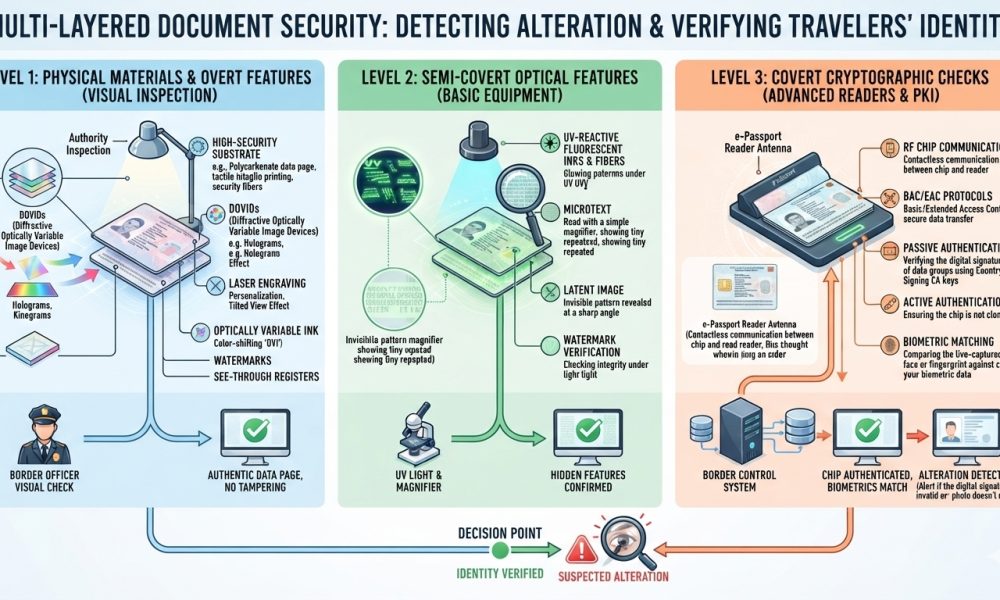
How document materials, optical features and cryptographic checks work together to help authorities detect alteration and verify travelers’ identities.
Washington, DC, October 3, 2026 — Modern passports rely on a layered security architecture that combines specialized physical materials, sophisticated optical features, machine-readable information, biometric data and cryptographic protections, allowing border authorities to evaluate both the document itself and the identity of the person presenting it.
Rather than relying on a single hologram, watermark, electronic chip, or database query, contemporary passport inspection generally involves several independent security mechanisms that reinforce one another, creating multiple opportunities for trained officers and automated systems to identify inconsistencies, unauthorized alterations, or counterfeit components.
This layered approach reflects a fundamental principle of secure document design: any individual security feature can be copied, damaged, or misunderstood, but reproducing an entire collection of coordinated physical and digital protections is far more difficult.
Physical Security Begins With the Passport Booklet
The first defensive layer lies in the passport’s physical construction, where governments use specialized substrates, security printing techniques, embedded features, and manufacturing processes designed to make authentic documents difficult to reproduce with ordinary commercial printing equipment.
Many modern passport data pages are made from durable polycarbonate rather than conventional laminated paper, allowing personal information, photographs, and security elements to be integrated directly into the material rather than printed on a removable surface.
Laser engraving can place biographical information and portraits inside multiple layers of a polycarbonate page, so an attacker trying to substitute a photograph or change identifying information may struggle to modify one element without damaging surrounding structures.
Traditional paper pages can also include sophisticated security elements, including watermarks, security fibers, ultraviolet-reactive designs, microprinting, fine-line backgrounds, and specialized inks that become visible only under particular lighting conditions or when viewed from specific angles.
These features give trained document examiners numerous visual and tactile reference points, allowing them to compare typography, printing quality, page construction, alignment, and optical characteristics against known examples of legitimately issued travel documents.
Optical Features Add Another Layer of Examination
Modern passports frequently incorporate optically variable features that change appearance when the document is tilted, illuminated differently, or viewed from another angle, making simple photographic reproduction substantially less useful for creating convincing counterfeit documents.
Diffractive devices, holographic elements, kinegrams and color-shifting features can display changing patterns, symbols or images that require specialized manufacturing methods and carefully controlled materials that ordinary desktop printers and scanners cannot accurately reproduce.
Some passport designs also include multiple versions of the holder’s portrait, including a primary photograph, smaller secondary images and laser-generated portraits, which allow inspectors to compare facial representations produced through different manufacturing techniques.
Under ultraviolet illumination, additional hidden patterns, fibers, symbols, and artwork may appear across passport pages, giving trained examiners another way to identify documents whose visible appearance might initially seem convincing under normal white light.
Because these optical features operate independently of electronic systems, they remain valuable even when a chip cannot be read immediately, a network connection is unavailable, or an officer needs to determine whether the physical booklet itself appears consistent with genuine production standards.
Machine-Readable Information Supports Automated Checks
The machine-readable zone near the bottom of a passport’s data page allows inspection systems to quickly capture standardized biographical information, including the holder’s name, passport number, nationality, date of birth, sex, and document expiration date.
The standardized structure in this area follows specifications developed through the International Civil Aviation Organization’s travel document framework, enabling border systems worldwide to interpret essential passport data using a common technical format.
Check digits incorporated into the machine-readable zone provide mathematical consistency checks that can help systems identify certain transcription errors or basic alterations. However, those calculations alone cannot establish whether a document was genuinely issued by the government identified on its cover.
Border inspection therefore combines machine-readable information with other evidence, including the printed data page, electronic chip contents, physical security features, government databases and biometric comparisons, producing a much stronger assessment than any single data source could provide independently.
The Electronic Chip Extends Security Into the Digital Layer
Biometric passports contain a contactless electronic chip that stores standardized data associated with the passport holder, usually including information from the printed data page and a digital version of the facial photograph used for identity comparison.
Depending on the issuing country and document generation, additional biometric information may also be supported under applicable legal and technical frameworks. However, access controls and national policies determine which biometric records can be stored or retrieved.
When compatible inspection equipment successfully reads the chip, officers and automated border systems can compare electronically stored information against the visible information printed on the passport, making inconsistencies between the physical and digital versions easier to identify.
This comparison can reveal situations in which a physical data page has been altered. At the same time, the electronic information may remain unchanged, or copied electronic information may conflict with the visible identity information elsewhere in the booklet.
For travelers interested in understanding how electronic passports operate, the Amicus International Consulting guide to passport security and modern counterfeit detection explains how physical inspection, chip examination, and identity verification contribute to a broader security assessment.
Cryptographic Signatures Help Establish Data Authenticity
One of the most important digital protections in an electronic passport is cryptographic signatures, which allow inspection systems to determine whether the chip data was digitally signed through the legitimate issuing authority’s passport infrastructure.
During electronic inspection, compatible systems can examine the digital signature associated with the passport’s stored data and evaluate whether that information has been changed since the document was issued.
Participating governments can exchange the certificates needed for international validation through mechanisms such as the ICAO Public Key Directory, which supports cross-border verification of electronic passport signatures without requiring countries to rely solely on bilateral certificate exchanges.
Successful cryptographic validation does not eliminate the need to examine the traveler or the physical booklet, because electronic authenticity is only one component of the broader process used to establish document integrity and identity.
The system’s strength comes from combining these separate controls, because a document may contain correctly formatted data while showing suspicious physical characteristics, or it may physically resemble a genuine passport while failing key electronic Authentication procedures.
Facial Comparison Connects the Document to the Traveler
Authenticating a passport establishes whether the document and its stored information appear legitimate. Still, border authorities must separately determine whether the person presenting the passport is actually the individual to whom the document was issued.
Officers traditionally make this comparison visually by comparing the traveler’s face with the portrait printed on the passport. At the same time, many airports now supplement human inspection with automated facial comparison technology at kiosks and electronic border gates.
Automated systems may capture a live facial Image and compare it with the portrait stored inside the passport chip, producing a similarity assessment that helps authorities determine whether the traveler appears consistent with the enrolled passport holder.
Facial comparison represents a distinct security function from chip Authentication, because a passport can contain valid digitally signed information while still being presented by someone who is not the legitimate holder of that document.
For this reason, sophisticated border inspection treats document authenticity and identity verification as related but separate questions, requiring systems to evaluate both before deciding whether the traveler satisfies entry or departure requirements.
Database Checks Provide Additional Context
After obtaining passport information, border authorities may also check immigration systems, lost-and-stolen passport databases, national security records, visa databases, and other authorized sources, depending on national law and the circumstances of the traveler’s journey.
These database queries serve a different purpose than physical passport examination, because they can reveal whether an otherwise authentic document has been reported lost, stolen, canceled, revoked, or associated with another administrative or security concern.
A genuine passport can therefore fail an immigration inspection for reasons unrelated to counterfeiting. At the same time, a professionally fabricated document can still be detected because physical, electronic, or database information does not align with legitimate government records.
Understanding this distinction matters because passport security involves more than judging whether a booklet looks convincing, as authorities increasingly evaluate the document as part of a larger identity and information ecosystem.
No Single Feature Determines Authenticity
A common misunderstanding involves treating one successful security check as definitive proof that a passport is authentic, even though professional document examination typically relies on several complementary features and independent verification methods.
A readable machine-readable zone does not prove legitimate issuance, a visible hologram does not establish that the data page has not been altered, and an electronic chip that responds to an NFC reader does not automatically prove that every component of the passport is genuine.
Similarly, an unsuccessful smartphone NFC scan does not automatically establish that a passport is counterfeit, because reading difficulties can result from device positioning, antenna location, protective covers, chip damage, software compatibility or incorrect scanning procedures.
Professional examination therefore focuses on consistency across multiple layers, asking whether physical materials, printing characteristics, machine-readable information, chip data, cryptographic signatures, biometric information, and government records collectively support the same identity and document history.
Layered Security Makes Counterfeiting Increasingly Difficult
The evolution of passport security demonstrates how governments have moved from primarily visual identity documents toward integrated security platforms that combine advanced manufacturing techniques with cryptographic technology and increasingly sophisticated biometric verification systems.
Counterfeiters attempting to imitate these documents must therefore reproduce far more than a photograph and printed data page, because modern inspection can examine materials, optical effects, ultraviolet features, machine-readable information, chip contents, digital signatures and biometric relationships.
Even when one security feature is copied convincingly, inconsistencies elsewhere may give inspectors evidence that the document deserves additional examination, which is why modern passport security emphasizes overlapping protections rather than relying on one supposedly impossible-to-copy element.
For legitimate travelers, these protections generally operate quietly in the Background, allowing inspection systems to authenticate documents quickly while helping governments protect identities, detect altered travel documents, and maintain confidence in international passport issuance systems.
As passport technology continues evolving, the strongest security model will remain one built around coordinated physical and digital defenses, because combining independent verification methods gives authorities substantially more information than any single hologram, database search, biometric comparison,n or electronic chip could provide alone.




