
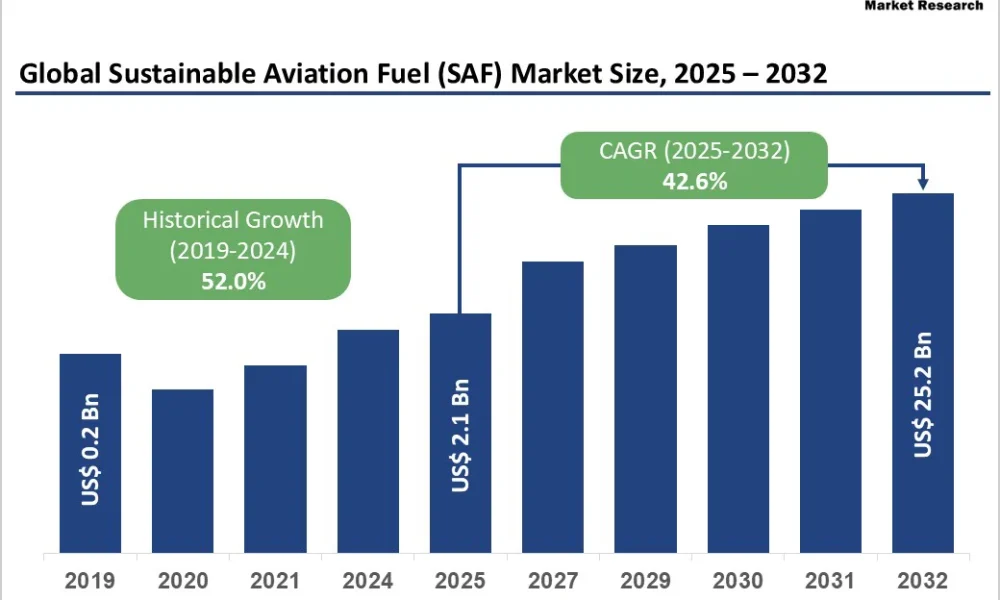
The global Sustainable Aviation Fuel Market is entering a transformative growth phase as the aviation sector accelerates efforts to decarbonize operations. According to Persistence Market Research, the market is likely to be valued at US$ 2.1 billion in 2025 and is projected to reach US$ 25.2 billion by 2032. This extraordinary expansion reflects the rising adoption of sustainable aviation fuel across commercial airlines, cargo operators, and defense aviation. The shift toward low carbon aviation fuel is being reinforced by regulatory frameworks and airline sustainability commitments aimed at reducing lifecycle greenhouse gas emissions. As the aviation industry aligns with global climate targets, SAF is emerging as a critical pathway to reduce reliance on conventional jet fuel while maintaining operational efficiency.
The market is expected to grow at a CAGR of 42.6% between 2025 and 2032, demonstrating one of the fastest growth trajectories within the renewable energy and aviation sectors. This growth is strongly influenced by stringent aviation decarbonization mandates and the industry’s commitment to achieve net zero carbon emissions by 2050, as endorsed by the International Civil Aviation Organization and the International Air Transport Association. Increasing investment in production capacity, supportive government incentives, and advancements in feedstock processing technologies are strengthening the sustainable aviation fuel ecosystem. Commercial airlines represent the leading end user segment due to large fuel consumption volumes, while North America leads geographically owing to early regulatory adoption and infrastructure readiness.
Explore Full Report Quality – Free Sample Inside : https://www.persistencemarketresearch.com/samples/35851
Key Highlights from the Report
➤ Rapid expansion of the sustainable aviation fuel market driven by net zero aviation targets by 2050
➤ Market projected to surge from US$ 2.1 billion in 2025 to US$ 25.2 billion by 2032
➤ Strong CAGR of 42.6% anticipated between 2025 and 2032
➤ Commercial aviation emerges as the leading end user segment due to high fuel demand
➤ North America dominates market share supported by favorable regulatory frameworks
➤ Rising investments in production capacity and alternative feedstock technologies accelerate adoption
Market Segmentation
The Sustainable Aviation Fuel Market is segmented primarily based on product type and end user. In terms of product type, the market includes bio based aviation fuel derived from various renewable feedstocks and advanced synthetic fuel pathways developed to reduce carbon intensity. Bio based fuels currently account for the dominant share due to established production processes and compatibility with existing aircraft engines. Synthetic aviation fuel technologies are gaining attention as innovation improves scalability and cost efficiency. The growing focus on lifecycle emission reduction continues to shape product development strategies. Producers are also emphasizing drop in fuel compatibility to avoid significant modifications in aircraft infrastructure. This segmentation reflects the industry’s need for scalable, reliable, and environmentally sustainable fuel alternatives.
From an end user perspective, commercial airlines represent the leading segment, driven by high fuel consumption volumes and strong sustainability pledges. Cargo carriers are increasingly adopting sustainable aviation fuel to meet corporate environmental goals and regulatory standards. Defense and military aviation are gradually integrating SAF blends to reduce operational carbon footprints. Business aviation operators are also exploring sustainable fuel procurement to enhance brand reputation and comply with emerging environmental norms. The demand dynamics differ across segments depending on fleet size, route networks, and sustainability mandates. As adoption broadens, long term supply agreements between fuel producers and airlines are becoming a defining trend in the market landscape.
Regional Insights
North America leads the Sustainable Aviation Fuel Market due to proactive policy implementation and early adoption of low carbon aviation initiatives. Strong collaboration between fuel producers, airlines, and regulatory bodies has accelerated infrastructure development. The presence of advanced refining capabilities and government backed incentives further supports regional growth. Airlines in the region are actively securing sustainable fuel supply contracts to meet emission reduction targets. Continuous investment in research and development also strengthens production scalability. These factors collectively position North America as the dominant regional market.
Europe represents another significant region driven by ambitious climate policies and sustainability mandates within the aviation sector. Regulatory alignment with global decarbonization goals encourages airlines to integrate sustainable aviation fuel into operations. Increasing public awareness of carbon emissions from air travel is pushing carriers to adopt greener alternatives. Collaborative industry initiatives and cross border policy frameworks further enhance SAF uptake. Regional governments are actively promoting renewable energy integration across transport sectors. As a result, Europe remains a critical growth contributor to the global market.
Want Specific Data? Request Report Customization : https://www.persistencemarketresearch.com/request-customization/35851
Market Drivers
The primary driver of the Sustainable Aviation Fuel Market is the aviation industry’s commitment to achieving net zero carbon emissions by 2050. This commitment, endorsed by the International Civil Aviation Organization and the International Air Transport Association, has intensified the need for alternative aviation fuels. Airlines are under mounting pressure from regulators, investors, and consumers to reduce carbon footprints. Sustainable aviation fuel offers significant lifecycle emission reductions compared to conventional jet fuel. Regulatory mandates are compelling carriers to incorporate SAF blends into regular operations. These factors collectively stimulate consistent demand growth.
Additionally, stringent decarbonization policies across major aviation markets are accelerating fuel transition strategies. Governments are implementing supportive frameworks to encourage sustainable fuel production and consumption. Investment inflows into renewable fuel infrastructure are expanding production capacity. Technological advancements are improving conversion efficiency and feedstock utilization. Growing awareness about climate change impacts on the aviation sector further reinforces the urgency of adoption. Together, these drivers create a strong foundation for long term market expansion.
Market Restraints
Despite rapid growth, the Sustainable Aviation Fuel Market faces challenges related to high production costs. Sustainable fuel manufacturing remains more expensive than conventional jet fuel due to feedstock procurement and refining complexities. Limited large scale production facilities constrain supply availability. Airlines may face financial pressure when integrating higher cost fuel alternatives. Infrastructure readiness varies across regions, creating uneven adoption rates. These factors pose short to medium term constraints.
Another significant restraint involves feedstock availability and supply chain complexities. Competition for renewable raw materials can affect production consistency. Scaling advanced fuel technologies requires substantial capital investment. Certification and regulatory compliance processes may extend commercialization timelines. Market participants must also address logistical challenges in fuel distribution networks. Overcoming these constraints will be essential for sustained growth momentum.
Market Opportunities
The Sustainable Aviation Fuel Market presents substantial opportunities through expanding production capacity and technological innovation. Increasing collaboration between fuel producers and airlines is fostering long term supply agreements. Advancements in feedstock diversification are enhancing scalability. Investments in refining infrastructure are expected to reduce production costs over time. Emerging economies offer untapped potential for sustainable aviation initiatives. These developments open new avenues for market participants.
Furthermore, growing corporate sustainability commitments create additional demand for low carbon aviation fuel. Airlines adopting green branding strategies are likely to expand SAF procurement. Policy support and international climate agreements will continue to strengthen adoption rates. Strategic partnerships across the value chain can accelerate commercialization. As production efficiency improves, cost competitiveness will enhance market penetration. These opportunities collectively reinforce the market’s strong growth outlook.
Complete Your Order – Get Full Report Immediately : https://www.persistencemarketresearch.com/checkout/35851
Company Insights
Key players operating in the Sustainable Aviation Fuel Market include
- Total Energies
- Lanza Tech
- Neste Oyj
- World Energy
- Flucrum Bioenergy
- BP Plc
- Northwest Advanced Biofuels LLC
- Aemetis, Inc
- Alder Energy
- Gevo Inc
- Red Stock biofuel
- WaasteFuels
- SkyNRG BV
- Shell Plc
- Preem AB
- LanzaJet
- Montana Renewables
- Phillips 66
- DG Fuels
- Diamond Green Diesel
Recent Developments:
January 2024
March 2024
Future Opportunities and Growth Prospects
The Sustainable Aviation Fuel Market is positioned for exponential expansion as the aviation sector intensifies decarbonization efforts. With strong regulatory backing, industry commitments, and technological progress, sustainable aviation fuel will remain central to global aviation sustainability strategies. As production capacity scales and cost structures improve, broader adoption across commercial and defense aviation is anticipated. The projected surge from US$ 2.1 billion in 2025 to US$ 25.2 billion by 2032 underscores the transformative potential of sustainable aviation fuel in reshaping the future of air transport.




