
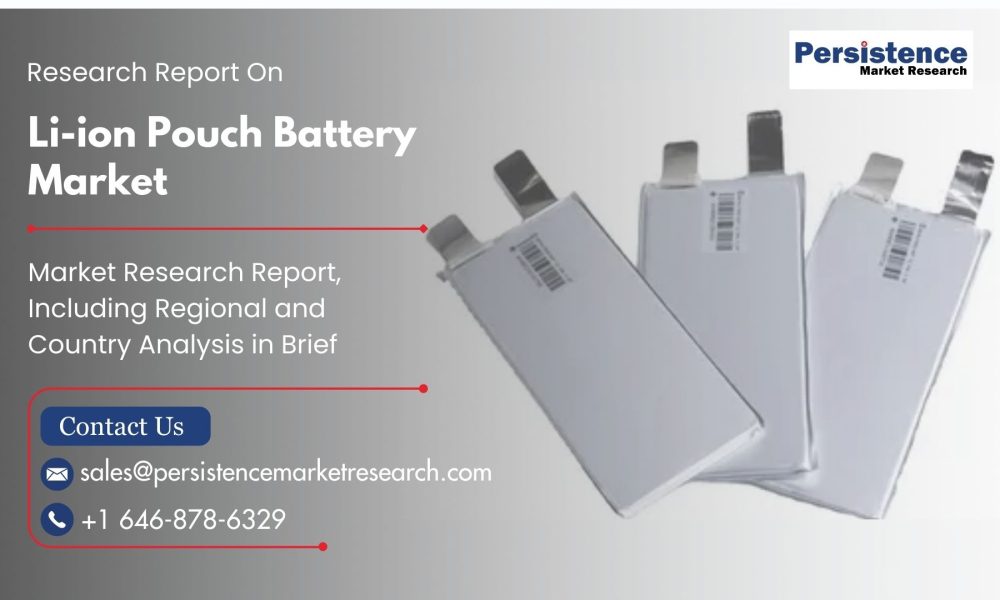
Li-Ion Pouch Battery Market: Powering the Next Generation of Energy Storage
In an era defined by electrification, sustainability initiatives, and rapid innovation in energy technologies, lithium-ion batteries are at the heart of the global clean energy transition. Among these, Li-ion pouch batteries have emerged as a highly preferred format due to their lightweight design, flexible packaging, and high energy density — making them indispensable in electric vehicles (EVs), consumer electronics, energy storage systems (ESS), and a range of industrial applications. This blog explores the current dynamics, growth prospects, segmentation, key drivers, challenges, and future trajectory of the global Li-ion pouch battery market.
What Are Li-Ion Pouch Batteries?
Li-ion pouch batteries are a type of lithium-ion cell where the electrodes and separators are enclosed within a flexible, laminated foil pouch rather than rigid metal cases. This design offers multiple advantages, including reduced weight, enhanced design flexibility, and the ability to pack cells more efficiently — crucial for compact and lightweight battery systems. Their configuration enables higher energy density and custom form factors, supporting applications from sleek smartphones to large EV battery packs and grid-scale storage units.
Get Your FREE Sample Report Instantly – Click Now: https://www.persistencemarketresearch.com/samples/32488
Market Size and Forecast
The global Li-ion pouch battery market has shown remarkable growth and is expected to continue its upward trajectory. In 2025, the market was valued at approximately US$48.5 billion and is projected to grow to US$104.6 billion by 2032, at a strong compound annual growth rate (CAGR) of around 11.6% over this period. This expansion underscores the accelerating adoption of battery-powered applications across multiple sectors.
This growth is underpinned by rising EV adoption, expanding renewable energy storage needs, and increasing demand for lightweight, high-performance batteries in electronics — positioning pouch batteries as a core technology in the future of energy storage.
Key Market Drivers
- Electrification of Transportation
One of the strongest drivers for Li-ion pouch batteries is the rapid shift toward electric mobility. Electric vehicles increasingly rely on high-capacity battery packs that maximize energy storage while minimizing weight — a combination where pouch batteries excel. Advanced battery chemistries and packaging configurations improve vehicle range, safety, and performance, bolstering demand from EV manufacturers globally.
Government incentives and stringent emission norms are catalyzing EV adoption, particularly in major markets like China, the United States, and Europe. Policies designed to phase out internal combustion engine vehicles have significantly increased investments in battery technologies, directly contributing to the growth of pouch battery production and application.
- Renewable Energy Storage Expansion
As nations expand renewable energy infrastructures, efficient energy storage solutions become vital to balance production and demand — especially for intermittent sources like solar and wind. Li-ion pouch batteries are increasingly integrated into energy storage systems (ESS) due to their scalability and efficient performance. These systems help stabilize grids, enhance energy reliability, and support decentralized energy networks, further accelerating demand.
- Rising Consumer Electronics Adoption
Beyond automotive and energy storage applications, pouch batteries are widely used in consumer electronics such as smartphones, laptops, tablets, and wearable devices. Their flexible form factors allow for slimmer and lighter device designs, meeting consumer expectations for portability without compromising battery life. This trend has contributed to consistent growth in this segment, and the demand is expected to continue rising with technological advancements and expanding use cases.
Get a Customized Market View in One Click: https://www.persistencemarketresearch.com/request-customization/32488
Market Segmentation Insights
Capacity and Voltage Trends
The market is segmented across various capacity ranges, with the 50–100 Ah segment holding a significant share. Batteries in this range strike an optimal balance between energy density and practical applicability, particularly for EVs and stationary storage solutions. Likewise, 48 V rated systems are popular due to their broad compatibility with automotive and ESS infrastructure, delivering efficient performance without the safety complications of higher voltage architectures.
Chemistry Preferences
Chemical composition plays a crucial role in performance and application suitability. Lithium iron phosphate (LiFePO₄) chemistry is emerging as a dominant choice thanks to its thermal stability, safety, and cycle durability — essential for both automotive and high-demand storage applications. These attributes make LiFePO₄ pouch batteries particularly attractive where safety and longevity are prioritized over maximum energy density alone.
End-User Segments
The electric vehicle segment constitutes the largest share of demand, accounting for over half of the market revenue. This dominance reflects the direct relationship between EV production growth and battery demand. Consumer electronics follow as another major segment, driven by consistent demand for compact, high-performance power solutions in portable devices. Other emerging applications include robotics, medical devices, and industrial systems that benefit from the lightweight and customizable properties of pouch cells.
Regional Market Dynamics
North America
North America represents a leading market with roughly 27% share in 2025, propelled by significant government investments in battery manufacturing, recycling infrastructure, and EV adoption incentives. Research collaborations and public funding initiatives are fostering innovation and domestic capacity growth, reducing dependency on imported battery components.
Europe
Europe’s growth is driven by regulatory emphasis on sustainability, safety standards, and renewable energy integration. Comprehensive battery regulations, including carbon footprint requirements and recycling mandates, are shaping the future of battery manufacturing in the region, encouraging sustainable practices and boosting demand for advanced battery formats like pouch cells.
Asia Pacific
Asia Pacific is the fastest-growing region, with significant investments in EV manufacturing and battery production infrastructure. Countries like China, Japan, South Korea, and India are expanding capacity and technological competencies. China remains a dominant force, while India’s focus on domestic battery production under national initiatives is creating new growth corridors.
Challenges Facing the Market
Despite strong growth prospects, the Li-ion pouch battery market faces several challenges:
- High manufacturing costs and raw material price volatility — particularly for lithium, cobalt, and nickel — can constrain affordability and production scaling.
- Safety and thermal management issues require advanced battery management systems (BMS) and protective solutions, increasing overall system complexity and cost.
- Supply chain constraints, geopolitical dependencies, and recycling challenges could impact long-term material availability and cost structures.
Future Outlook and Opportunities
The future of the Li-ion pouch battery market is characterized by continuous innovation and expanding application territories:
- Next-Generation Technologies: Emerging technologies like anode-free batteries and advanced cathode materials can deliver higher capacities and longer life cycles.
- Sustainability Focus: Enhanced recycling processes and circular economy approaches will become crucial as battery deployment scales.
- New Application Frontiers: Beyond EVs and consumer electronics, sectors like medical devices, IoT, aerospace, and off-grid power solutions are poised to adopt pouch battery formats due to their lightweight and adaptable design.
For In-Depth Competitive Analysis, Buy Now: https://www.persistencemarketresearch.com/checkout/32488
Conclusion
The global Li-ion pouch battery market is on track for robust growth, underpinned by electrification trends, renewable energy integration, and ongoing innovation in energy storage technologies. With strong demand from electric vehicles, energy storage systems, and consumer electronics, the market is expected to more than double by 2032. While challenges in manufacturing costs and raw material supply persist, strategic investments in innovation, sustainability, and regional infrastructure development will continue to drive this dynamic market forward — positioning Li-ion pouch batteries as a cornerstone of future energy systems worldwide.
About Persistence Market Research:
Persistence Market Research delivers strategic research solutions that drive business growth. Founded in 2012 and registered in England and Wales in 2023 as Persistence Research & Consultancy Services Ltd., we have completed 3,600+ custom and syndicated studies and supported 2,700+ projects for leading research firms. Combining traditional methodologies with modern tools, we provide actionable insights to multinational corporations, consultants, investors, and government bodies, earning strong trust through long-term client relationships.
Contact Us:
Persistence Market Research
Second Floor, 150 Fleet Street,
London, EC4A 2DQ, United Kingdom
USA Phone: +1 646-878-6329
UK Phone: +44 203-837-5656
Email: [email protected]
Web: https://www.persistencemarketresearch.com




