
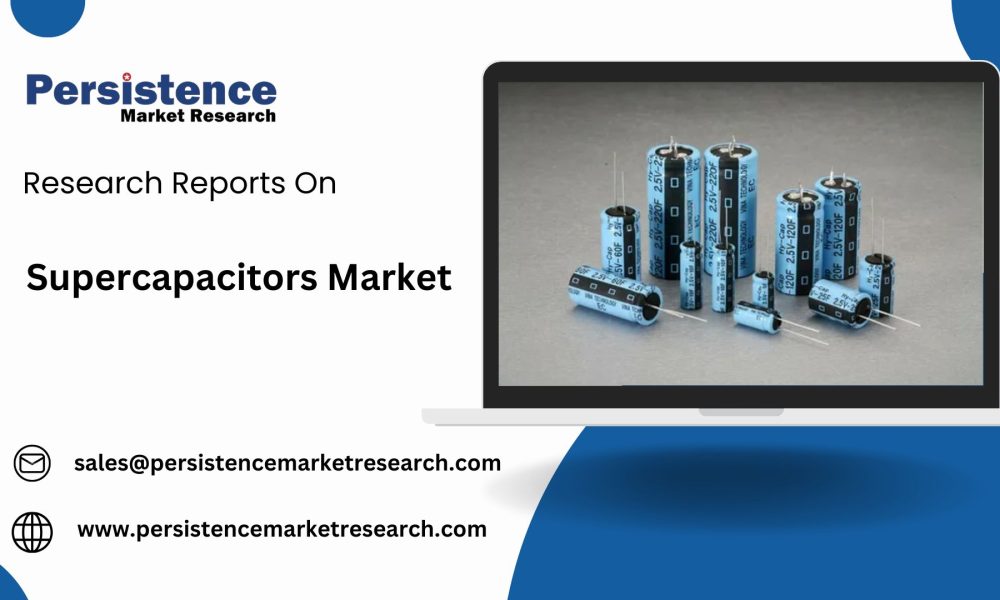
The global energy storage landscape is undergoing a rapid transformation, with supercapacitors emerging as one of the most promising technologies for bridging the gap between traditional batteries and capacitors. Known for their high power density, rapid charging capabilities, and long lifecycle, supercapacitors are increasingly being adopted across industries ranging from automotive and consumer electronics to renewable energy and industrial applications.
According to market insights, the global supercapacitors market size is projected to be valued at US$ 2.4 billion in 2025 and is expected to reach US$ 8.2 billion by 2032, growing at a robust CAGR of 19.2% during the forecast period (2025–2032). This growth is propelled by the rising demand for high-efficiency energy storage solutions, advancements in material science, and their expanding role in next-generation applications.
Historical Growth: Building the Foundation
Supercapacitors are not new to the market; their development traces back decades. However, their commercial adoption has accelerated since 2019, when the market was valued at US$ 0.7 billion. Between 2019 and 2024, the industry witnessed a strong CAGR of 17.8%, driven primarily by:
- Growing focus on electrification in the automotive sector, including electric vehicles (EVs), hybrid electric vehicles (HEVs), and regenerative braking systems.
- Rising investments in renewable energy storage to support grid stability and enhance energy efficiency.
- Increasing demand in portable electronics, where supercapacitors complement or replace conventional batteries.
This solid historical growth has laid the foundation for the strong trajectory predicted from 2025 to 2032.
Market Size and Future Outlook
- 2025 Valuation: US$ 2.4 billion
- 2032 Projection: US$ 8.2 billion
- CAGR (2025–2032): 19.2%
This expansion underscores how supercapacitors are set to evolve from niche energy storage components into mainstream solutions for industries seeking sustainable, efficient, and reliable alternatives to conventional batteries.
Regional Insights
- Asia Pacific – The Global Leader
Asia Pacific is projected to dominate the supercapacitors market in 2025 with a 42% market share. Several factors drive this dominance:
- China and Japan lead in automotive production and renewable energy investments.
- Robust industrialization and manufacturing ecosystems that enable large-scale adoption.
- Government-backed clean energy initiatives supporting energy-efficient storage technologies.
As Asia Pacific continues to expand its EV industry and strengthen renewable energy infrastructure, the region is expected to retain its leadership throughout the forecast period.
- North America – The Fastest Growing Market
North America is set to emerge as the fastest-growing region for supercapacitors, fueled by:
- Technological innovation, especially in material science and nanotechnology.
- Strong government support for clean energy projects and grid modernization.
- Rising adoption of supercapacitor-based solutions in industrial machinery and EVs.
The U.S., in particular, is investing heavily in battery alternatives and hybrid energy storage systems, making supercapacitors a key part of its sustainability roadmap.
Market Segmentation Insights
By Product Type: Double Layer Capacitors Take the Lead
Among product types, Double Layer Capacitors (EDLCs) are expected to command nearly 48% of the market share in 2025. Their advantages include:
- High energy density compared to other capacitor types.
- Widespread adoption in automotive and renewable energy storage systems.
- Proven reliability for applications requiring frequent charge-discharge cycles.
While EDLCs lead the market, hybrid capacitors are gaining traction, offering a balance between energy density and power output.
By Material: Conducting Polymers as the Fastest Growing Segment
In terms of materials, conducting polymers are expected to be the fastest-growing category. Their popularity stems from:
- Cost-effectiveness compared to advanced carbon-based materials.
- Flexibility, making them suitable for emerging applications like wearable electronics and flexible devices.
- Compatibility with next-generation energy storage technologies.
Carbon-based materials, however, continue to dominate the market due to their efficiency and scalability.
By Application: Automotive Leads the Way
The automotive sector remains the largest application area, accounting for over 40% of global revenue in 2025. The rising adoption of EVs and HEVs makes supercapacitors indispensable for:
- Regenerative braking systems
- Quick acceleration and peak power delivery
- Extending battery lifespan by handling high power demands
Beyond automotive, consumer electronics, industrial machinery, and renewable energy systems represent growing applications. For instance, supercapacitors are increasingly used in wind turbines, solar systems, and IoT devices.
Elevate your business strategy with comprehensive market data. Request a sample report now: https://www.persistencemarketresearch.com/samples/9176
Key Market Drivers
- Surge in Electric Vehicle Adoption
With governments worldwide pushing for EV adoption, supercapacitors are playing a crucial role in supporting regenerative braking, improving efficiency, and enhancing power delivery. - Growing Renewable Energy Integration
Supercapacitors are being used in wind and solar power plants to stabilize energy output and reduce dependency on fossil fuels. - Advancements in Material Technology
The development of graphene-based and polymer-based supercapacitors is enhancing performance, lowering costs, and broadening application areas. - Demand for Fast-Charging Solutions
Consumers and industries are demanding instant charging and high-power delivery, which supercapacitors can provide more efficiently than conventional batteries. - Integration with IoT and Smart Grids
Supercapacitors are increasingly being integrated into IoT systems, sensors, and smart grids, opening new opportunities for energy-efficient and sustainable solutions.
Market Challenges
While growth prospects are strong, the supercapacitors market faces several challenges:
- High manufacturing costs, particularly for advanced materials like graphene.
- Limited energy density compared to traditional lithium-ion batteries.
- Integration complexity in existing energy storage and automotive systems.
- Competition from emerging battery technologies, such as solid-state batteries.
Addressing these challenges will be critical for sustained market expansion.
Emerging Opportunities
The next wave of growth for the supercapacitors market will come from:
- Wearable Electronics
Flexible and lightweight supercapacitors made with conducting polymers are poised to revolutionize smart wearables and medical devices. - Public Transportation
Supercapacitors can power electric buses, trams, and trains, offering cost-effective and sustainable alternatives to traditional batteries. - Grid Modernization
Integration into smart grids will enhance load balancing, improve efficiency, and ensure reliable power delivery. - IoT and Edge Devices
As billions of IoT devices come online, supercapacitors will enable low-maintenance, high-efficiency power solutions.
Competitive Landscape
The supercapacitors market is highly competitive, with companies focusing on innovation and strategic partnerships. Key strategies include:
- Developing graphene and polymer-based supercapacitors for higher efficiency.
- Collaborating with automotive manufacturers to enhance EV performance.
- Expanding into renewable energy and industrial automation markets.
Prominent players include Maxwell Technologies, Skeleton Technologies, Panasonic, Eaton, and CAP-XX, each investing heavily in R&D and capacity expansion.
Conclusion
The supercapacitors market is on a fast track to growth, driven by electrification trends, renewable energy integration, and technological innovation. With the market expected to grow from US$ 2.4 billion in 2025 to US$ 8.2 billion by 2032 at a CAGR of 19.2%, the opportunities for businesses and innovators are vast.
As supercapacitors continue to evolve, their integration into EVs, smart grids, IoT devices, and wearable electronics will redefine the global energy storage landscape. Companies that invest early in advanced materials, cost optimization, and application expansion are set to lead the next era of energy storage solutions.
Related Reports:




