
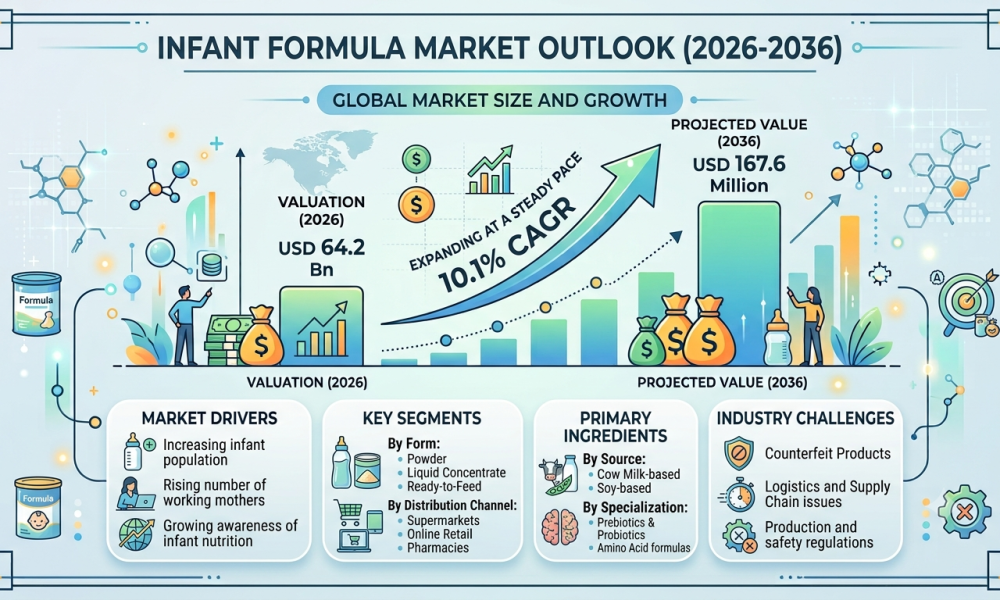
The global infant formula market is projected to grow from USD 64.2 billion in 2026 to USD 167.6 billion by 2036, registering a 10.1% CAGR during the forecast period. Demand is supported by the growing use of formula as primary or supplemental infant nutrition, rising demand for specialized formulations, premium ingredients such as human milk oligosaccharides (HMOs), lactoferrin and probiotics, and the expansion of convenient ready-to-feed formats. Working mothers and dual-income households are also supporting demand for infant formula as a practical feeding option.
Product innovation is creating additional opportunities for manufacturers, particularly through premium recipes and formulations designed around specific feeding needs. Companies are increasingly focusing on functional ingredients, formulation evidence, supply-chain control, and convenient formats. At the same time, stringent regulatory requirements and safety concerns are increasing the importance of ingredient traceability, manufacturing controls, and transparent product claims.
Get detailed market forecasts, competitive benchmarking, and pricing trends: https://www.futuremarketinsights.com/reports/sample/rep-gb-838
Global Segment Leaders
- Product Type – Starting Milk Formula: 50.0% in 2026. The segment leads as starting formula is widely used for primary or supplemental nutrition, particularly among working mothers seeking convenient feeding options.
- Distribution Channel – Pharmacy Stores and Supermarkets: 50.0% in 2026. These channels remain important because of broad accessibility, reliable product availability, and their role as key consumer purchasing points.
Country-Level Performance
Germany is projected to grow at the fastest pace among the profiled countries, with a 12.8% CAGR through 2036. Growth is supported by premium formula demand and increasing emphasis on evidence-backed product claims, despite declining birth numbers.
The United Kingdom is expected to record a 12.2% CAGR, supported by demand for products offering clear nutritional value, while changing shelf-placement and pricing considerations continue to shape the market.
South Korea is forecast to grow at a 10.4% CAGR, supported by a 6.8% increase in births in 2025 to 254,500, creating a larger demand base for infant nutrition products.
The United States is projected to expand at a 9.8% CAGR, with supply resilience, ready-to-feed formats, and product innovation supporting market value despite declining birth numbers.
Japan is forecast to grow at a 7.6% CAGR, with convenience-focused and compliant products supporting demand in a market facing continued declines in births.
Regional Context
Germany and the United Kingdom represent the faster-growing European markets, with CAGRs of 12.8% and 12.2%, respectively. Growth in these markets is increasingly influenced by premium formulation value, evidence-backed claims, pricing considerations, and regulatory developments rather than newborn volumes alone.
South Korea and the United States are projected to grow close to the global market rate, with CAGRs of 10.4% and 9.8%, respectively. South Korea benefits from improving birth trends, while the United States is seeing greater emphasis on ready-to-feed formats, supply continuity, and product innovation.
Japan records the lowest CAGR among the five profiled countries at 7.6%, reflecting persistent demographic pressure from declining births. Manufacturers are therefore focusing on targeted formulations, compliance, convenience, and higher value per feed.
The full report covers North America, Latin America, Western Europe, Eastern Europe, East Asia, South Asia and Pacific, and the Middle East and Africa, with more than 30 countries covered, including the USA, UK, Germany, Japan, and South Korea.
Access full Report in PDF Format@ https://www.futuremarketinsights.com/reports/brochure/rep-gb-838
Competitive Landscape
The competitive landscape includes Nestlé S.A., Danone S.A., Abbott Laboratories, Reckitt Benckiser Group (Mead Johnson Nutrition), FrieslandCampina, China Feihe Limited, The a2 Milk Company, and Bright Dairy & Food Co., Ltd. The market includes global infant nutrition platforms, dairy-integrated premium formula suppliers, and brands differentiated by milk source, with competition shaped by formulation evidence, manufacturing control, local registration, supply-chain resilience, product formats, and geographic reach.
Recent developments include Nestlé’s June 2025 rollout of NAN Sinergity, combining probiotics with six HMOs across Latin America and the Middle East. In April 2026, Mead Johnson Nutrition and Mass General Brigham announced a five-year research program focused on human milk composition and pediatric nutrition for premature and vulnerable infants. In August 2026, Abbott launched Similac 360 Total Care Made With Whole Milk, a sterile ready-to-feed formula positioned close to Abbott’s powder on a per-feed basis.
About Future Market Insights (FMI)
Future Market Insights, Inc. (ESOMAR certified, recipient of the Stevie Award, and a member of the Greater New York Chamber of Commerce) offers profound insights into the driving factors that are boosting demand in the market. FMI stands as the leading global provider of market intelligence, advisory services, consulting, and events for the Packaging, Food and Beverage, Consumer Technology, Healthcare, Industrial, and Chemicals markets. With a vast team of over 400 analysts worldwide, FMI provides global, regional, and local expertise on diverse domains and industry trends across more than 110 countries.



