
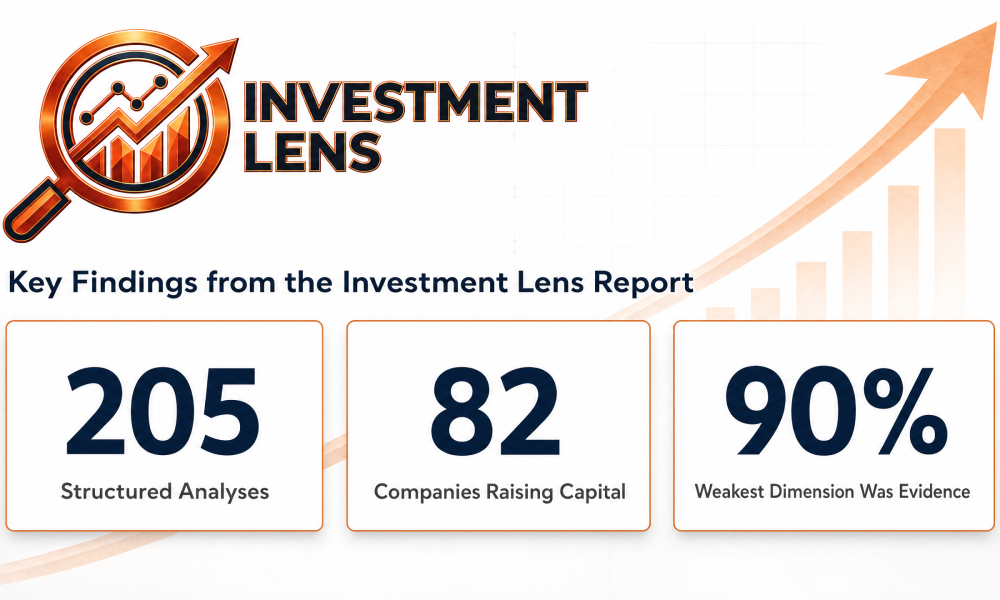
Redtail Capital publishes findings from 205 analyses of 82 companies actively raising capital, and opens commercial access to Investment Lens™, the system used to produce an objective pitch deck analysis.
Founders are being coached on the wrong half of the pitch deck. That is the central finding of research published today by Redtail Capital, drawn from 205 structured pitch deck analyses of 82 companies actively raising capital between March and July of 2026.
The Investment Lens pitch deck analysis system scores each deck across eight dimensions. Four focus on the narrative or how a company tells its story: the problem, the market, the solution, and the team. The other four consider whether it can prove it: the business model, the competitive position, traction, and investment readiness. The result is an overall score from zero to ten, and a score for each individual dimension.
The split between the two groups is more than a full point. Narrative dimensions average 7.82 out of 10. Evidence dimensions average 6.57. In 90% of the companies analyzed, the single weakest dimension was an evidence dimension.
Problem definition was the strongest dimension for 56 of the 82 companies, more than two-thirds. It was also the dimension that separated the strongest companies from the rest by the smallest margin, suggesting that the most thoroughly taught skill in the startup ecosystem has become the least differentiating thing in a pitch deck.
Investment readiness scored lowest of all eight dimensions, averaging 6.05 with a median of exactly 6.0. Sixty-one percent of companies scored below 7.0 on it. It remained the weakest dimension even among the 15 companies scoring 8.0 or higher overall, companies that had already demonstrated customers, revenue, and traction, but had not translated any of it into a coherent ask.
A second pattern emerged in the verdicts. Fifty of the 82 companies received the same overall assessment: promising but requiring refinement. Twelve cleared the threshold Redtail classifies as a strong venture candidate. The underlying companies differed considerably; the conclusions written about them did not.
“Our innovation ecosystem of incubators and accelerators is very good at teaching founders how to tell their story, and the data shows it works. What needs improvement is the ask. Traction can take years and capital to build. A clear, specific, defensible ask can be developed in days, and on the evidence of 82 companies, it is an overlooked component.” Jay Goth, Founder & CEO, Redtail Capital
Redtail published the study’s limitations alongside its findings. The sample represents only a few firms’ deal pipelines over five months rather than a random sample of the market. Sector, stage, and geography are not captured as structured data, and no claims were made about them. The firm also noted that it holds no outcome data: nothing in the analysis connects a score to whether a company successfully raised.
Redtail Capital intends to publish quarterly reports beginning with the end of the fourth quarter of 2026. As more pitch decks are analyzed across several industries
and geographies, we expect to begin to be able to elucidate trends that can help founders improve their pitches and free up capital to flow to the deserving companies
that are poised to make an impact.
INVESTMENT LENS PITCH DECK ANALYSIS OPENS TO THE PUBLIC
Built for Founders. Available Today.
The analyses behind the research were produced using Investment Lens™, Redtail Capital’s pitch deck analysis platform, which becomes commercially available today. The system scores a pitch deck across the same eight dimensions and returns a written assessment in one of two formats.
The Founder Report is delivered to founders and executives who are looking to raise capital. It shows where a company’s case for investment is weak, where it is strong, and offers specific guidance on how it can be improved. Investment Lens is designed so that a company can receive the report, adjust, and iterate repeatedly. As founders receive investor feedback, they can address issues before presenting to the next group.
“As an entrepreneur who has pitched for years, I wish I had access to this tool when I was raising. We understand that the pitch process is dynamic and ever-changing, depending on company stage, investors being approached, and market dynamics. We set this up so that a company can receive the report, adjust, and iterate over and over again.” Jay Goth, Founder & CEO, Redtail Capital
The second format is an Investor Report for investing organizations that need a consistent, objective first-pass on incoming deal flow. Redtail offers an institutional licensing plan that groups can use under their own label, providing both a quick analysis of incoming deal flow and an immediate feedback system for applicants.
“This process was developed because a group I belong to had an overwhelming number of applications and we were not getting back to the companies quickly enough with legitimate feedback. By creating a white-label version that other institutions can use and pricing it extremely reasonably, we believe it will accelerate the capital-raising process for all concerned.” Jay Goth, Founder & CEO, Redtail Capital
Access for companies raising funding is $9.95 per month for unlimited pitch deck analyses of their company. Institutional licensing is available for accelerators, angel groups, venture capital, and private equity organizations seeking a branded solution. Investment Lens does not evaluate companies, make introductions, or participate in fundraising outcomes. Start your pitch deck analysis at redtailcapital.com/investment-lens.
The full research report, “The Wrong Half of the Deck,” is available by clicking here.