
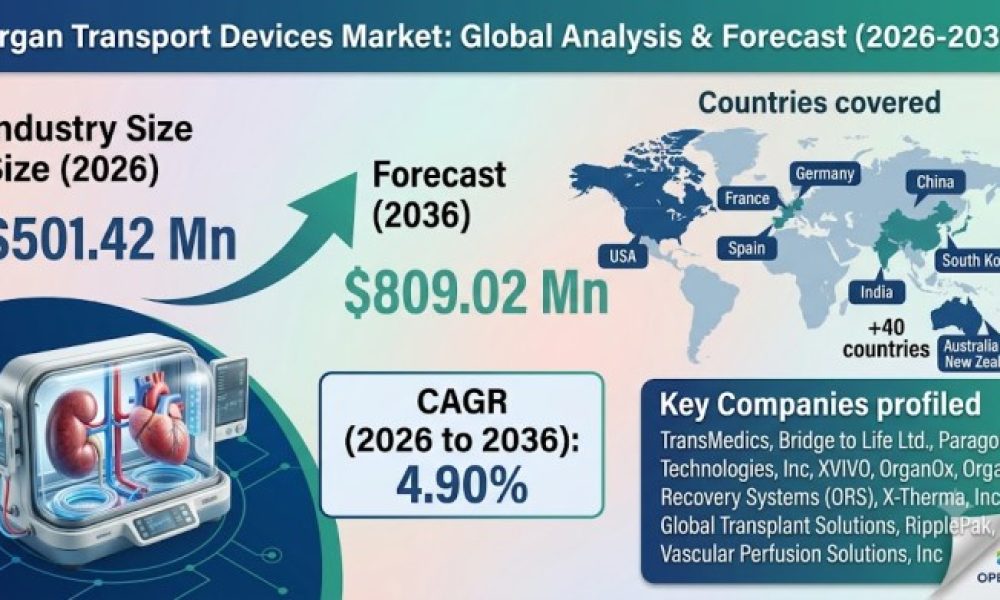
Newark, Del. — The global organ transport devices market is projected to grow from USD 501.42 million in 2026 to USD 809.02 million by 2036, registering a compound annual growth rate (CAGR) of 4.9%, according to Future Market Insights (FMI). The market was valued at USD 478.0 million in 2025.
As transplant programs coordinate organ recovery and recipient care across wider geographic areas, healthcare providers need transport systems that maintain appropriate preservation conditions throughout transit. Devices that support temperature control, cold storage and machine perfusion are expected to remain central to this market.
FMI estimates that devices will account for 51.3% of product demand in 2026, while kidney transport will represent 34.6% of organ-based demand. Hospitals are projected to account for 66.8% of the market by end user, reflecting their central role in transplant coordination and clinical care.
👉 Get Detailed Market Forecasts, Competitive Benchmarking, and Pricing Trends:
https://www.futuremarketinsights.com/reports/sample/rep-gb-15180
Why the Organ Transport Devices Market Is Growing
Organ transplantation depends on preserving donated organs between procurement and implantation. Transport conditions, timing and handling can influence organ quality, making reliable preservation systems an essential part of transplant logistics.
Traditional cold-storage methods remain important, while machine perfusion technologies provide alternatives for selected organs and clinical situations. These systems can circulate preservation fluid and, depending on the technology, maintain organs under controlled temperature conditions during transport.
The expansion of organ-sharing networks also increases the importance of transport coordination. Tracking systems, validated containers and portable perfusion equipment can help transplant teams monitor shipments and manage complex transfers between donor and recipient facilities.
For device manufacturers, the opportunity lies in developing systems that combine dependable preservation performance with practical handling, clear monitoring and compatibility with established transplant workflows.
Where Growth Is Fastest
FMI’s country-level forecasts indicate that Spain and several Asian markets will grow faster than the overall global market during 2026–2036.
- Spain — 8.6% CAGR: Established organ donation and procurement coordination are expected to support demand for reliable transport systems.
- China — 7.9% CAGR: Continued development of transplant infrastructure and specialist hospital capacity is projected to support expansion.
- South Korea — 7.5% CAGR: Investment in transplant services and preservation technology is expected to contribute to growth.
- India — 7.4% CAGR: A large patient population requiring transplantation and the need to move organs across substantial distances are expected to support demand.
- France — 6.3% CAGR: Established transplant services are projected to support continued adoption.
- Germany — 5.5% CAGR: A structured organ procurement and allocation system supports demand for dependable transport equipment.
- Australia and New Zealand — 5.1% CAGR: Geographic distances between donor and recipient facilities make reliable organ preservation and transport important.
- United States — 4.7% CAGR: High transplant activity and established transplant networks are expected to sustain demand.
What Leads the Market
FMI’s 2026 estimates identify three leading segments:
- Devices — 51.3% of product demand: Transport devices, including specialized containers and portable preservation systems, support organ handling and protection during transit.
- Kidney transport — 34.6% of organ-based demand: Kidney transplantation represents the largest organ category in the report’s market segmentation.
- Hospitals — 66.8% of end-user demand: Hospitals remain central to transplant procedures, specialist teams and coordination between procurement and recipient care.
These figures refer to separate segmentation categories and should not be combined. Each describes a different dimension of the market.
👉 Access the Complete Report in PDF Format:
https://www.futuremarketinsights.com/reports/brochure/rep-gb-15180
The Hurdle: Preservation Performance and Logistics
Organ transport devices must maintain the required conditions throughout the journey while allowing clinical teams to handle and monitor the organ safely. Temperature stability, device reliability, transport duration and compatibility with the relevant preservation protocol all influence purchasing decisions.
Advanced perfusion systems can also require additional equipment, staff training and operational support. These requirements may create adoption barriers for facilities with limited budgets or lower transplant volumes.
Manufacturers therefore need to demonstrate the practical value of their systems alongside preservation performance. Procurement teams may weigh equipment costs, consumables, servicing, portability and training requirements when evaluating different solutions.
Industry Investment and Competitive Developments
The competitive market includes manufacturers of portable perfusion systems, cold-storage solutions, transport containers and related preservation technologies. FMI identifies the following companies among the participants in the sector:
- TransMedics
- XVIVO
- Organ Recovery Systems
- Bridge to Life Ltd.
- Paragonix Technologies
- OrganOx
- X-Therma
- Global Transplant Solutions
- RipplePak
- Vascular Perfusion Solutions
The market includes both established device suppliers and specialized companies focused on particular preservation methods or transport needs. Competition is expected to depend on device reliability, clinical validation, workflow integration and the ability to serve transplant centers across different regions.
FMI’s market analysis highlights temperature control, GPS-enabled tracking and portable perfusion designs as areas of interest as transplant networks coordinate organ movement across longer distances.
Analyst Perspective
Anurag Sharma, Principal Consultant for Healthcare at Future Market Insights, said: “The organ transport devices market is likely to shift toward standardized cold chain and perfusion-enabled transport systems. Device makers with reliable temperature control, GPS tracking and portable perfusion designs are expected to gain preference as transplant networks extend donor matching distances.”
What This Means for Device Manufacturers and Transplant Centers
For manufacturers, the forecast points to opportunities in dependable cold-chain equipment, portable perfusion systems and transport-monitoring capabilities. Products that fit existing clinical protocols and provide clear operational benefits may be better positioned to gain adoption.
For transplant centers and procurement organizations, device selection involves more than the initial purchase price. Buyers need to assess preservation requirements by organ type, transport distance, monitoring capabilities, consumable costs and staff training needs.
As organ-sharing networks develop, the ability to preserve organs consistently during transit will remain a key consideration. The projected increase in market value reflects demand for specialized transport solutions, although adoption will continue to depend on clinical requirements, budgets and the performance of individual technologies.
Read the full report: https://www.futuremarketinsights.com/reports/organ-transport-devices-market
Report Scope
Future Market Insights’ Organ Transport Devices Market report covers the 2026–2036 forecast period and analyzes the market by:
- Product: Devices, disposables, cold storage solutions, perfusion solutions and slush preparation solutions.
- Organ: Kidney, heart, lung, liver, pancreas and small bowel/intestine.
- End user: Hospitals, transplant centers and organ procurement organizations.
- Regions: North America, Latin America, Europe, East Asia, South Asia, Oceania, and the Middle East and Africa.
About Future Market Insights
Future Market Insights, Inc. (FMI) is an ESOMAR-certified market research and consulting firm headquartered in Delaware, USA, with offices in the United Kingdom, the United Arab Emirates and India. FMI delivers syndicated and custom research across food and beverage, healthcare, chemicals, technology, packaging, consumer goods and industrial sectors.
Media Contact
Future Market Insights, Inc.
Phone: +1-347-918-3531



